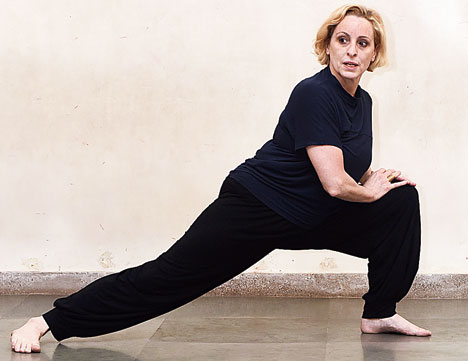

Pictures: B. Halder
Who: Janis Claxton
Age: 53
She is: Artistic director of Janis Claxton Dance, a contemporary dance company based in Edinburgh
Looks up to: Erick Hawkins
Her style: Contact improvisation and martial arts
Awards: Creative Edinburgh Collaboration Award (2016) and Bank of Scotland Herald Angel Award
Known for: Her dance project POP-UP Duets (fragments of love), presented as part of the 2016 Made in Scotland Showcase at the National Museum of Scotland
Edinburgh-based award-winning choreographer Janis Claxton is in town to train dancers at a two-week workshop for a series of performances to be held as part of the first season of Pickle Factory, a city-based festival to celebrate all things dance. The Australian dancer is revisiting and reimagining her critically acclaimed work, POP-UP Duets (fragments of love), to arrive at a spontaneous process of dance in a public space, starting on February 21 at Jadavpur University. t2 caught up with Claxton during the workshop at Ranan, a performing arts group with a studio in Tollygunge.
Tell us how you are training the six dancers for the Pickle Factory festival...
I have a piece of work called POP-UP Duets (fragments of love), which are five-minute love-duets for public spaces. From this work that Vikram Iyengar of Pickle Factory had seen, he asked me to come to India to explore some of the processes we use for POP-UP Duets. So we are using the process of this work, which is work about dance in public spaces, and calling it DIPS — dance in public spaces. We are going into the street with a variety of improvisational processes to find out how people react when they see contemporary dance and it will all be in duet form. It’s new for everyone because a lot of the classical Indian dances are in the solo form.
What kind of an experience can the audience look forward to?
What we are doing is bringing dance into the public realm. It’s not a performance. I am interested in the accidental audience. The idea is that two dancers will be working, sitting together in a park or drinking tea or something and they will start to interact, like they’re having a conversation. The conversation will evolve and it turns into a dance, almost magically, we hope. So the audience will accidentally see what’s happening and will realise it’s a dance and then it finishes. It’s more like a performance that emerges out of the public situation, where there are dancers and other situations, all mixed up together.
What is the kind of improvisation that you’re leaving room for in a public-space performance such as this?
I am teaching the dancers a partnering technique, which involves a lot of different, really specific rules and processes and guidelines. We have different rules that you can use and within that, they improvise and they make music with their bodies — be it with a rhythmic variation or some kind of emotional story that evolves or a sculptural shape — all different elements of dance. But they have really strict rules but the rules change second by second.
What are some of the techniques of dance that you use? Who are your influences?
I have studied a lot of different techniques. I draw from a specific branch of contemporary dance technique and then I also studied a lot of Chinese kung fu, so I have a big influence of martial arts and I have studied various kinds of alignment techniques and body-knowledge techniques.
Another thing I am influenced by is Contact Improvisation technique. We don’t call my technique anything because we don’t do that as much in the West. Possibly my main influence is American dancer Erick Hawkins, who is probably more famous in some parts of the world as Martha Graham’s (stalwart of modern dance) husband. Steve Paxton is the main founder of Contact Improvisation, though it’s a very open-source technique, much like most of my work. The thread for me is health and well-being and truth and honesty and clarity in the expression of dance. For me, dance was therapy as I had a very difficult childhood and dance kept me alive. So I spent many, many years creating lots of different workshops and classes for lots of different people.

What is Contact Improvisation?
It is a dance form that started in the ’70s with a bunch of contemporary dancers. It was New York and they were a bit bonkers and decided to see what would happen if they threw themselves at each other. They started doing this dance where they would run and jump on each other and fall. Then they thought they needed some mats because they could hurt themselves otherwise.
It started off with Steve Paxton, Nancy Stark Smith and a few others. They started breaking bones and thought how could they use more fluidity to work together. So the essence of Contact Improvisation is that two dancers follow a rolling point of contact at each other’s body and then there’re all sorts of techniques you learn — how to take weight, how to take your partner’s weight up on your shoulders. And it is very much about equality, so it’s not just about the man lifting the woman but the woman can take the man on her shoulders. It’s become this open-source, incredible art form that is there everywhere in the world and people keep developing and adding to it in their own ways.
Tell us about your award-winning dance company.
Janis Claxton Dance company is a project-based dance company, so we work when we get funding. At the moment, we have a big funding for POP-UP Duets to do an international tour. And then after that, I have to get back to writing applications for more funding, which I don’t want to think about! It is difficult these days to get a situation that is full-time. But because we are project-based, it gives me the freedom to come and do things like this.
How does one transcend funding obstacles and continue pursuing the arts?
Artistes will always do stuff and then there will be a time when an artiste can’t keep doing it because of circumstances. We have lots of funding in Scotland and despite that, we think it’s not enough. But here, I am seeing that one dancer is a doctor, one is a model and others are doing all sorts of jobs because there’s not enough funding. It’s amazing because artistes still dance and make it happen because we have to. So all I know about the future of dance is that we will make it happen because we have to.
I tried to quit for two years but couldn’t. I got physically ill, so my body and spirit wouldn’t let me quit. When you find your purpose, even if it doesn’t pay, you don’t have a choice.
Anannya Sarkar