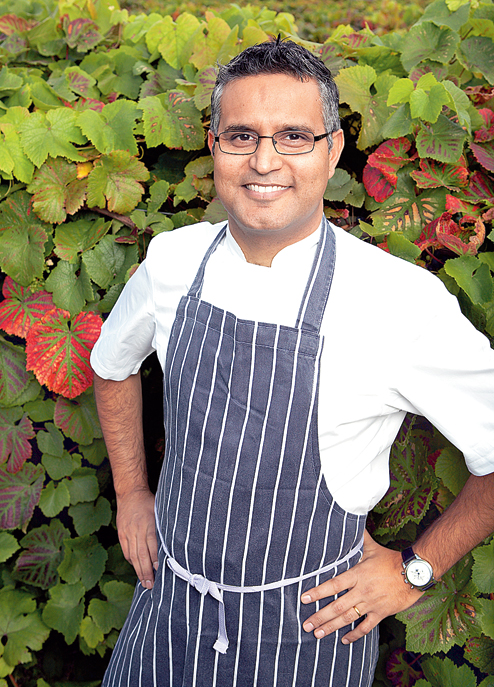

It’s one of the funniest things that has ever happened to Chef Atul Kochhar. In 2001, the chef had made a huge leap forward into the big league by winning his first Michelin star and he called his father to proudly tell him about it. “I called up my dad, very excited, and said, ‘Dad, I got a Michelin star.’ He congratulated me. Then, after a small pause he added, ‘That’s great, but what’s that?’”
Kochhar is at the top of the pecking order in the international culinary world — he won his second Michelin star in 2007 and is variously described by the global press as “the grandmaster of spice” and “more magician than mere cook”.

He’s now making a bold entry into the Indian dining scene. Not only is the celebrity chef rustling up a unique spread for Indians through his flagship property called NRI (Not Really Indian) at Mumbai’s Bandra-Kurla Complex (BKC), but he’s also set to launch his Latin tapas bar called Lima, right next to NRI. NRI is slated to open its doors to Mumbai diners later this month and Lima will launch in January. What’s more, the chef also opened an outpost of his much-acclaimed London restaurant, Benares, in Madrid just two months ago.
The chef, who’s back cooking in India after a gap of 22 years, is excited about NRI. “I never wanted to come back and cook Indian food. My aim is to serve Indian diners culinary fare that will be really close to the original recipes of the Indian diaspora,” says Kochhar, who’s received rave reviews globally for his innovative, modern Indian cuisine.

It’s late afternoon and the bespectacled chef is seated in his sprawling office in a super-swank building in BKC. He’s in between meetings and despite his busy schedule, he’s happy to talk about NRI — a work-in-progress that’s a hive of activity. Dressed in a crisp, blue shirt with rolled-up sleeves, he leisurely stirs sugar into his coffee. A short distance away, giant glass windows look out onto the Bandra Worli Sea Link and the Taj Lands End hotel.
It’s a buzzing time for the chef, who’s been hailed across the world for doing “things to the taste buds that make them blush with lusty delight”. For starters, the London-based chef has been visiting places like Malaysia, Mauritius, Durban, the Caribbean islands and Kenya for his own TV cooking shows and also to research the cuisines of the Indian communities settled there. The end product of his travels has been the menu for NRI. “I feel it will be a great thing to bring their culture/cuisine and ethos back to the motherland,” says Kochhar.
So from a night out at NRI, expect everything — from Malaysia’s Roti Canai and Singapore’s Pepper Crab to East African Zeera Chicken and South African Bunny Chow and Bobotie. In addition, the chef is going to grow his own produce in Ganeshpuri outside Mumbai, with help from horticulturist Dr G.S. Iyengar. “I want my food to be pesticide-free,” says the 1969-born chef.

Kochhar’s signature scallops dish (below) is a huge hit

His way with spices has earned him fans both in India and abroad. Admirers say the chef has been instrumental in elevating the status of Indian cuisine internationally and has contributed in a big way to how the world sees Indian food today. “He has kept flavours of Indian food intact and yet refined its presentation in a way that’s acceptable to a foreign audience,” says leading restaurateur Riyaaz Amlani.
Kochhar, who comes from Jamshedpur, says he grew up in a family where food was always the central topic. With a grandfather who owned a bakery and a father who had a catering business, he says food was all around him.
By the time he grew up, he was totally besotted with the chemistry of food, its flavours and smells and he forged ahead to realise his culinary dream. He began his career in 1993, cooking at The Oberoi where he worked as a sous chef and supervised a team of 18.
But the master of spices had more ambitious plans. He left India at the end of 1994 to join Tamarind restaurant in London and during his tenure as head chef, he won his first Michelin star in 2001. Ask him what motivated him to seek greener pastures and pat comes the reply: “While I was living in India, the salaries which we used to get were horrendous. And I couldn’t live on that. I wanted a better lifestyle,” he says matter-of-factly.


Armed with a hands-on approach to cooking and a willingness to push the boundaries of his gastronomic repertoire, he helped fuel a craze for high-end Indian food through Tamarind in London. But culinary superstardom and glory were still eluding him.
Kochhar discovered the recipe for success three years after he landed in London, when his father decided to pay him a visit. He had cooked what he thought was a great meal for his father at his restaurant but Kochhar senior wasn’t happy. What the son didn’t know was that his father had explored all the local vegetable, fish and meat markets before he arrived for a meal at his son’s restaurant. “Unfortunately, this was something I had failed to do even after three years of staying there because I couldn’t be bothered,” he acknowledges.
He was seriously chastised: “Without mincing words, my father called me daft.” Kochhar was advised to adapt to his current landscape post-haste and pick up local produce for his culinary offerings.
Listening to his father helped him steer his cooking in a new direction. Kochhar started working with a fishmonger and even went out in a dinghy to sea to watch how the fishermen landed the fish. “I learnt how pH negative and pH positive soil affected various fruits,” he says.
As a result, his cuisine began to change because he started working with British produce in a big way. It was no coincidence that his father visited him in 1998 and he was awarded a Michelin star in 2001, he says.


He left Tamarind in 2002 and, in April 2003, opened Benares Restaurant & Bar, his first independent venture, which was named after the spiritual city, in London’s Mayfair. Kochhar says he went ahead and opened a restaurant because he wanted to be a businessman.
However, he was very clear in his head he’d never follow in the footsteps of chefs who opened restaurants, killed themselves over getting a Michelin star and forgot the business. “It’s a restaurant where I’ve never lost money,” he says. The icing on the cake was another Michelin star in 2007. The Michelin Guide 2016 has just come out and Benares has received the star for 10 years in a row. “We became the first Indian restaurant to hold it for 10 years consecutively,” he says.
Once Benares received widespread acclaim and became a certified hit, Kochhar slowly expanded his food empire and launched the restaurant, Indian Essence, in 2012 just outside London in Kent. “Indian Essence is an attempt to recreate the aura of the London curry houses,” he says. In addition, he has a fine dining restaurant in Dubai called Rang Mahal. Also part of his restaurant repertoire is Sindhu, in Marlow in England.
Kochhar has his finger in other pies too. The chef has collaborated with P&O cruises with an outlet of his restaurant Sindhu on board some of the company’s ships.
Kochhar also is driven by the need to seek inspiration from diverse cultures around the globe. The menu at his Latin tapas bar, Lima, will offer homage to the cuisines of Brazil, Peru and Mexico. He’s planning to surprise diners with exotic stuff like Ceviche (seafood fare that’s popular in the coastal regions of Latin America), Tiradito (a Peruvian raw fish dish), and some Nikkei cuisine (Japanese-influenced Peruvian cuisine). “We’ll be the first restaurant in the country to experiment with Peruvian food,” he says.
What’s a day like for the emperor of spices, given his fast-proliferating culinary empire? “It’s still a boys’ job to make breakfast at home,” says the chef, referring to himself and his nine-year-old son. His day starts at six in the morning, and he gets to work by 10am. Kochhar’s frenetic day is then punctuated with administrative work, cooking and serving people. “But I love to eat with my staff every day and we eat dinner between 5pm and 5:30 pm,” he says. The chef manages to call it a day only at 10pm.
Kochhar is moving at a fast clip and charting a bold path in business, and he is completely at home with new cultures across the world. He says firmly: “Food is the best language.”