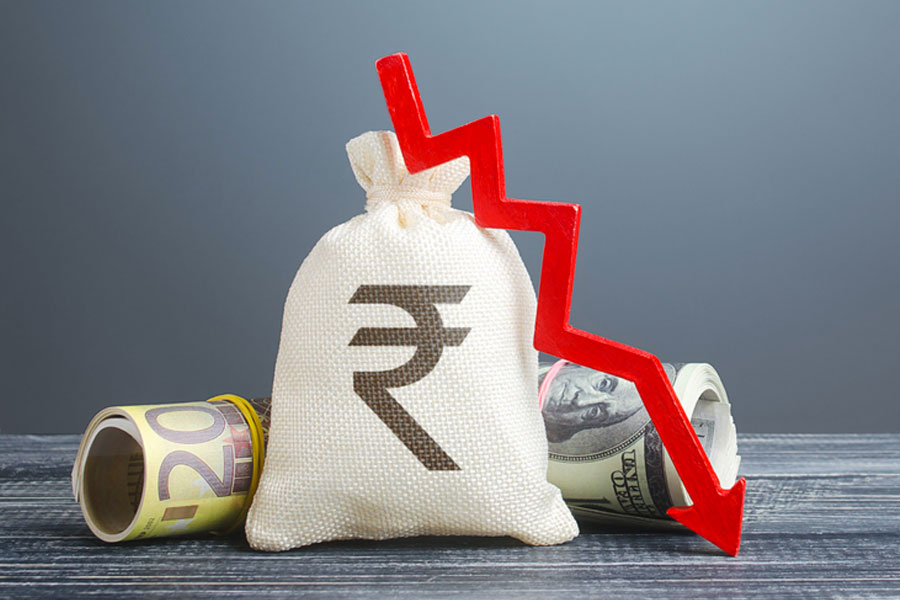
The rupee on Wednesday breached the 90-to-a-dollar mark for the first time, battered by uncertainty over the India-US trade deal, persistent foreign investment outflows and strong demand for the greenback from importers.
The Indian currency closed at a new low of 90.21, weakening 25 paise from Tuesday’s 89.96. The rupee has now fallen over 5 per cent in 2025, ranking among the poorest performers in Asia. While it took four years to slide from 70 to 80 per dollar, the plunge to 90 occurred in just a little over three years.
The Opposition seized on the rupee slide to criticise the Narendra Modi government’s management of the economy. Market experts warned that the currency may be headed for a prolonged period of weakness.
However, chief economic adviser V. Anantha Nageswaran maintained that the depreciation was not a concern.
Nageswaran asserted that inflation and exports remained unaffected and the rupee was expected to recover next year.
Congress spokesperson Supriya Shrinate took to X and said Prime Minister Modi appeared to be searching for his “lost prestige” in some deep pit, arguing that the rupee’s fall had become symbolic of the government’s policy failures.
“In 2014, he was handed the rupee at 58.86 against the dollar, and he has taken it beyond 90. Looks like he’s determined to score a century here as well,” she posted, adding that a weaker rupee would ultimately translate to a higher import bill and inevitably push consumer prices higher, especially of essentials such as fuel, vegetables and fruits.
Trinamool Congress leader Sagarika Ghose also weighed in, reminding Modi of his 2013 barbs against then Prime Minister Manmohan Singh when the rupee breached the 60-to-a-dollar mark. “Now as PM what should we say? Who is ‘mute’ now, Shri Modi? Or are you waiting for a century?” she posted, suggesting that Modi had lost the moral ground to criticise currency depreciation.
90 the new normal?
Market participants are beginning to accept that the rupee breaching the 90-mark may not be an aberration but a reset.
Currency traders said the domestic unit was likely to remain under pressure over the next few months, with analysts flagging selective intervention by the Reserve Bank of India. RBI governor Sanjay Malhotra had earlier said the central bank did not target an absolute exchange rate, insisting that market dynamics would determine the rupee’s trajectory.
Nilesh Shah, managing director of Kotak Mahindra AMC and a member of the Prime Minister’s Economic Advisory Council, said a gradual weakening of the rupee — about 2-3 per cent annually — was natural given the country’s productivity and inflation differentials. A permanently stronger rupee, he argued, was neither feasible nor desirable, especially from the standpoint of export competitiveness.
Anindya Banerjee, head of commodity and currency at Kotak Securities, attributed the currency’s fall to a triad of triggers — growing uncertainty over the Indo-US trade deal, which buoyed the dollar and hurt emerging market currencies; a wave of forced selling after stop-loss triggers were activated above 90; and sustained demand for dollars from importers in sectors such as oil, electronics and metals.
Foreign portfolio flows remain a drag, with foreign institutional investors (FIIs) selling equities worth ₹3,642.30 crore on Tuesday. The FIIs have so far taken out $17 billion from Indian equities. Brent crude hovered near $63 a barrel, aggravating concerns.
Analysts expect the rupee to trade between 89.50 and 91.20 in the near term. A rebound, they say, hinges on fresh capital inflows, policy clarity on global rate cuts and a revival in exports. Until then, the currency is likely to remain weak, albeit with occasional RBI intervention to curb volatility.