
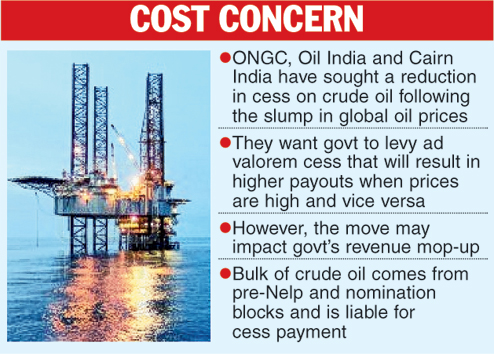

New Delhi, Oct. 11: The cess imposed on domestic crude production is likely to be reviewed as it hurts the revenues of exploration companies such as ONGC, Oil India and Cairn India following a slump in global crude prices.
Oil ministry sources said that they would soon discuss the matter with the finance ministry. The cess was increased when global crude prices had spiked to over $100 per barrel.
"While there is justification in the demand of the exploration firms to seek a relook at the cess, the government has to take a decision considering the issue holistically," a senior oil ministry official said.
However, the demand of the oil companies to switch to an ad valorem rate might not be feasible as it would adversely impact the government's revenue collection.
In ad valorem rate, the duty is linked to prices, meaning when prices rise tax collections are higher and they fall when prices are lower. Cess is now imposed on per-tonne basis and therefore not linked to prices.
"An ad valorem rate may not be acceptable to the finance ministry," the official said, adding that at an inter-ministerial meeting will take a call on the issue soon.
PetroFed, an association of oil companies, had recently written to revenue secretary Hasmukh Adhia and oil secretary K.D. Tripathi seeking the imposition of an 8 per cent cess on the price of crude oil realised (ad valorem duty).
According to the association, the current rate of cess constitutes about 20 per cent of the oil price and severely impacts the revenue of producers because operating and fixed costs do not fall in tandem with the decline in crude prices.
At present, ONGC and Oil India pay a cess of Rs 4,500 per tonne on the crude that they produce from fields offered to them on a nomination basis. Cairn has to pay the same cess for oil from the Rajasthan block.
"In 2005-06, when crude oil prices had increased from an average of $40 per barrel to $60 per barrel, cess was increased from Rs 1,800 to Rs 2,500 per tonne.Again, when crude oil prices increased to over $100 per barrel, the cess was increased to Rs 4,500 per tonne ($10 per barrel) with effect from March 17, 2012," PetroFed said.
According to the existing policy, cess is levied on crude produced from fields given on a nomination basis but not from blocks awarded under the New Exploration Licensing Policy (Nelp) such as Reliance Industries' KG-D6 block. The bulk of crude oil produced in the country comes from pre-Nelp and nomination blocks and is liable for cess payment.
Before seeking relief from the government, Cairn had initiated arbitration against the levy but had to drop it as part of the conditions laid down by the Centre to approve the company's takeover by the Vedanta group.