
New Delhi, June 9: The department of telecom is finalising spectrum sharing and trading rules to be sent for cabinet approval next week. The Telecom Commission, the DoT's highest decision making body, is meeting later this week to finalise the guidelines.
Officials said the guidelines "would be aimed at increasing spectrum use efficiency and enable companies to sell spectrum, thereby monetising an idle resource".
Analysts said it is also expected to boost competition and provide incentives for innovation to mobile operators.
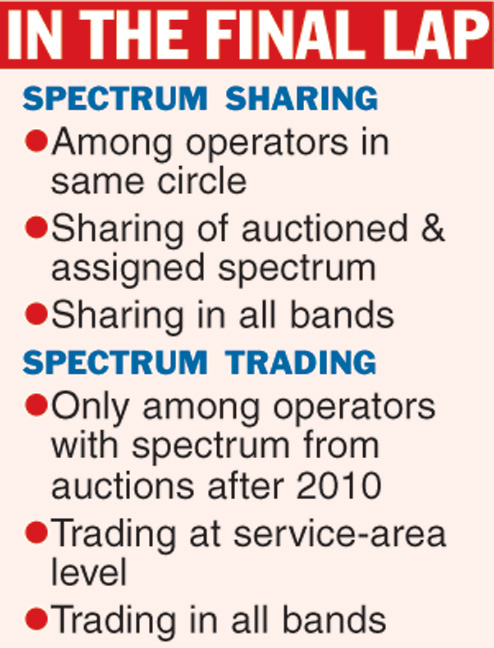
Spectrum sharing will allow telecom companies to share their unutilised airwaves with other service providers within the same telecom circle, while spectrum trading will allow a telecom firm to buy or sell radiowaves.
Once the guidelines for trading and sharing of radiowaves are finalised, "companies will be able to lower the cost of spectrum and operate more efficiently", added officials.
The telecom regulator has recommended the sharing of all categories of airwaves held by operators, including spectrum assigned without auction. It has also proposed that sharing can be done in all the bands - 800, 900, 1800, 2100, 2300 and 2500 MHz.
However, operators need to have spectrum in these bands in the given circle.
For trading in spectrum, Trai recommended it only for those operators who have purchased spectrum through auctions in 2010 and later. Moreover, trading will have to be at the service area level and airwaves in the 2G, 3G, 4G and CDMA bands should be allowed to be traded.
The government had earlier said it would allow sharing of auctioned spectrum, except that given in the high-speed 3G bands. Sharing of airwaves which were allocated at fixed prices was being considered after payment of a one-time charge, which was protested by companies such as Airtel and Vodafone.
"If any one or both of the licensees, sharing their spectrum, have administratively assigned spectrum (allocated without auction) in that band, then, after sharing, they will be permitted to provide only those services which can be provided through the administratively held spectrum," Trai had recommended.
At present, operators are allowed to share passive infrastructure such as mobile towers, which has helped them to reduce operational cost, but not active infrastructure such as spectrum. The need for a spectrum trading and sharing policy is a major demand of the companies.