Book: GLORIOUS FAILURE: THE FORGOTTEN HISTORY OF FRENCH IMPERIALISM IN INDIA
Author: Robert Ivermee
Published by: Context
Price: Rs 699
The French were latecomers to India but were by no means indifferent to the promise of power and aggrandisement. However, our recall of French power has remained limited. Most of us who grew up with the story of Robert Clive’s exploits and French failure did not really appreciate the extent and the ramifications of French colonial and imperial ambitions even though there were some classic works like those by S.P. Sen on the French in India. More recently, there has been a renewed interest in French power and presence in settlements like Chandernagore and Pondicherry where relations among French officials, the Jesuit Mission and local commercial intermediaries have been subject to scholarly investigation. Robert Ivermee’s monograph is a valuable addition to the existing scholarship on French presence and power and is more than simply a synthesised account of the operations of the cumbersome French Eastm India Company, the private trade of its officials, and its transactions with and against local power holders.
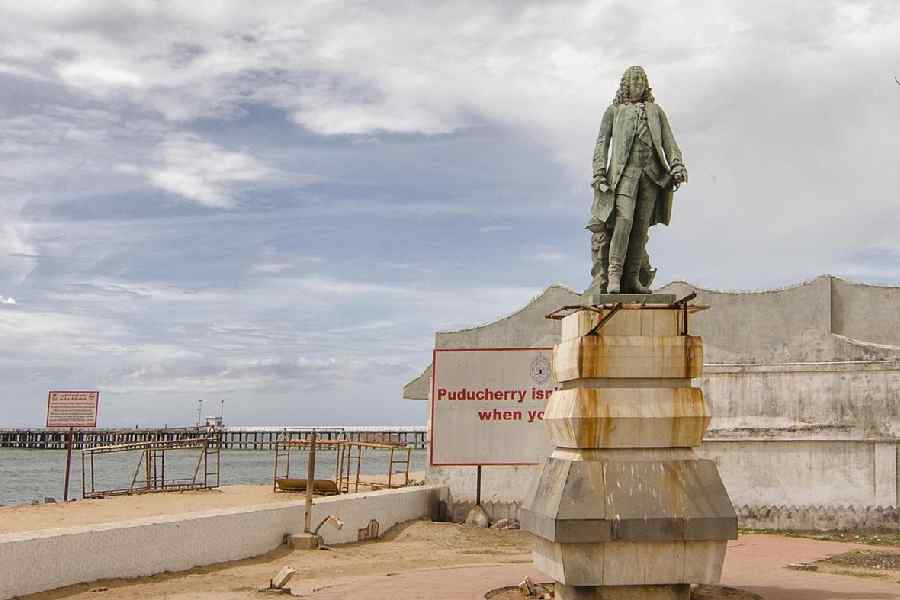
The subtitle, “The Forgotten History of French Imperialism in India”, is telling for it makes two important points: one, the French presence in the subcontinent was anything but benign and, two, French professions of revolutionary ideas of liberty and equality were more rhetorical than substantive. In some ways, the critique resembles the arguments about the lie of British liberalism and the empire of free trade. This book is written lucidly, dips generously into both archival and official material as well as the diary of Ananda Ranga Pillai to eloquently describe the mood swings and tempers of men like Dupleix (picture) or Commander Bussy. It is narrative history at its best, tracking the history of a trading company in a settlement like Pondicherry in the early 18th century when ignorance and arrogance along with conflicts between agencies, such as the French administration and the Jesuit Mission, combined to produce political situations that went out of control. We have thus an excellent description of the Nayiniyappa Pillai scandal of 1715, when Pillai, the chief broker of the Company, was shamed, whipped and removed from office largely under the
pressure of the Jesuits who conspired with an ambitious governor to get Pillai incarcerated and replaced by a Tamil Christian broker. The author describes the scandal as one of the worst instances of French bigotry which it undoubtedly was.
Where the book excels is its treatment of the reception of the French Revolution in the Indian settlements and the ways in which the aspirations of the subject peoples were summarily dismissed. Ivermee refers to the Declaration of the Rights of Man and of the Citizen, the application of which was not envisaged to be universal. Not only were there issues of distinguishing active (property owners with the vote) from passive citizens (without the vote) like in France, but there was also the additional caveat of not wishing to extend freedom to those men who were different in terms of colour, religion, language and status. Tamils and mixed-race men were excluded from any form of representation. Indians were not seen as ready for freedom given their deference to caste conventions. The only constitutional concession that was given was allowing four representatives of the Tamil community to attend meetings of the Assembly when their issues were involved. Ivermee points out how at every point, new exceptions to the principles of liberty were invented in order to ensure exclusion.
The development of the Revolutionary wars impacted Indian states and British power in India. There were instances of princely states like Mysore approaching the French for support in its war against the English. French aid was not forthcoming and what followed was the defeat of Tipu Sultan and the eventual mastery of the British in India. This included attacks on French settlements. In May 1814, the Treaty of Paris was concluded which signalled the end of the French Empire in India. The terms of peace involved the restitution of older settlements but with some caveats like, for instance, a ban on the dispatch of troops to India.
The book ends with a brief description of the afterlives of French imperialism. India did not vanish from the French imagination; there were consistent references to Indian cultural ideas, practices and symbols in popular culture as well as in institutionalised knowledge. The nineteenth century was an important period for the articulation of sociological knowledge about India. On the other end of the spectrum, by the twentieth century, as the clamour for Indian nationalism grew strident, non-British settlements were seen as sanctuaries. The situation changed when France could no longer ignore the assertion of Indian sovereignty. It considered some provisions for extending citizenship to Indians, albeit limited. This resulted in several Indians leaving for France. Those who remained stood as testimony to a mixed and shared history, the residual elements of which still remain visible in the old settlements of Chandernagore and Pondicherry.
The book is wonderful, written with clarity and has an excellent narrative quality. The images of French India come out vividly, reminding readers of the complex history of inter-imperial negotiations and multiple processes of decolonisation in the same space.