 |
 |
 |
 |
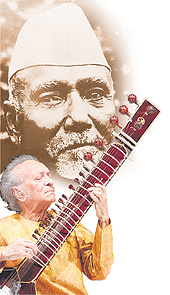
| FAMILY PLOT: From top: Ravi Shankar married his guru Allauddin Khan’s daughter Annapurna Devi; Mallika Sarabhai with her mother Mrinalini; P.C. Sorcar (Jr) and his family |
P.C. Sorcar (Junior) says the box-room of his Ballygunge residence in Calcutta is home to hundreds of them. Neatly shielded by their ancient jackets, they lie coated in dust, undisturbed for years. Family secrets is what Sorcar chooses to call these manuscripts, which hold the key to the magic tricks that the family has been renowned for through several generations. “No one from the outside world has seen them yet,” says the magician.
The Sorcars aren’t the only family who happen to be sitting on centuries-old wisdom, guarding them from the outside world for the benefit of their own progeny who might want to exploit them in the future. But in throwing them open for public scrutiny — much of the syllabus at Sorcar’s proposed University of Magic is to derive from these manuals — the legendary magician might be one of the few artistes to place the spirit of art above familial obligations. For in domains where the guru-shishya mode still prevails, knowledge is often known to selectively percolate down to students. And if critics are to be believed, artistic genes are not the only thing that some fathers exclusively pass on to their sons, and occasionally, their daughters.
The artists’ world is full of stories of how famous musicians keep the secrets of their art only for their offspring. Dancers, magicians, and even chefs are known to push talented students out of the charmed circle.
A book on four generations of classical singers — dealing with author Namita Devidayal’s relationship with her guru, Dhondutai, who was trained by Kesarbai Kerkar, whose teacher was the legendary Alladiya Khan — has revived the old debate. Devidayal writes in The Music Room, launched on Saturday: “The gharana is not just a stylistic orientation, but also a repository of ragas and compositions, regarded almost as immovable property and must be kept in safe custody the same way a wealthy matron would safeguard her jewels. Just as a direct heir has the right to inherit family wealth, so this intangible wealth was kept only for the blood relatives of the founder — that too, usually for the male.”
Singer and researcher Ulhas Kashalkar points out that there was a time when Muslim ustads would not let Hindu students into the finer points of their art. “Subsequently, there came a time when each guru would teach a few stock bandishes of a raga to his students while reserving the more complex and special compositions of the same raga for his own sons,” says Kashalkar. “Somewhere down the line, filial or religious bonds seemed to rule over the spirit of the art itself,” he observes.
But if that was in the past, how do things fare in the present? Namita Devidayal offers her own take on the issue. The flow of knowledge from a guru to a disciple, she holds, is facilitated by the love and trust that exists between the two. “But while it takes time for an ordinary disciple to grow a strong emotional bond with the guru, a child only develops the relation more naturally. To an extent, this natural bonding might tend to make some gurus biased towards their children,” says Devidayal.
Another reason for bias, say critics, is the tendency to view gharanas as fiefdoms. “In reality, classical music is seen to be better propagated through disciples than parental lineage,” says music aficionado and consultant S. Kalidas, citing everyone from Bhimsen Joshi to Krishnarao Pandit to Kesarbai as examples. “Disciples tend to learn more diligently and have been seen to preserve the stylistics and repertoire of a gharana far better than familial lines which often produce musical illiterates today,” he says.
An interesting reverse example of this trend can be found in the 2005 book An Unheard Melody, where writer Swapan Bandyopadhyay speculates that Annapurna Devi, the Surbahar-playing daughter of Ustad Allauddin Khan and the first wife of sitar maestro Ravi Shankar, was perhaps so talented that her husband forced her to bow out from the world of music. But there is another school of thought which holds that the only way Ravi Shankar could have learnt the secrets of his guru’s art was by marrying his daughter and joining the family.
Of course, not everyone agrees that sharing filial bonds with the ‘family’ has anything to do with an exponent’s making it on his or her own terms. “Being a child of an artiste is advantageous in a few ways, in that the parents know both the glamour and the clamour of the job and can prepare children for both,” says dancer Mallika Sarabhai. “Besides, the environment in the house is more open and encouraging, and you get immersed in the art and its peripheries in conversations and preparations happening around you.”
But that, say many, is not enough to see one through. Kuchipudi exponent Raja Reddy echoes Sarabhai’s views, while stressing natural talent. “None of my guru’s sons became dancers themselves,” says Reddy. “They preferred to pursue public sector careers, since they didn’t have dance in their veins. And when I conduct classes today, talent is what I always value above everything else. My students are all my children.”
In fact, Reddy says he doesn’t allow his elder daughter to play the glamorous part of Krishna, simply because she isn’t fit for it. “Somewhere, a guru has to respect his art more than his weakness for his children,” he says.
Kashalkar can only agree. “It all boils down to the bond between the guru and the disciple,” he says. “The deeper the bond, the better knowledge travels from one generation to another.”