 |
 |
 |
 |
| DOG DAYS IN BANGALORE ( from top): A street dog being dragged with a metal wire and loaded on to a truck; the killings in Mandya; stray dogs stare out of their cramped cages |
| Strays in Metros Calcutta 60,000 Bangalore 70,000 Delhi 500,000 |
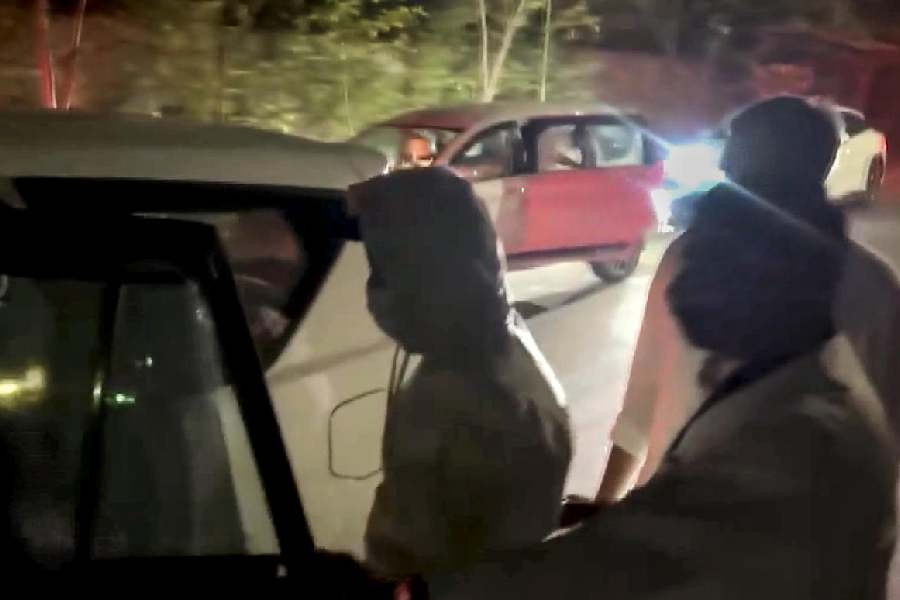
The tip-off came late last Sunday night. “A friend called to inform us that dogs were being captured and killed in Mandya,” says Savitha Nagabhushan, a Bangalore-based animal activist. The rest of the night was spent arranging for a video camera, tapes and a taxi. Nagabhushan left for Mandya — a small town 120 km south of Bangalore — with two colleagues at dawn the next day.
In Mandya, the trio roamed the town searching for municipal trucks carrying dogs. “We finally spotted a truck standing in an isolated by-lane. It was loaded with dead dogs,” recalls Nagabhushan.
Nagabhushan posed as a canine-hater and asked the municipal workers if she could see how the dogs were caught and killed. The activists were stunned by what they saw. “The dogs were caught with a metal wire. Then cyanide was injected into their stomach or heart, depending on how much the dogs resisted,” says Nagabhushan. No attempt was made to find out if the dog was ferocious or friendly. “The dog-catcher said he was paid per dog corpse he brought,” says Nagabhushan.
Back in Bangalore, the sting operation’s video tapes created an uproar. Governor T.N. Chaturvedi demanded an explanation. Bangalore’s massive month-long dog hunt, launched by the city municipal body, the Bruhat Bangalore Mahanagara Palike (BBMP), was also called off indefinitely. But meanwhile, the movement against the culling of dogs had spread to other areas.
In Delhi, a rally was held at the India Gate on Friday, and mobile text messages are being sent to scores of people, urging them to join the movement against the culling. “We have been told that the Delhi government may do something similar to ‘sanitise’ the city before the 2010 Commonwealth Games,” says one activist who has been spending sleepless nights in Delhi, mustering opposition to the Karnataka action.
Mandya’s canine-killing drive was the outcome of a mass anti-dog hysteria that spread across Karnataka in the last month. In January this year, an eight-year-old girl was killed by a pack of dogs when she was playing outside her house in Bangalore’s Chandra Layout locality. The incident sent ripples of terror across the city.
A repeat killing happened within a month. In February, a four-year-old boy was mauled to death by some 15 dogs while he was playing hide-and-seek with friends in an open ground near his BEML Colony house. Suddenly, dogs became man’s worst enemy in Bangalore .
When the blame game began, the city municipal corporation came in the line of fire. Under pressure to do something, the BBMP began to randomly round up dogs across the city. Many were killed. “In five days, starting February 3, the BBMP caught 1,297 dogs. Of these, 229 ferocious dogs were put to sleep,” says L.T. Gayathri, chief health officer, BBMP. The municipal body also set up a dog helpline, which has received 2,000 calls reporting cases of dog menace so far.
BBMP’s ‘Operation dog-hunt’ left animal activists horrified. “Metal wires were used to catch dogs. This caused injuries to the animals. The dogs were packed into small, claustrophobic cages. They were kept without food at times,” says R.M. Kharb, chairman, Animal Welfare Board of India (AWBI). The AWBI threatened to sue the BBMP commissioner, K. Jairaj.
Kharb says the BBMP’s dog-catching drive was a knee-jerk reaction to two deaths. “Randomly rounding up and killing stray canines was only a way to control the dog-hate hysteria building across Karnataka. Nobody got to the bottom of the problem,” says Kharb.
The stray dog population of Bangalore was estimated to be 56,000, according to a Karnataka animal husbandry department survey conducted in 2003. “This has probably gone up to 70,000, due to the growth in size and human habitation of the city,” says Suparna Ganguly, vice president, Compassion Unlimited Plus Action (CUPA), a city-based animal welfare NGO. In comparison, Delhi has a stray dog population of five lakh, Mumbai two lakh and Calcutta has 60,000 street dogs.
But Bangalore’s sudden growth has seen an overall infrastructure collapse in the city. Till November last year, the city had no garbage landfill sites. Moreover, Bangalore’s garbage generation increased from 840 gm per capita in 1994 to 2.4 kg per capita in 2006. “The city has no solid waste management policy. Garbage is dumped on empty land, in lakes and along highways,” says Kharb. Stray dogs thrive on garbage. “They get a steady supply of food there and then breed and form packs,” says Kharb. And animals moving in packs can get aggressive.
Kharb believes India is paying the price for not implementing the decade-and-a-half-old World Health Organisation (WHO)-prescribed dog control guidelines. The guidelines — published by the WHO in 1990, along with the World Society for Protection of Animals — say that killing of stray dogs has never worked to control canine population. “The twin solutions prescribed are an aggressive animal birth control (ABC) programme and solid waste management,” says Kharb.
The animal birth control programme was launched in Bangalore in 2003, but only in areas under the BBMP. “The colonies where the two children were killed by stray dogs lie outside the jurisdiction of the city municipal corporation. The ABC programme was not operational here,” says BBMP health officer Gayathri.
But dogs don’t recognise municipal boundaries. “There’s no point controlling the dog population in one area and letting them thrive in the neighbourhood. If you remove dogs from territory A, the ones from territory B will move in,” says Hiranmay Karlekar, consultant editor, The Pioneer, New Delhi, and an animal enthusiast.
But with no immediate solutions in sight, the conflict continues. The activists are out on the streets. But Bangalore’s municipal body, clearly, doesn’t believe in letting sleeping dogs lie.