Sundaram Tagore and the art of the matter

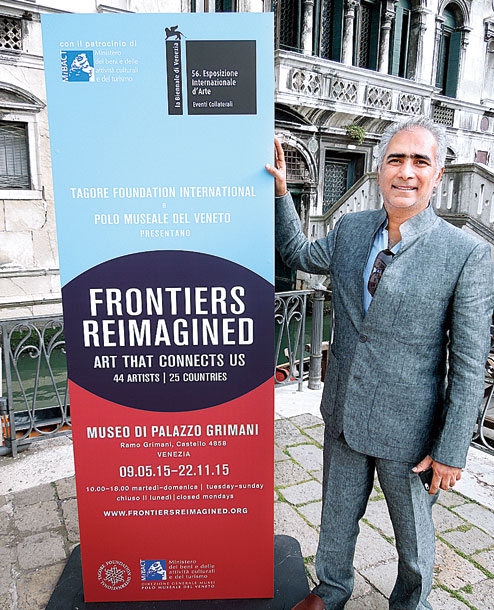
What next for Sundaram Tagore? Since I will be writing separately about Frontiers Reimagined, the exhibition Sundaram has curated at the Venice Biennale with co-curator Marius Kwint, I will focus instead on the man and his mission.
Mine is not the only opinion that Frontiers Reimagined is one of the best things at the Biennale this year.
Sundaram, who has galleries in New York, Singapore and Hong Kong (where he has been living for the last few years with his wife and daughter), travels the world in an attempt to discover what he considers the best in contemporary art.
The point is that Sundaram wants passionately to do something for Calcutta, the city where he was born in 1961 into the Tagore family, which he finds both a help and a hindrance.
Basically, he thinks Calcutta should have a Biennale, along the lines of the one in Venice. Of course, the latter has been going since 1895. However, Sundaram, who won a scholarship to study in Venice in 1989, has been coming to the city since then and has contacts all over the world when it comes to the arts. He agrees Bengal has an arts tradition that makes Calcutta an ideal location for a Biennale.
So, perhaps the time has come to appoint him cultural ambassador for Calcutta with a brief to begin a Biennale.
To be sure, Calcutta does not have canals and bridges but it is near water and there is something about its narrow lanes and by-lanes which are reminiscent of Venice.
"This could be Bagbazar," he quipped, as we walked down a lane in Venice last week.
Lost in Venice

It is easy to get lost in Venice but locals show infinite patience in helping foreigners.
One night what should have been a 40-minute walk ended up taking another hour. The young man who then spent 40 minutes escorting me to my Hotel Boscolo introduced himself as Geri Della Rocca de Candal, an Italian who was over from Oxford.
He was a research scholar based at Lincoln College doing renaissance history with a focus on printing - and yes, Venice had an early history in printing, long before William Caxton (1415-1492) in England.
Another evening a girl in her 20s, an art student who was a perfect stranger, volunteered to guide me part of the way.
And then at one of Sundaram Tagore's parties, I was introduced to another Italian student, Gianni Dubbini, who was doing a PhD on "European representation in Indian art" in the 17th and 18th centuries, with a focus on Venice's links with India.
Did Venice really have links with India?
"Oh, lots, going back Marco Polo," replied Gianni.
Sooner or later, all conversation goes back to the Venetian merchant traveller (1254-1354).
(At St. Xavier's in Patna, if asked about Marco Polo, some boy would undoubtedly have replied, "He was named after the airport in Venice, Father.")
Gianni, who is based at Ca' Foscari University of Venice, mentioned Niccolao Manucci (1639-1717), an Italian writer and traveller who worked in the Mughal court of Dara Shikoh.
By and by, Gianni's PhD and possibly his book will reveal the mystery of another Venetian "who lived for several years in Calcutta".
Love story

Several Indians are milling around at an exhibition, just off Piazza San Marco, devoted to the works of Sebastião Salgado, the world famous Brazilian photographer whom I have long admired.
When I get to meet him, he says he might have an exhibition in Delhi. I urge him to hold it in Calcutta instead.
Also at the party is the New York-based actress Devika Bhise, who has been cast opposite Dev Patel as Janaki, wife of the mathematical genius Srinivasa Ramanujan in the Matt Brown directed film, The Man Who Knew Infinity .
Devika is with her father, Bharat, and mother, Swati, who tells me the film will get its first market screening in Cannes on May 15.
Swati, who is the film's India distributor, says she acted as a cultural adviser in the film, which is partly about Ramanujan's relationship with the Trinity College mathematician G.H. Hardy (played by Jeremy Irons). But it has also been turned into a love story between Ramanujan and his wife.
Swati, who teaches Bharatnatyam, has come up with the notion that Ramanujan's ideas on mathematics were influenced by the taal - the beat - he heard coming from a nearby temple.
I recall an interview with Amartya Sen when he was appointed Master of Trinity in 1998. He had pointed out the room Ramanujan had occupied.
When I mentioned Ramanujan's own explanation that his south Indian God would appear in a dream and give tips on his number theories, Prof. Sen's reaction was scornful: "Rubbish."
But personally, I don't entirely discount the dreams.
Deep meaning
There are 90 national pavilions at the Venice Biennale, which is considered the premier global exhibition for contemporary art.
It's my ignorance that a long line of imperial-type statues in the Giardini, the sprawling gardens where many of the pavilions are located, is attributed to a Raqs Media Collective from Delhi.
The artists were named as Monica Narula, Jeebesh Bagchi and Shuddabrata Sengupta.
Each of the statues has an inscription but what do they mean?
For example: "He wore a mask, and his face grew to fit it."
Now my turn to be mysterious: "If you think it's art, it's not for the Venice Biennale."
India should certainly get a permanent pavilion - as Russia, the US, Great Britain and China do.
Making movies
Like Calcutta, Venice inspires movies.
Over dinner, Sundaram Tagore, his friend from New York, Gautam Patwa, and other guests come up with the following: The Talented Mr Ripley (1999), starring Matt Damon, Gwyneth Paltrow and Jude Law; Don't Look Now (1973), with Julie Christie and Donald Sutherland; and The Tourist (2010), with Angelina Jolie and Johnny Depp.
My contribution is Luchino Visconti's Death in Venice (1971), in which Dirk Bogarde plays an old man who develops a troubling attraction for an adolescent boy.
At the Danieli Hotel, where the PR firm Erica Bolton & Jane Quinn, who are working for Sundaram, have their temporary Venice headquarters, films suggested include Fellini's Casanova (1971), which opens with a carnival in Venice; and Visconti's Senso (1954).
Shots of Palazzo Contarini Polignac on the Grand Canal in Venice are included in Brideshead Revisited (2008), adapted from Evelyn Waugh's book.
Someone reminds me that SMERSH agent Rosa Klebb "gets her kicks" in a Venice hotel in the James Bond movie, From Russia With Love (1963), starring Sean Connery.
There is a Venice sequence in the 11th Bond movie, Moonraker (1979), with Roger Moore as 007.
Bollywood credits include Do lafzon ki hai dil ki kahaani , shot on a gondola on the Grand Canal in the Amitabh Bachchan-Zeenat Aman starrer, The Great Gambler (1979); Kareena Kapoor and Akshay Kumar in St. Mark's Square in Kambakkht Ishq (2009); and Bachna Ae Haseeno (2008), with Ranbir Kapoor, Bipasha Basu and Deepika Padukone.
And one should not forget the many adaptations of Shakespeare's The Merchant of Venice .
Tittle tattle

Venice has another Indian, especially Calcutta, connection. No matter how elegant or beautiful a home or even a palazzo, residents will hang out their washing to dry on a clothes line in the Italian sun.
It made me feel so much at home.