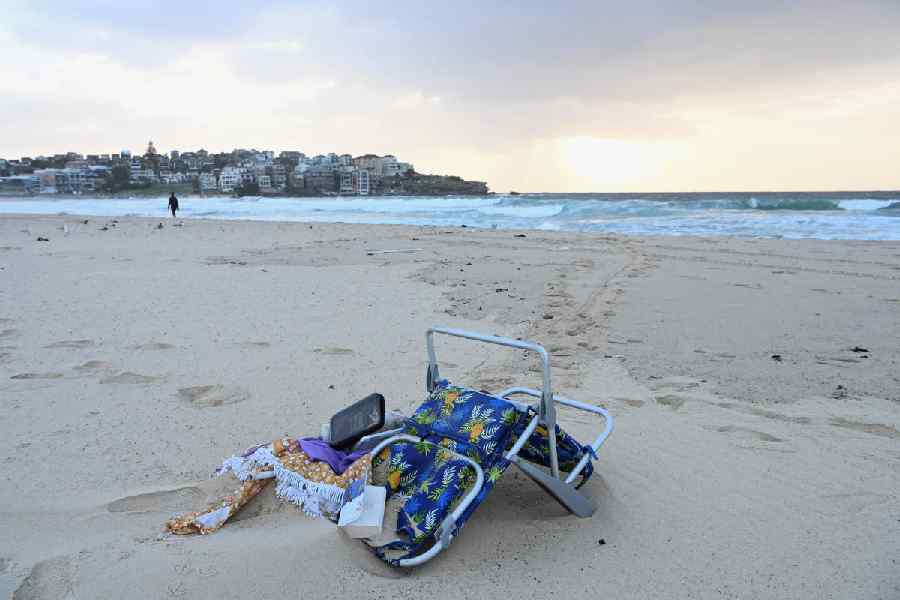
In Australia, a father and son gunned down 15 people celebrating a Jewish holiday at the beach. In England, a Syrian-born British citizen rammed a car into people and attacked others with a knife outside a synagogue on Yom Kippur. On Tuesday, the Polish authorities arrested a law student suspected of plotting to attack a Christmas market.
All of them were accused of supporting the Islamic State, a terrorist group whose deadly ideology continues to inspire adherents to commit atrocities years after its core organisation was badly degraded.
The recurring bloodshed shows the group has adapted to a post-caliphate era. It is weakened compared with a decade ago, when it held large swaths of territory in Iraq and Syria, and instead now wields propaganda as its most potent tool to inspire deadly attacks.
The Bondi Beach massacre in Sydney, Australia, came a day after a member of Syria’s security forces killed two US Army soldiers and an American civilian interpreter in Palmyra, Syria. President Donald Trump blamed the Islamic State, and officials said the gunman had been slated to be fired because of his extremist views.
Terrorism experts expressed concerns that the success of the Sydney attack could fuel more extremist plots as the holidays approach, with European Christmas markets an attractive target. Such lone-wolf attacks require little funding and are difficult to predict and prevent because they are aimed at vulnerable targets, like open-air crowds.
The Islamic State’s "resilience lies in its malleability, surviving by shaping itself around its new realities", Rita Katz, the executive director and founder of the SITE Intelligence Group that tracks terrorism, wrote in an analysis.
Since the September 11 attacks, the US and its allies have greatly diminished the abilities of terrorist organisations to carry out sophisticated plots by taking the fight to their redoubts in such countries as Syria, Afghanistan, and Libya, and by deploying superior firepower and technology.
A Sunni Muslim insurgent group, the Islamic State traces its beginnings to Iraq. After local militias and American troops defeated a branch of al Qaeda fighters, the group rebranded as the Islamic State. It exploited the chaos of Syria’s civil war more than a decade ago to seize vast swaths of territory in the country and in neighbouring Iraq.
The group gained notoriety for kidnappings, sexual enslavement and public executions in West Asia. It orchestrated or inspired terrorist attacks across Europe, including coordinated assaults in France in November 2015 that killed 130 people and suicide bombings in Belgium a year later in which nearly three dozen were killed.
But its self-proclaimed caliphate was largely routed nearly seven years ago by US troops and the Kurdish-led Syrian Democratic Forces in northeastern Syria.
Because it no longer holds much territory, the Islamic State relies even more on its longstanding playbook of spreading its radical ideology online and through clandestine cells and regional affiliates. Last year, the Islamic State’s Khorasan branch, based in Afghanistan, claimed responsibility for major attacks in Iran, Russia and Pakistan.
The Islamic State’s propaganda urges followers to target gatherings of non-Muslims and provides detailed advice on using guns, bombs, vehicles, knives or a combination of methods to increase casualties. It is "essential to leave some kind of evidence or insignia identifying the motive and allegiance", the group has told followers.
New York Times News Service