
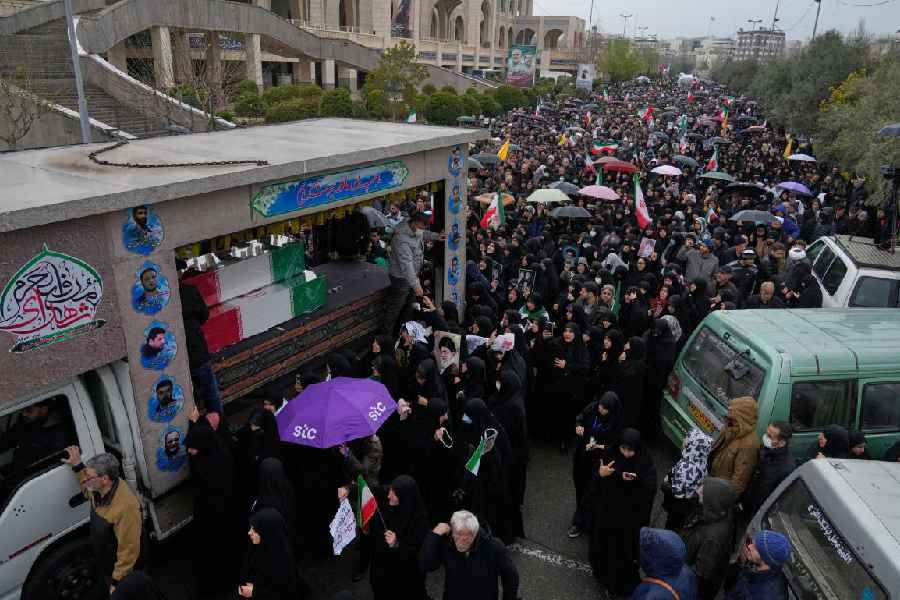
When Masoud Pezeshkian, the president of Iran, appeared in public very briefly to greet citizens at an anti-Israel rally last week, another member of his family was also there.
Yousef Pezeshkian, the president’s 44-year-old son, who serves as his adviser, had not seen or spoken to his father since Israel and the United States began the war against Iran on Feb. 28 and the country’s leadership went underground. He was hoping to get a glimpse of him. In a diary he has been posting on a Telegram channel, he lamented that it had been to no avail.
The son, who has a doctoral degree in physics and is a college professor, has kept a daily diary of the war mixing reflections both personal and political. The diary offers a rare glimpse into how Iran’s political figures are faring as the war rages — and closes in on them. And perhaps inadvertently, Pezeshkian at times takes his readers into the arguments and inner deliberations of Iran’s top leadership.
While Iran’s leaders have projected defiance in public statements, the younger Pezeshkian writes of the fear underneath the facade as multiple leaders are targeted and killed in Israeli bombings.
“I think some political figures are panicking,” he wrote on the sixth day of the war, in early March. “The people are stronger and more resilient than our pundits and political leaders. We have to keep reminding ourselves that defeat will only come when we feel defeated.”
He worries for his father, he wrote, and said he and his two siblings could not wait for the two remaining years of the presidency to end so “we can all get back to our normal lives.”
As Iran enters the fourth week of war, with leader after leader killed, those who remain have all retreated to what they hope will prove secure locations. Israeli and U.S. airstrikes have so far killed the former supreme leader, Ayatollah Ali Khamenei, and wiped out his top military command chain; Ali Larijani, the head of the Supreme National Security Council and de facto ruler of Iran, and the head of the Ministry of Intelligence, Esmaeil Khatib, among others.
Pezeshkian wrote in his diary that protecting the lives of officials has become the No. 1 priority for the country. Stopping the targeted killings, he said, “is now a matter of honor.”
Pezeshkian has posted diary entries on his Telegram page nearly every day since the war started, continuing a practice that dates back at least a year. He has linked some of the entries to his other official social media pages, including Instagram.
His writing mixes personal anecdotes about time with his family with messages of loyalty to the rulers of the Islamic Republic and nods to their critics. That includes defending his father against attacks from rival factions.
Pezeshkian recounted attending a meeting with government officials in the first week of the war at which disagreements about strategy surfaced.
“The biggest serious disagreement we have is: How long are we supposed to fight?” he wrote. “Forever? Until Israel is destroyed and America retreats? Until Iran is in complete ruins and we surrender? We have to study the different scenarios.”
Pezeshkian did not respond to a request for comment. Two Iranian officials and a former senior official who know him and work with him in his father’s administration said the social media pages were authentic and that he wrote the entries and managed the accounts. Iranian media have sometimes referred to his writings.
In the diaries, Pezeshkian says he keeps receiving messages about the war not just from friends and acquaintances but also from strangers. Occasionally, he said, “the messages call for us to surrender and return the power to the people,” a notion that he dismissed as “ignorant and delusional.”
He did say that he worried that Iran’s attacks on Arab countries in retaliation for the U.S. and Israeli strikes might backfire. “It’s so sad that to defend ourselves we have to attack American bases in friendly countries,” he wrote. “I don’t know if they will understand our situation or not.”
Pezeshkian fiercely defended his father for apologizing to Arab countries for the strikes in a video message on March 7 and saying they would stop. Conservatives and military commanders reacted angrily to the apology, and the president’s pledge to stop the strikes was reversed within hours.
“Apologizing to neighbors is an ethical duty, not a legal one,” the younger Pezeshkian wrote. He said that people living in Arab countries in the Persian Gulf were not at fault and that their lives had been upended by the war.
Israel’s ability to hunt down senior officials in their secret locations has unnerved Iran’s leaders and caused anxiety about who may be next, and how the losses can be absorbed, according to three senior Iranian officials who asked that their names not be published because they were discussing sensitive issues. Some losses hit harder than others, the officials said.
Larijani, for example, had singular power and influence across different political factions and within the security and military apparatus. He was viewed as a figure who might be able to engage with the Trump administration in ceasefire talks.
“I did not want to believe it at all,” wrote Pezeshkian of the news that Larijani was dead. “We should not have allowed the enemy to have another successful assassination.”
Many wonder who is now running the country in the absence of Larijani. Mojtaba Khamenei, who succeeded his father as supreme leader, remains out of sight.
The three senior Iranian officials said in interviews that the country was currently being run by a committee.
Commanders of the Revolutionary Guard are leading the charge, with Gen. Ahmad Vahidi, their newly appointed commander in chief, running the tactical side of the war. A member of Khamenei’s inner circle, Gen. Mohammad Bagher Ghalibaf, has been quietly filling in for Larijani. A former commander of the Guards who is now speaker of the parliament, he is in charge of strategic decision-making.
Masoud Pezeshkian and his vice president, Mohammad Reza Aref, are in charge of the day-to-day running of the state to make sure it continues to function, the officials said. They said that retired generals, along with former officials and managers, had been called back to service.
Analysts say Iran’s system of governing has evolved into a resilient ecosystem of overlapping institutions. A network of leaders, loyal civil servants, military cadres, and civil and defense foot soldiers have mobilized not just to maintain the Islamic Republic’s rule but also to continue waging the war.
Eliminating the top tier of leadership has not led to a collapse.
“Facing the constant risk that Israel could take out its senior leadership, the Islamic Republic is running the war effort as a networked survival machine, with all hands on deck and authority diffused across overlapping centers of power,” said Ali Vaez, the Iran director for the International Crisis Group.
But in his diary, Yousef Pezeshkian says, that unless Iran can stop the targeted killings, “we will lose the war.”
He has also shared some anecdotes about his personal life. He speaks of coloring with his children, taking them out to play in the park, buying them balloons. He writes of meeting a friend for a long walk in the park and his resolve to exercise so he can maintain his mental stamina.
Once, he said, he received a mysterious message directing him to show up at an address. He panicked, suspecting an Israeli trap. But after checking with security, he said, he realized it was just an iftar invitation from friends to break the Ramadan fast with them.
One evening, Pezeshkian said, wondering what the future might hold for his beloved country, he turned to the Quran. He shared his interpretation of a verse that he had read: “My impression is that the calamity we are now grappling with is the result of our own behavior. Maybe tears will be our redemption and asking for forgiveness.”
Then this week, he said, he paid a visit to his grandmother. For most Iranians, the war is inescapable, but his grandmother was completely unaware of the events unfolding in their country, he said. It broke him.
“After 19 days of war, I finally broke down and cried, several times,” Pezeshkian wrote.