Past and present teachers of the Indian Statistical Institute, Calcutta, along with academics, on Sunday said that the revised ISI Bill, 2025, drafted by the ministry of statistics and programme implementation, seeks to decimate the institute’s democratic and federal structure.
Partha P. Majumder, the former National Science Chair of the government of India and a former ISI professor alleged that the bill, which seeks to dilute the composition of the institute’s council and academic council, would vest authority in the hands of the Union government and its nominees through an overarching board of governance.
On December 12, Majumder wrote to the ministry demanding that the revised bill be withdrawn. He said the bill would undermine the democratic structure that has guided the institute since Prashanta Chandra Mahalanobis founded it in 1931.
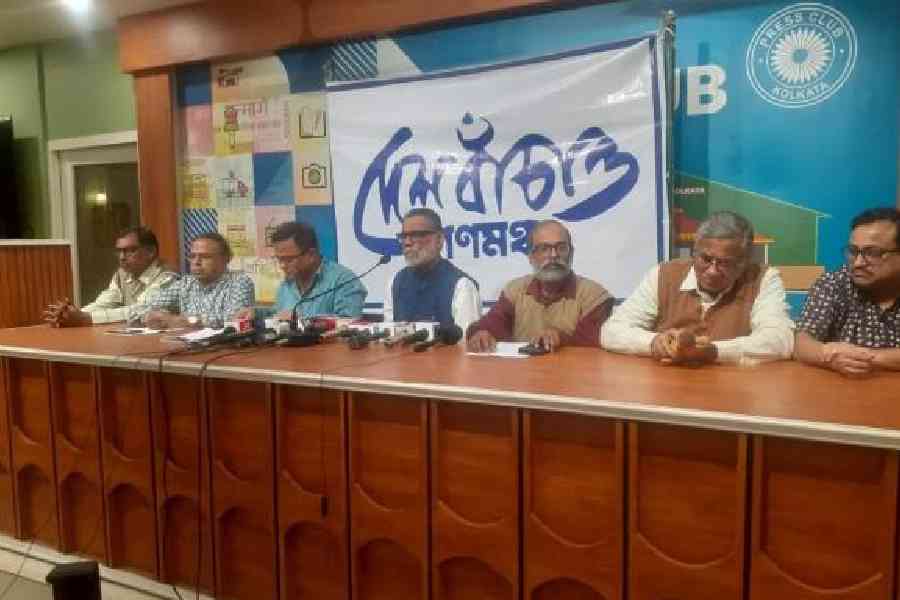
Majumder’s letter was read out at a news conference organised on Sunday.
The news conference organised by Desh Banchao Ganamancha, a civil society forum, was held a day before the window to give feedback on the revised ISI bill came to an end.
The ministry is likely to table the bill in Parliament for its passage.
Majumder wrote: “The ISI adopted ‘Unity in Diversity’ as its motto.....Now your ministry is poised to repeal the ISI Act, abolish the ISI Society and bring structural changes in ISI through a bill that is bound to adversely affect its functioning.”
Majumder, who had founded the National Institute of Biomedical Genomics in Kalyani, told Metro if the bill was implemented ISI can no longer justify “Unity in Diversity” as its motto because the bill seeks to abolish the present semblance of a federal structure and proposes to change the current democratic and autonomous functioning by replacing it with a mode of functioning that is “essentially top down”.
Arijit Bishnu, a professor, Advance Computing and Microelectronics Unit (ACMU), criticised the government for introducing the bill without any internal consultation
“What is of grave concern is that the Union government did not bother to hold any discussion with the real stakeholders. In September, when the draft ISI bill was circulated, no discussion was held. Similarly, when the ministry uploaded the revised bill on November 28, following a protest over the draft bill, no one was consulted. There was no review by any expert committee,” said Bishnu.
The newspaper reported on December 11 that the teachers and staff of the institute voiced deep concern that the proposed ISI Bill could pave the way for the “abolition” of hundreds of vacant teaching and non-teaching posts.
They said their concerns stemmed from the fact that under the revised draft bill, the board of governors (BoG) — dominated by members nominated by the Union ministry of statistics and programme implementation — would become the institute’s highest decision-making body.
Anupam Basu, a former professor of computer science and engineering department at IIT Kharagpur and the former director of NIT Durgapur, said the revised ISI bill “smacks of an interventionist approach”.
“ISI, which is a Society under the control of the Bengal government, has a distinct character as it ensures a collective representation of teachers, scientists and employees in the running of the institute. The Union government, by repealing the ISI Act endorsed by Jawaharlal Nehru in 1959, wants to establish bureaucratic control,” said Basu.
The students and research scholars of ISI on Thursday met Rahul Gandhi in Delhi, urging the Leader of the Opposition to oppose the bill whenever it is placed in Parliament.