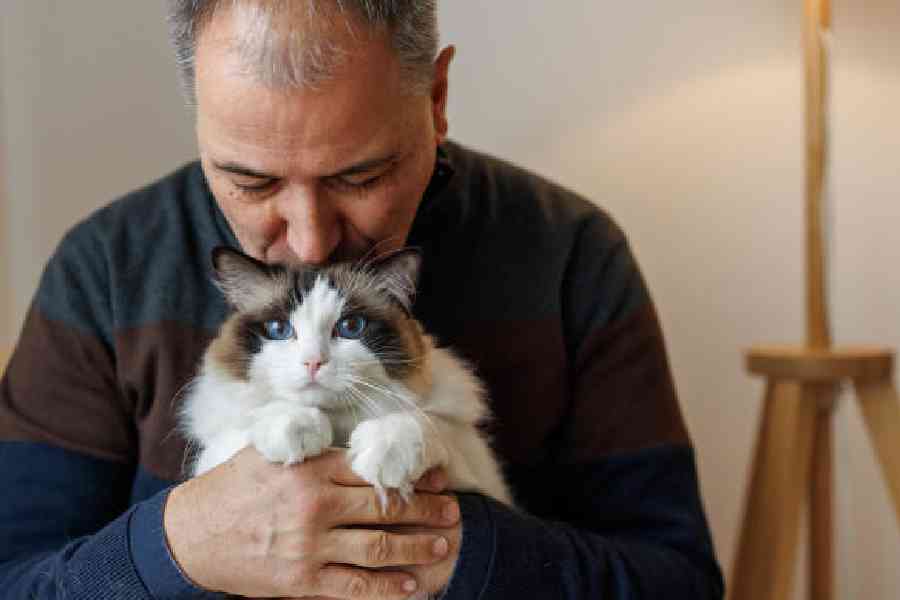
As he lectured on animal behaviour, Kaan Kerman, an instructor in the psychology department at Bilkent University in Turkey, noticed a pattern. Dog owners tend to confidently interpret their pets’ behaviour, he said, “but cat owners are always puzzled”. Compared with dogs, cats have been studied less, partly because they prefer to stay at home.
When he and his colleagues asked cat owners for permission to film inside their homes, the response was enthusiastic. “As long as you give us some answers about our cats,” was a common reply. What that study found may not be as welcome among men who care for cats.
In a study published last month in the journal Ethology, the researchers reported that cats meow more frequently when greeting male caregivers. The team hypothesised that men “require more explicit vocalisations to notice and respond to the needs of their cats”. In other words, the researchers are suggesting that many cats have concluded that men don’t always listen and adjusted their behaviour accordingly.
Volunteers who identified themselves as their cats’ primary caregivers were asked to wear an unobtrusive camera and record their first few minutes after returning home, while behaving as naturally as possible. The researchers analysed the first 100 seconds of footage from 31 volunteers, focusing on the first cat to approach the caregiver in multi-cat households.
Across all demographic variables — including the sex and age of the cat, pedigree status and number of cats in the home — only one factor was linked to vocalisation frequency: the biological sex of the caregiver. On average, cats produced 4.3 meows in the 100-second greeting window with men, and 1.8 with women. (The researchers also counted vocalisations such as trilling, chirping, growling or purring.)
The researchers suspect that the difference reflects communication styles. Earlier work has found that female caregivers tend to speak more to their cats and may be better at interpreting feline vocal cues than males.
Jonathan Losos, an evolutionary biologist at Washington University in St Louis, US, and author of The Cat’s Meow, said the hypothesis was plausible, but only if competing explanations can be ruled out.
“So the authors suggest that we men are clueless, that we’re ignoring cats and they need to get our attention more,” he said. “Could be true.”
Still, he noted that the sample size was small and that alternative explanations are possible. “Is this inherently due to differences between men and women,” he asked, “or something about the experimental setup? Could men and women differ in how they follow instructions?”
Mikel Delgado, a cat behaviourist and senior research scientist at Purdue University, US, was more sceptical. “We need to be careful about interpreting this as a clear finding that is going to translate to all cats,” she said. Furthermore, the study did not account for other factors, including how long a cat had been left alone and whether it was hungry. And, Delgado said, although participants were instructed to behave naturally, the researchers did not track how much the owners spoke to their pets in the study footage, another variable that influences how much cats vocalise.
Kerman and his colleagues acknowledged that cultural factors may have shaped the findings, because all of the study participants lived in Turkey. Recent research has shown that communication between cats and humans varies across cultures. In Turkey, men typically engage less frequently in verbal interaction, the researchers said, potentially causing cats to meow more insistently to elicit a response.
“One of the things that I really would like to do,” Kerman said, “is to replicate this study in other parts of the world.” Such work matters for cat welfare, he added, because cats are “very good at hiding their problems”. The better humans understand what their cats are trying to convey, the better they can care for them.
NYTNS