When self-driving cars started picking up commercial passengers in San Francisco in the US two years ago, they were not eagerly welcomed. Protesters took to the streets demanding that the vehicles be removed, citing concerns about safety and the loss of people’s jobs.
Then an autonomous car operated by Cruise, a subsidiary of General Motors, ran over and dragged a pedestrian. Not long after, another Cruise vehicle collided with a fire truck. The company’s vehicles were eventually taken off the road. The future of self-driving cars looked like it was on the rocks.
But Google’s Waymo, a self-driving car company with a more cautious approach, stuck around. Today San Francisco has, to the surprise of many and the continuing aggravation of a few, become “Waymo-pilled”.
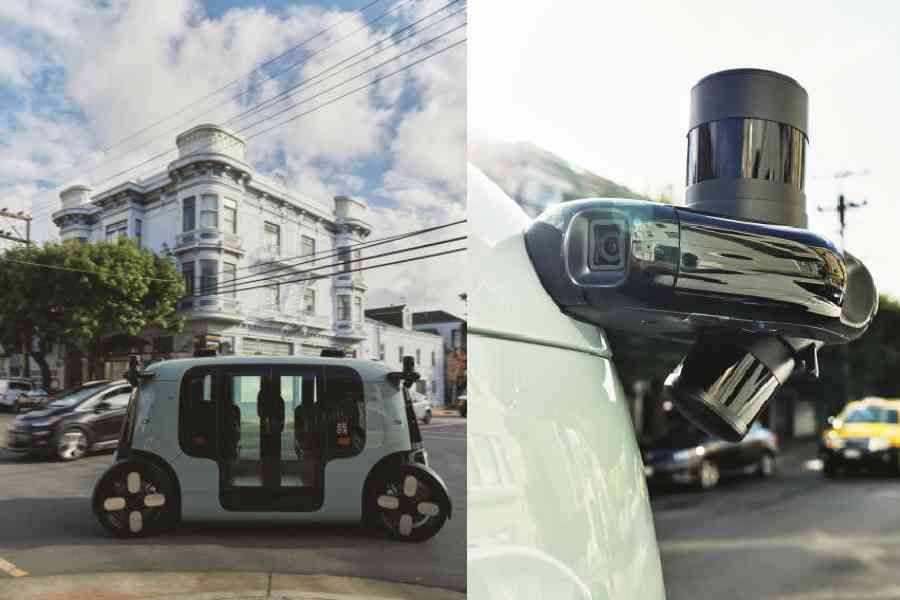
Now Waymo is getting a significant competitor. Amazon announced that it would begin a free test programme in the city for Zoox, its boxy, carriage-shaped robot taxis.
The day-to-day experiences of people here — both good and bad — offer a preview
of what other cities can expect in the coming years. But first, a look at the new competitor.
Meet Zoox
Our ride began on a sunny afternoon when Zoox founder Jesse Levinson used the app to summon a car to the Tartine Manufactory, a famous bakery.
After a few minutes, a Zoox vehicle parked on a street around the corner rather than in front of the bakery. That move was by design: the robot taxis are programmed to pick people up only from zones deemed safe, meaning that riders may occasionally have to do a bit of walking to their car.
When we entered the car, it felt like sitting in a roomy luxury vehicle, built from the ground up with the idea that a human driver wouldn’t be needed. There were four seats, two on each side facing each other, meaning some riders may have to ride backward. Each passenger had access to a wireless charger for a phone and a touch screen to pick music, set the cabin temperature, call for help or open the car doors. Notably, unlike a Waymo, the Zoox (see pic above) has no steering wheel.
The Upsides
The emergence of Zoox — along with an expansion of Waymo — means more consumers will soon get to try one of these cars. So why could that be a good thing?
Self-driving cars could reduce the risk of major accidents. Whether they are distracted by their phones, inebriated, reckless or unskilled, lots of people are bad drivers. In the first half of 2025, roughly 17,000 people in the US died in motor vehicle crashes. Data on Waymo car accidents showed that while incidents had increased as the company expanded but the vast majority of them resulted in no or minor injuries.
For consumers, the more the options, the better it is. For years, Uber and Lyft have dominated the industry. During peak commute times, summoning a car can become challenging, and fares, which climb with demand, can get pricey. Waymo and Zoox give consumers more options.
Some riders would feel safer riding with a robot than with a stranger. Uber and Lyft have made headlines over reports of sexual assaults by drivers. Self-driving cars give riders the option to eliminate that possibility.
The Downsides
Even though driverless taxis are designed to make fewer mistakes, they are far from perfect.
The robot cars are conservative about obeying speed limits and braking to avoid collisions. When more of these cars hit roads, they will almost certainly add to drivers’ frustrations.
Also, self-driving cars sometimes won’t pick you up where you want them to. Although Uber or Lyft drivers are often willing to illegally double-park in front of your home, a Waymo or Zoox will park in an area deemed safe even if it’s farther away.
Despite their lack of drivers, autonomous cars typically charge more for rides than Lyft and Uber.
They still make mistakes. It’s too early to conclude that self-driving cars are safer for the public. Cruise shut down after the collision tanked its reputation and led to regulatory scrutiny.
To that end, Zoox has lots to prove.
NYTNS