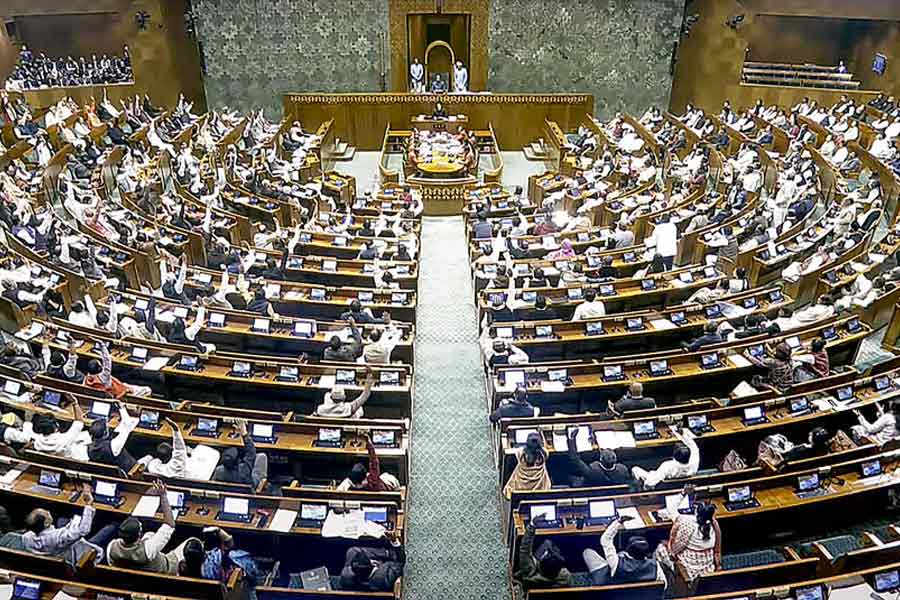
The Lok Sabha on Wednesday passed a bill to open the country’s civil nuclear energy sector to private players, amid a walkout by the Opposition which accused the government of undermining India’s energy independence and clean energy goals by dismantling the consensus on the nuclear liability regime reached in 2010.
Science and technology minister Jitendra Singh strongly defended the Sustainable Harnessing and Advancement of Nuclear Energy for Transforming India Bill 2025 — dubbed SHANTI — saying the legislation was intended to strengthen India’s nuclear power programme to transform the future of the country and the next generation of Indians. He said the new legislation would help India achieve its target of 100 GW atomic energy generation by 2047.
The new bill replaces the Atomic Energy Act, 1962, and the Civil Liability for Nuclear Damage Act, 2010, to open the doors of India’s nuclear industry to private players.
Opposition members staged a walkout after expressing dissatisfaction with the minister’s response on the removal of supplier liability for nuclear equipment, arguing that the change would endanger citizens in
the event of a nuclear accident or incident.
Responding to the criticism, Singh justified the omission of the supplier clause, saying the bill had been framed in line with “what is relevant in the changed scenario”. He argued that technological advances, improved safeguards and a reduced risk of catastrophe had significantly altered the context since 2010.
“Supplier responsibility will lie with the operator.
Supplier is a wide definition and collaborators were reluctant to come forward because of the liability clause…. The government will only deal with the operator,” Singh told the House in response to a query from Congress MP Manish Tewari.
Seeking clarification after the minister’s reply, Tewari sought to know the logic behind not holding the supplier liable in case of faulty equipment. “Is it the philosophy of the government — privatising profit and socialising liability?” he asked.
Talking to reporters outside the House, Tewari said the Opposition had walked
out because of the government’s “strange position” that a supplier would not be liable for a faulty product that leads to a nuclear incident or accident.
“Where is the pressure coming from to completely absolve the nuclear suppliers? It’s inexplicable that in a matter as serious as nuclear energy — to completely give a pass to the suppliers is something which is completely unheard of,” he said.
In his reply after the discussion, Singh said that if India had to be a global player, it had to follow global benchmarks and strategies. He said the bill was necessary to address India’s growing energy needs and increase the share of nuclear power up to 10 per cent of the energy mix.
Tewari accused the BJP of having earlier attempted to derail India’s nuclear programme in 2008 by opposing the Indo-US nuclear deal when the UPA was in power.
“When the UPA government was trying to end India’s nuclear isolation, end nuclear apartheid, you brought a vote of no confidence against that government. You people tried to derail India’s nuclear programme for political reasons. You were an impediment in breaking India’s nuclear apartheid. That’s a history you shouldn’t forget. You covered yourself in ignominy,” he told the House amid protest from the BJP members.
Referring to the main provision in the bill to allow private participation, the Congress MP questioned the coincidence in the timing of the proposed legislation and the announcement by a private conglomerate’s intent to enter the nuclear energy sector.
Tewari said it was strange that “a conglomerate that has built an empire on leased public assets announced its intent to enter the nuclear energy sector in late November, and the government brought the bill within days.