
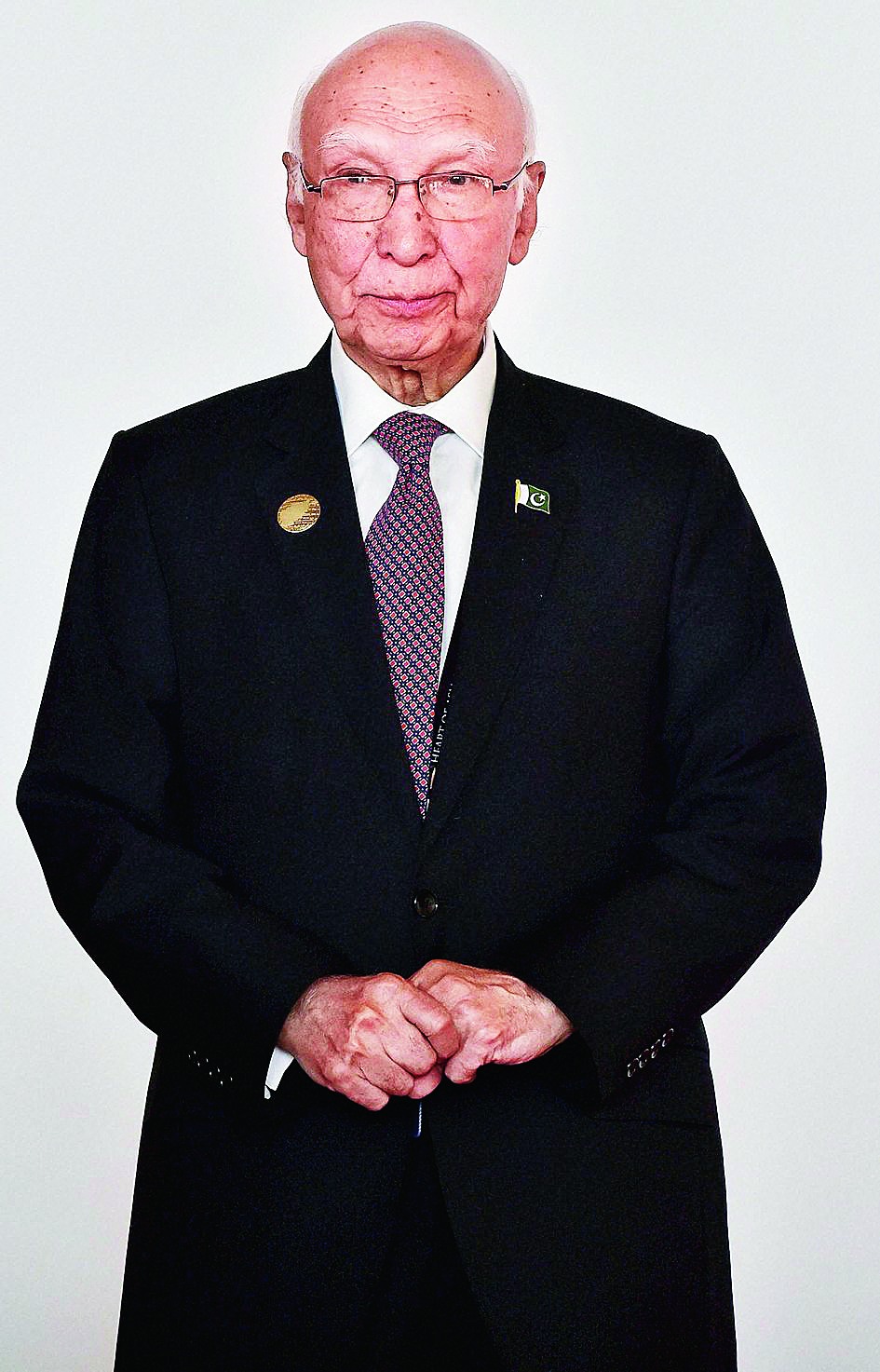

Amritsar, Dec. 4: Afghanistan President Ashraf Ghani and Pakistan's top diplomat Sartaj Aziz sparred over terrorism at the Heart of Asia ministerial meet here today, as a key 14-member regional grouping failed to resolve differences over connectivity and militancy.
India and Afghanistan had pressed the grouping - aimed at building a regional consensus on political, economic and security cooperation for Afghanistan - to adopt a counter-terrorism framework binding on all members.
That framework is aimed at defining and collectively censuring countries that support or provide sanctuary to terrorists - a direct jab at Pakistan, which both India and Afghanistan accuse of sponsoring cross-border terrorism in their territories.
But only two of the 12 countries other than India and Afghanistan in the grouping - Iran and Russia - had confirmed their support to the framework Kabul had drafted by the time officials met this morning.
India and Afghanistan view the reluctance of some members to formally endorse the framework as an outcome of pressure from Pakistan and China, both members of the Heart of Asia process. The remaining countries in the grouping include Azerbaijan, Kazakhstan, Kyrgyzstan, Saudi Arabia, Tajikistan, Turkey, Turkmenistan and the United Arab Emirates.
"We propose an Asian and international regime - whatever is acceptable, particularly, to our neighbour Pakistan to verify cross-border activities," Ghani said, addressing the summit and looking at Aziz, seated about 10ft away. "We do not want a blame game. We want verification."

Ghani also suggested that a $500m-fund Pakistan has offered Afghanistan could be used to combat terrorism.
"This fund, Mr Aziz, could very well be used for containing extremism because without peace any amount of assistance will not meet the needs of our people," the Afghan President said.
Aziz hit back, when it was his turn to speak.
"It is simplistic to blame only one country for the recent upsurge in violence," Aziz said. "We need to have an objective and holistic view."
Late in the afternoon, Pakistan's defence minister Khawaja Asif also accused Ghani of trying to deflect attention from his "ineffective governance".
"President Ghani's regrettable statements at Heart of Asia amount to placing blame for his ineffective governance at Pakistan's doorstep," Asif said.
India - both in Prime Minister Narendra Modi's address and in a statement by finance minister Arun Jaitley, leading the Indian delegation here - stuck to its traditional position.
"It is also our collective duty to ensure that resurgent forces of terrorism and extremism do not find sanctuaries and safe havens in any name, form or manifestation," Jaitley said. "Neighbours of Afghanistan have a particular responsibility in this regard."
Modi cautioned that "silence and inaction against terrorism in Afghanistan and our region will only embolden terrorists and their masters".
Jaitley suggested, in an evening media briefing, that terrorism was the principal focus of talks at the meet. He cited the unprecedented listing of multiple terror groups in the Heart of Asia declaration released at the end of the summit to bolster his argument. The groups listed include the Lashkar-e-Toiba, Jaish-e-Mohammed and the Haqqani Network, all of which are based in Pakistan. "Terrorism was at the core of discussions," Jaitley said. "It was a centre-stage issue."
But terrorism wasn't the only point of contention that played out at the Heart of Asia summit.
Both Modi and Ghani pointedly referred to the trilateral transit pact they had struck with Iran in May, and the development by India of the Chabahar port in Iran, to point to the need for the region to enhance connectivity.
India and Afghanistan are now discussing an air link, Jaitley said, "especially for high-value goods".
Modi and Ghani too referred to an "air transport corridor". The idea behind the corridor is to try and overcome, to some extent, Pakistan's refusal to allow direct transit to Indian cargo headed for Afghanistan, and Afghan trucks wanting to enter India. But it is unclear whether the "air corridor" will pass over Pakistan.
"Afghanistan would like to see itself as a bridge between South and Central Asia," said Hekmat Karzai, Afghanistan's deputy foreign minister. "Our challenges and opportunities are common."
Islamabad is opposing a request by Kabul and New Delhi that India be allowed to join the currently bilateral Afghanistan Pakistan Trade and Transit Agreement.
"The PM said he wants Afghanistan to develop as a geography of peace," Jaitley said.