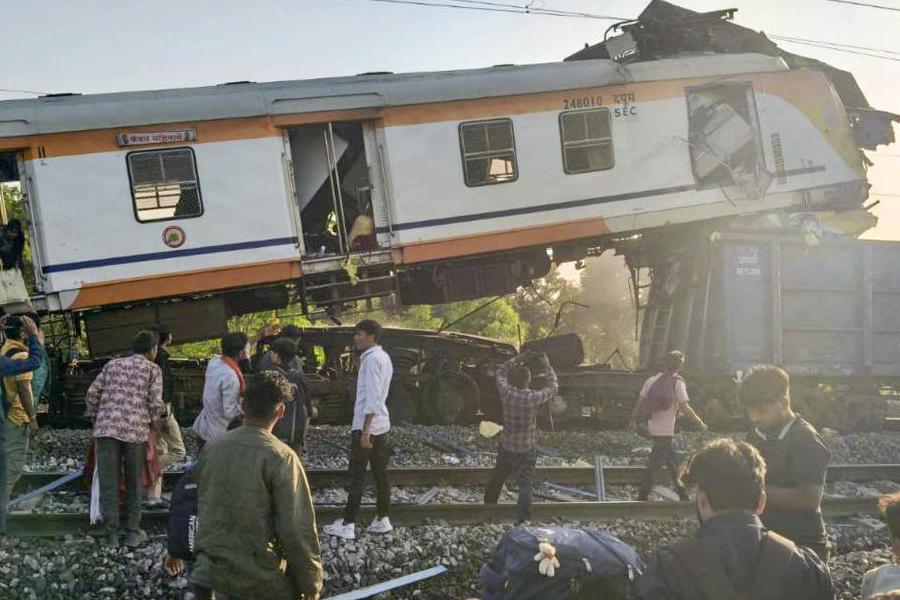
The Commissioner of Railway Safety’s investigation into the 4 November, 2025 rear-end collision in Chhattisgarh has placed responsibility squarely on the rail administration, faulting it for allegedly deploying an unfit loco pilot who failed a mandatory aptitude test and repeatedly sought basic instructions over the phone while operating the train.
The collision, involving a MEMU passenger train and a stationary goods train in the Bilaspur division, left 12 people dead, including the loco pilot, and injured 19 passengers.
The probe report, submitted recently to the Railway Board, builds a detailed picture of procedural lapses, gaps in training, and ignored warnings that may have contributed to the disaster.
Brijesh Kumar Mishra, Commissioner of Railway Safety (South Eastern Circle), writes in his report: “LP (loco pilot) deployed on MEMU train no. 68733 appeared in the 'aptitude test' on 09.06.2025 but could not clear the same and 'failed'. Telephonic calls made by LP during the run for seeking guidance from CLI (Chief Loco Inspector), even on minor issues, also indicate his lack of knowledge.”
According to the CRS, the Assistant Loco Pilot had also observed these shortcomings.
“LP was lacking in qualities required to handle the MEMU train, including knowledge of rules, timely decision making and reaction time, as observed by the ALP (Assistant Loco Pilot) also. In view of the above, it can be concluded that the LP deployed was not fit to work on the MEMU train no. 68733,” Mishra notes.
The investigation relied heavily on the loco pilot’s official phone records. Two calls in particular raised red flags.
The report states: “Call record for the CUG connection indicates that there were two calls made by the LP during the run. It has been informed that at 10:20:14 hrs, while the train No. 68734 was standing at GTW (Gatora) station, the loco pilot called CLI and asked how to reset the ACP (alarm chain pulling) when it occurs.”
And later that afternoon: “At 13:11:32 hrs, the loco pilot called CLI to seek guidance on how to release the parking brake when the train was in a standing condition at GAD.”
These are tasks that trained MEMU operators are expected to handle without external help. “Hence, it clearly shows a lack of knowledge and confidence on the part of the loco pilot,” the CRS observed.
The report also points to irregularities in the issuance of the loco pilot’s “Certificate of Competency,” stating: “It indicates that due procedure has not been followed while issuing the competency certificate and LP may not be fully competent to work on MEMU trains.”
Railway Board rules mandate that MEMU operations, treated as single-driver operations, require loco pilots to clear an aptitude test. Despite the pilot failing that test, he was assigned to the MEMU.
Mishra reiterates the rule clearly: “LP appeared in an aptitude test on 09.06.2025 but could not clear the same and 'failed'. Hence, it is obvious that the LP deployed on train no. 68733 was not fit for working on this train as a motorman.”
Officials in SECR argued that the loco pilot could still operate a MEMU with an Assistant Loco Pilot, but the CRS rejected this outright.
“Calling the argument ‘unacceptable’, the report says the Board’s norms “clearly restrict deployment of loco pilots without passing the aptitude test.”
The CRS points out that the train required an ALP in any case. “Hence, working of train no. 68733 needed assistant loco pilot, even if driven by motorman.”
A shortage of qualified staff emerges as another structural issue.
“Against the requirement of 142 no. of LPs to run MEMU trains in SECR, only 102 LPs have passed the mandatory 'aptitude test', leaving a shortfall of 40. LPs should be deputed on MEMUS only after passing the 'aptitude test',” the CRS states, urging the Railway Board to resolve staffing gaps.
The report also recommends technological intervention. It suggests adopting an Advanced Auxiliary Warning System (AAWS), already in use in Mumbai’s suburban EMUs.
“The system monitors speed of EMU rakes according to the aspect of signals and applies emergency brakes in case of violation of signals, ensuring safety. A similar system is recommended for MEMU operations in automatic signaling territories at other places.”
Beyond this, the CRS flagged the need to reinforce basic safety practices.
“Administrative instructions have been issued several times in the past for counselling of ALPs that they should keep one hand on RS valve while passing a signal showing ‘one yellow’ aspect, enabling immediate application of emergency brake if train speed is such that it may not stop before the signal displaying ‘red’ aspect.”