
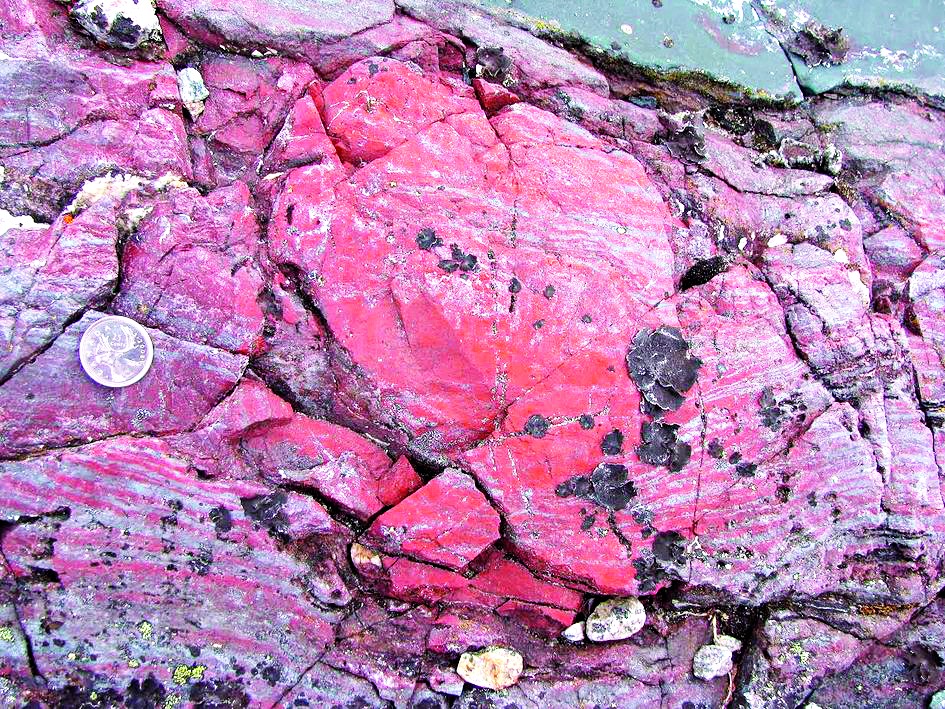

New Delhi, March 1: Scientists have discovered in 3.7-billion-year old rocks in Canada's Quebec province microscopic bead-like and red-hued filaments they say are signatures of Earth's earliest known life forms.
The tiny filaments appear to be residues left behind by bacteria and provide fresh support for the idea that life originated under the ocean at least 3.7 billion years ago and, perhaps, as early as 4.2 billion years ago, the scientists said.
Studies on the filaments suggest they were produced by ancient bacteria that lived in hydrothermal vents on the ocean floor and consumed iron, a key mineral that makes up the planet, the researchers said.
"We think we're looking at either protective sheaths or waste product filaments left by the microbes," Crispin Little, a senior palaeontologist at the University of Leeds in the UK and a member of the international research team that studied the fossils, told The Telegraph.
Microbes found near present-day hydrothermal vents are known to make sheaths that protect them from the heat and mineral precipitates in the vent environment. Little and his colleagues have described their findings in the journal Nature.
"The age was a surprise because it suggests life arose on Earth as soon as conditions were ripe for it to evolve - as soon as Earth had cooled enough to hold liquid water, life evolved rapidly," Little said.
Until now, the oldest microfossils had been reported from 3.46 billion-year-old rocks in western Australia, although some scientists had suggested that those residues might be non-biological compounds in the rocks.
The filaments from Quebec come from an area that holds some of world's oldest sedimentary rocks and are primarily made of a material called haematite, a type of iron oxide or rust.
Little and his colleagues found that the haematite filaments display similar characteristic branching of iron-oxidising bacteria found near other hydrothermal vents today. Their studies also suggest that the haematite were most likely formed when bacteria that oxidised iron for energy were fossilised in rock.
"These findings demonstrate that life developed on Earth at a time when Mars and Earth had liquid water on their surfaces," said Mathew Dodd, first author of the research paper and a PhD student at the University College, London. "This discovery supports the idea that life emerged on from hot seafloor vents," he said in a release.
The filaments were found in centimetre-sized structures called nodules, rosettes, and granules all of which are products of putrefaction, Dominique Papineau, team member and study leader, said in the release.
The scientists say these microbes themselves would have been preceded by even earlier life forms. "All we can say is that life must have originated even earlier - whether 10 million years earlier or 100 million years earlier, we do not know," Little said.