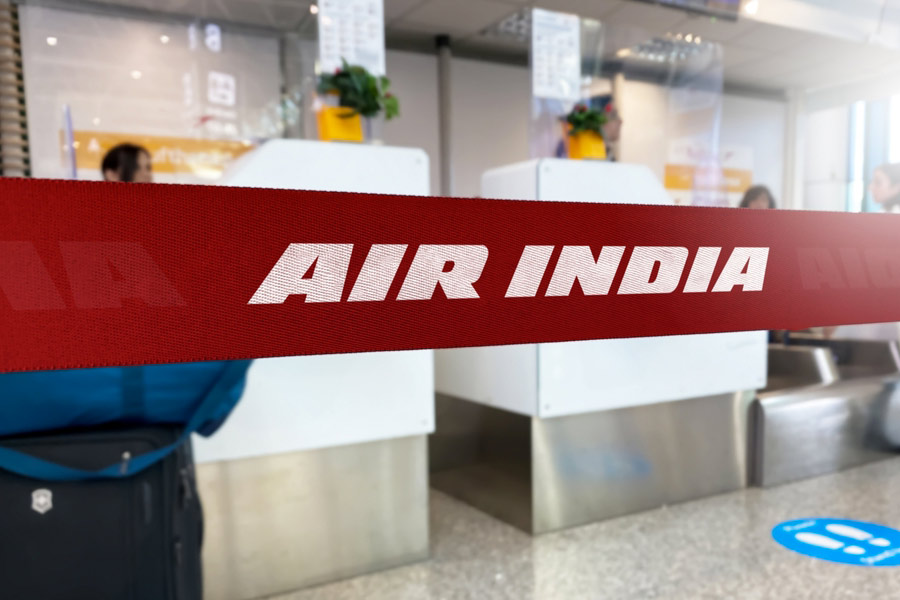
Air India and Air India Express said they have proactively capped economy-class fares on non-stop domestic flights since December 4, amid IndiGo's ongoing operational crisis, which has triggered massive cancellations and record-high ticket prices across major routes.
In a post on social media, Air India wrote, "Air India & Air India Express clarify that, since 4 December, economy class airfares on non-stop domestic flights have been proactively capped to prevent the usual demand-and-supply mechanism being applied by revenue management systems."
The airline added that it is aware of "screenshots of last-minute itineraries with one-stop or two-stop flights or a combination of economy and premium economy or business cabins taken from third party platforms. It is not technically possible to cap all such permutations, but we are engaging such platforms to exercise oversight."
Air India said it was working to support passengers stranded amid the crisis: "Air India and Air India Express are seeking to add capacity to help travellers and their baggage reach their destinations as quickly as possible."
Government caps fares as IndiGo crisis deepens
The government moved to cap airfares nationwide on Saturday after thousands of passengers were stranded and hundreds gathered outside major airports following IndiGo’s cancellation of 385 flights on the fifth consecutive day of disruptions.
IndiGo, which commands over 60 per cent of India’s aviation market, has cancelled thousands of flights this week due to a pilot shortage triggered by new flight duty time and rest rules.
The airline has acknowledged that it failed to prepare adequately for the November 1 deadline to implement stricter norms governing night landings and weekly rest requirements.
The cancellation crisis comes as the biggest operational challenge in IndiGo’s two-decade history. On Friday alone, more than 1,000 IndiGo flights were cancelled. Although the government has granted temporary exemptions from key duty-time restrictions, the airline says it expects operations to normalise only between December 10 and 15.
Passenger chaos as fares skyrocket
As IndiGo's flights dropped off the schedule, fares on other carriers surged steeply on many routes.
The government said it imposed fare caps to ensure “pricing discipline,” and the Civil Aviation Ministry noted it would "continue to closely monitor fare levels through real-time data and active coordination with airlines".
This marks the first time fares have been capped since the Covid-19 pandemic in 2020.
Record-high airfares hit travellers
Airfares touched unprecedented levels on Friday. A one-way, one-stop economy-class SpiceJet ticket from Kolkata to Mumbai for December 6 was priced as high as Rs 90,000, while Air India’s one-stop Mumbai–Bhubaneswar economy fare went up to Rs84,485, according to airline websites.
A travel industry executive said the massive cancellations—IndiGo operates about 2,300 flights daily—caused fares to triple or quadruple. "The situation is such that you can't predict what are going to be the ticket prices when you book a flight. It may be two times, three times or even more than the normal fare range," he said.
Even last-minute fares rose far beyond typical spikes. "The last minute fares are generally 2-3 times of the normal average fares. But in this situation, we have seen them surging even six times," a source noted.
Travel industry leaders criticised the surge. Ajay Prakash, CEO of Nomad Travel and former president of the Travel Agents’ Association of India, said, "If a Rs 10,000 ticket is being sold at Rs 60,000, at any place, I would call it black marketing, profiteering. So there is a dire need to look at it."
He added that with one airline holding a 64–65% market share, "a market where one airline has 64-65 per cent of the market share is as good as a monopoly," and called for fare caps during crises.
Subhash Goel, founder of Stick Travel and former IATO president, said, "I have written to the civil aviation ministry that there should be capping on airfares like it was during the Covid-19 pandemic."