India’s merchandise trade deficit widened sharply in April as the ongoing conflict in West Asia pushed up global crude prices and inflated the country’s import bill, adding pressure on the external account and the rupee.
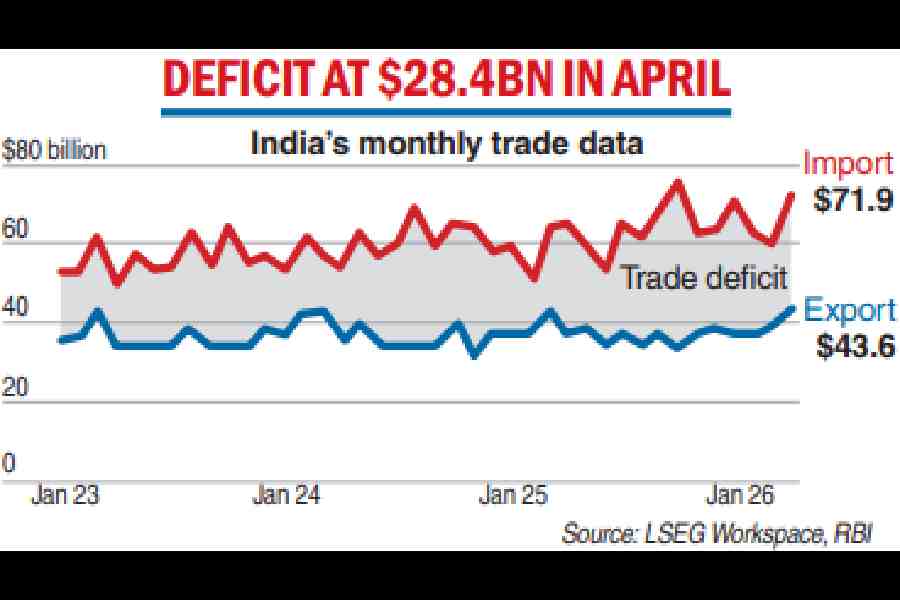
Data released by the ministry of commerce and industry on Friday showed the merchandise trade deficit — the gap between imports and exports — rose to $28.38 billion in April from $20.6 billion in March.
Merchandise exports during April stood at $43.56 billion against $38.28 billion in the same month last year, while imports rose to $71.94 billion from $65.38 billion a year ago.
A sharp increase in oil and gold imports contributed significantly to the widening gap. Oil imports climbed to $18.62 billion in April compared with $12.18 billion in March, while gold imports rose to $5.63 billion from $3.06 billion during the same period.
Commerce secretary Rajesh Agrawal said part of the increase in export value was due to rising global prices. “The positive growth in export value may also have some contribution from prices because prices of many things are going up,” he said.
Economists, however, cautioned that stronger export growth may not be enough to offset the impact of elevated imports, particularly energy shipments.
Aditi Nayar, chief economist at Icra, said the widening trade deficit is likely to keep pressure on India’s current account balance. She estimated the current account deficit for the current fiscal year at around 2 per cent of GDP, more than double the level estimated for the previous year.
The wider trade imbalance also weighed on the rupee, which slipped to a record low and weakened beyond the 96-mark against the dollar after the release of the trade data.
The Indian currency has emerged among the weakest-performing Asian currencies so far in 2026 amid persistent external sector concerns.
When asked about the impact of the depreciating rupee on exports, Agrawal said exports continued to show resilience. “Till now it has been showing a positive trajectory, and the early signs from May also look positive,” he said.
The government has also been encouraging exporters and importers to increasingly settle international trade in rupees to reduce dependence on foreign currencies. Agrawal, however, acknowledged that adoption of the mechanism remains at a nascent stage.
India’s merchandise exports to the West Asian region fell 28 per cent year-on-year to $4.16 billion in April from $5.78 billion a year ago.
Imports from the region also declined 31.64 per cent to $10.47 billion from $15.32 billion in April last year.
The conflict involving Iran has disrupted movement through the Strait of Hormuz, a critical shipping route for global energy supplies. India, the world’s third-largest crude oil importer, remains heavily dependent on oil shipments passing through the strategic waterway.
Government data showed India’s crude oil basket averaged above $114 a barrel in April, around 61 per cent higher than the average price during the previous financial year.
To cushion the economy from rising external pressures, the Centre has announced a series of emergency measures, including an increase in retail fuel prices for the first time in four years and tighter restrictions on gold imports to contain foreign exchange outflows and support the rupee.
Prime Minister Narendra Modi has also appealed to citizens to reduce fuel consumption and defer gold purchases for a year.
Agrawal said the higher duty on gold imports would help moderate domestic demand for the precious metal. He added that the government was also engaging with industry stakeholders to address issues exporters faced.