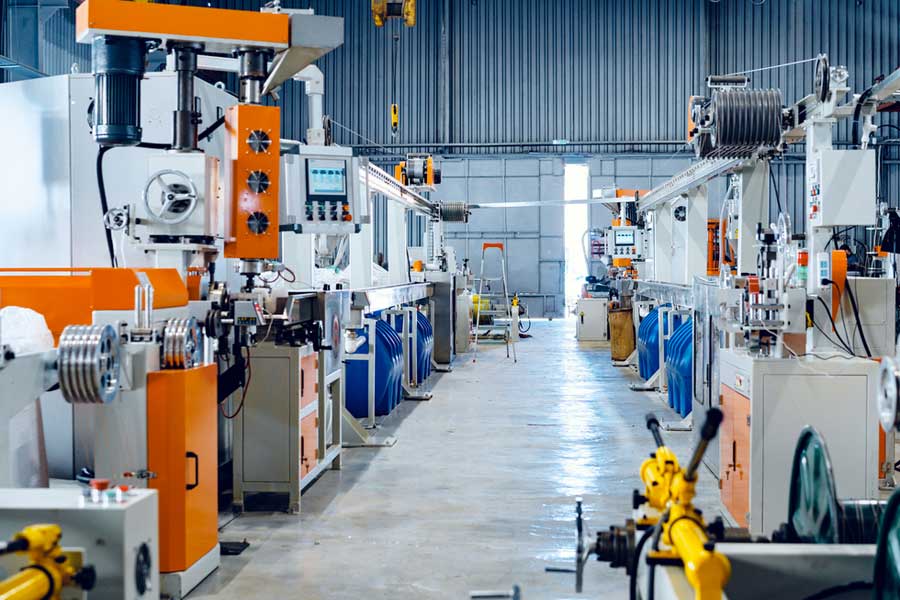
India’s manufacturing sector slowed to a nine-month low in November as softer growth in sales and production reflected challenging market conditions, according to a monthly survey released on Monday.
The seasonally adjusted HSBC India Manufacturing Purchasing Managers’ Index (PMI) dropped to 56.6 in November from 59.2 in October, marking the slowest improvement in operating conditions since February. In PMI terms, a reading above 50 signals expansion, while one below 50 indicates contraction.
"India's final November PMI confirmed that US tariffs caused the manufacturing expansion to slow," said Pranjul Bhandari, Chief India Economist at HSBC.
The survey noted that although international sales continued to rise — supported by stronger demand from Africa, Asia, Europe and the Middle East — overall growth momentum weakened. “Although companies suggested that the trend for international sales remained favourable – reflecting greater sales to clients in Africa, Asia, Europe and the Middle East – there was a mild loss of overall growth momentum,” the report said.
New export orders grew at the weakest pace in more than a year. “The new export orders PMI fell to a 13-month low. Business confidence, as indicated by expectations for future output, showed a big fall in November, potentially reflecting increasing concerns about the impact of tariffs,” Bhandari added.
The slowdown comes amid ongoing trade negotiations with the United States. On November 28, Commerce Secretary Rajesh Agrawal said India remained hopeful of reaching a framework trade agreement with the US this year that would address tariff challenges for Indian exporters.
Bilateral discussions have been underway for a long time. Although the first tranche of a trade deal was expected by fall 2025, the Trump administration’s tariffs on Indian exports have complicated progress. Agrawal noted that while a full Bilateral Trade Agreement (BTA) will take time, India is involved in “protracted negotiations” on a framework that would ease reciprocal tariff pressures.
“The boost from the cuts in goods and services tax (GST) may be fading, and it might be insufficient to offset the tariff headwind to demand,” Bhandari observed.
Price pressures eased during November, with input costs and selling prices rising at their slowest pace in nine and eight months, respectively.
Hiring activity also softened, as manufacturers aligned workforce and purchasing decisions with weakening new order growth. Employment rose at the slowest rate in the current 21-month stretch of uninterrupted expansion.
Looking ahead, firms remained optimistic about output growth over the next year, but overall sentiment slipped to its lowest level in nearly three and a half years. “Downgraded forecasts stemmed from concerns around a competitive landscape, including competition from international firms, as anecdotal evidence showed,” the report stated.
The HSBC India Manufacturing PMI is compiled by S&P Global from responses to purchasing managers across a panel of about 400 manufacturers.