Summary
For years, the United States has remained one of the most preferred destinations for Indian students seeking global education and career opportunities.
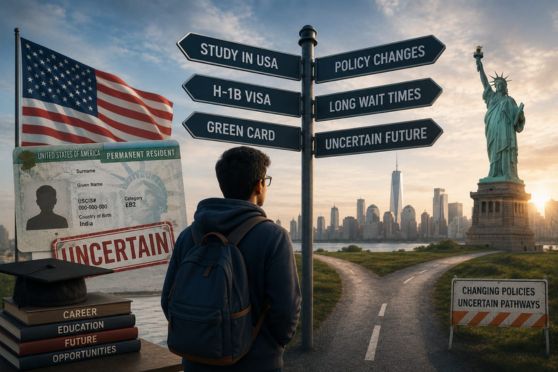
However, recent developments in US immigration policy have introduced a fresh layer of uncertainty.
For years, the United States has remained one of the most preferred destinations for Indian students seeking global education and career opportunities. Beyond academic excellence, many students have viewed a US degree as the first step towards long-term professional growth, often leading to employment opportunities and, for many, a transition to H-1B visas and eventually permanent residency.
However, recent developments in US immigration policy have introduced a fresh layer of uncertainty. A new policy interpretation by the US Citizenship and Immigration Services (USCIS) has raised concerns among international students, skilled professionals, and families that have traditionally considered the US a viable long-term destination. While the policy does not close the door on legal immigration, it has prompted many to reassess how predictable the pathway from education to settlement truly is.
Understanding the Latest USCIS Policy Interpretation
At the centre of the discussion is a recent USCIS memo that reiterates a key aspect of the green card process: Adjustment of Status (AOS), which allows individuals to apply for permanent residency from within the United States, is a “discretionary benefit” rather than an automatic entitlement.
Importantly, the memo does not alter existing immigration law. However, it signals a stricter and more cautious approach to the assessment of applications. For professionals on H-1B visas, this reinforces the reality that transitioning to permanent residency is not guaranteed and may involve greater scrutiny and case-by-case evaluation.
The Traditional Education-to-Residency Route Faces New Questions
For Indian students and professionals, the US has historically offered a relatively clear progression from education to employment and eventually permanent settlement. The H-1B visa has played a central role in this journey, serving as a bridge between short-term employment and long-term residency.
That perception is now being tested. Even before the latest policy emphasis, Indian nationals faced significant backlogs in employment-based green card categories, often resulting in lengthy waiting periods. The renewed focus on discretion adds another layer of uncertainty, making the pathway less predictable.
As a result, what was once regarded as a structured and achievable route is increasingly being viewed as uncertain, prompting individuals to reconsider their long-term expectations.
Rising Concerns Among Students and Skilled Professionals
The implications of this uncertainty extend beyond policy interpretation. For students, the prospect of eventually transitioning into an H-1B role and building a long-term career in the US has long been a key factor in choosing the country as a study destination.
When the stability of that pathway comes into question, it directly influences decision-making. Students are now exercising greater caution, evaluating not only academic opportunities but also how reliably those opportunities translate into long-term outcomes.
For H-1B professionals already working in the US, the concerns are even more immediate. Immigration status is closely linked to career progression, financial planning, and personal commitments. Any indication of increased scrutiny or procedural unpredictability can create hesitation around long-term decisions, even in the absence of immediate changes to eligibility requirements.
Changing Student Preferences in an Evolving Immigration Landscape
While the United States continues to offer unmatched academic and professional opportunities, student behaviour is gradually evolving. Increasingly, students are adopting a more balanced and strategic approach when selecting international study destinations.
Countries such as Canada, the United Kingdom, and Australia are now being considered alongside the United States, particularly because of their relatively clearer post-study work options and more transparent pathways to residency.
This does not necessarily diminish the US’s appeal. Rather, it reflects a shift in priorities. Students are increasingly factoring in immigration clarity, policy stability, and long-term flexibility alongside academic reputation and career prospects.
In this evolving landscape, international education decisions are becoming more nuanced. The focus is no longer solely on accessing global opportunities but also on understanding how sustainable those opportunities may be over time.
As policies continue to evolve, the US is likely to remain a key destination. However, for Indian students and H-1B professionals, the emphasis is increasingly shifting towards informed decision-making, where ambition is balanced with realism and opportunity is evaluated alongside certainty.
About the Author:
Anant Bengani is the Director & Co-Founder of Zell Education, one of India’s fastest-growing ed-tech organizations in Accounts and Finance. A Chartered Accountant with a background in Financial Markets, he co-founded Zell in 2015 and was recognized in the 30 Under 30 Young Entrepreneur list in 2021. Passionate about mentoring students and professionals, he actively guides them in navigating career opportunities.
Last updated on 27 Jun 2026