Also Read
A deadly, record-breaking heatwave driven by a rare "Omega block" weather pattern tightened its grip across Western Europe on Wednesday, killing at least 50 people, disrupting transport and power supplies, shutting schools, and prompting health alerts across several countries as temperatures continued to soar.
France, Britain, Italy and Spain remained among the worst-affected nations, with authorities warning that extreme heat could pose serious risks even to healthy adults. Meteorologists said more temperature records could be broken in the coming days.
France recorded its hottest day since records began nearly 80 years ago on Tuesday, with temperatures reaching 44.3 degrees Celsius in the southwestern town of Pissos. The country also registered a record national thermal indicator of 29.8 degrees Celsius, based on readings from 30 weather stations.
At least 50 deaths have been linked to the heatwave in France and Spain. French authorities said 48 people drowned while attempting to cool off in water bodies, while two young children died after being left in a car during the extreme heat. In Spain, two elderly people died of heatstroke, though temperatures there were beginning to ease on Wednesday after exceeding 40 degrees Celsius over the weekend.
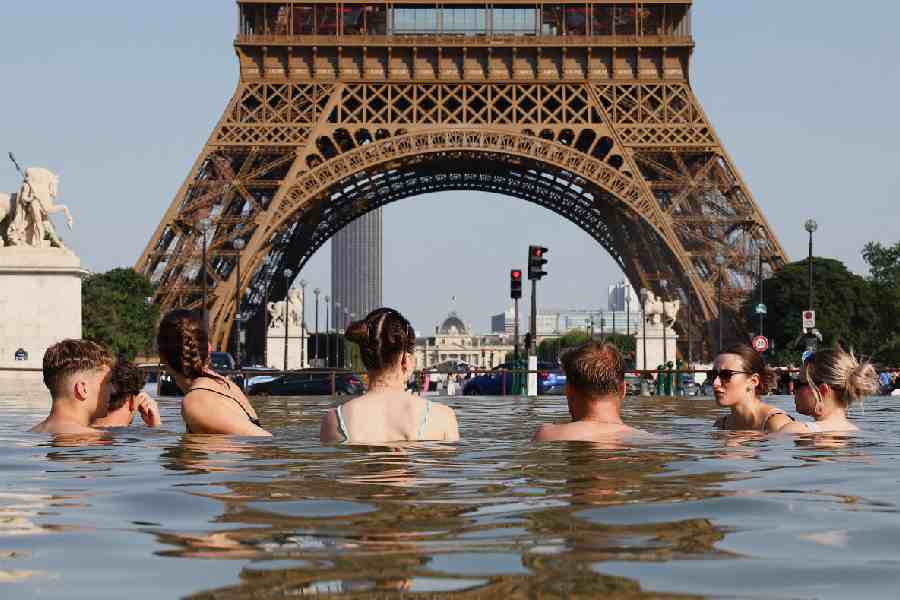
Authorities in France worked to restore electricity to thousands of homes in Brittany after heat-related power outages, while major tourist attractions including the Eiffel Tower and the Louvre Museum restricted visiting hours.
In Britain, which was on course for its hottest June day on record, the Met Office issued only the second "red heat health" warning in the country's history, covering much of central and southern England and Wales. Temperatures were forecast to reach 38 degrees Celsius in southern England.
"Red warnings are reserved for the most severe events and we're expecting severe and significant impacts from this heat wave, with health impacts likely for many, even beyond those who are normally more vulnerable to the heat," said Mark Sidaway, deputy chief forecaster for the UK Met Office.
Schools closed in several areas, train services were cancelled or slowed, and passengers were advised to avoid non-essential travel. Network Rail warned of "significant disruption" due to risks including buckled tracks and sagging overhead electric wires. Eurostar also cancelled four London-Paris services scheduled for Wednesday and Thursday because of the weather.
"If you think it's hot already, well, we ain't seen nothing yet," Met Office meteorologist Alex Burkill said on Wednesday morning.
Britain's grid operator asked electricity generators to make additional power available as demand surged during the heatwave.
Italy's Health Ministry issued its highest-level "red alert" for 16 cities, including Rome, Milan, Florence and Turin. Meteorologists warned conditions would worsen further across central and northern Italy, with the heatwave expected to peak between Sunday and Monday.
Temperatures could reach 41 degrees Celsius in parts of Tuscany and Emilia, while high humidity along coastal regions such as Liguria could push perceived temperatures to as high as 45 degrees Celsius.
The extreme conditions have been caused by a rare atmospheric phenomenon known as an Omega block, which traps hot air over large regions for prolonged periods. According to Reuters Climate Monitor, temperatures in parts of Europe have been running as much as 18 degrees Celsius above seasonal averages.
The pattern has drawn comparisons with the devastating August 2003 heatwave that lasted 16 days and caused an estimated 80,000 excess deaths across Europe.
The heat has disrupted daily life across the continent. Construction firms adjusted working hours to protect workers, retailers struggled to meet demand for fans and portable air-conditioners, and a French agricultural cooperative introduced night-time harvesting to reduce fire risks and protect workers from dangerous afternoon temperatures.
In Paris, where Fashion Week is under way, luxury labels including Dior and Rick Owens shifted events to the morning to avoid peak temperatures. At a Louis Vuitton show, spectators were seen struggling with the heat as models presented designs by Pharrell Williams.
Switzerland also took emergency measures, with some local authorities opening air-conditioned theatres for free daytime cinema screenings.
Scientists have repeatedly warned that climate change is increasing the frequency and intensity of extreme heat events. The World Meteorological Organisation says Europe is warming at more than twice the global average, making prolonged and severe heatwaves increasingly likely.