Summary
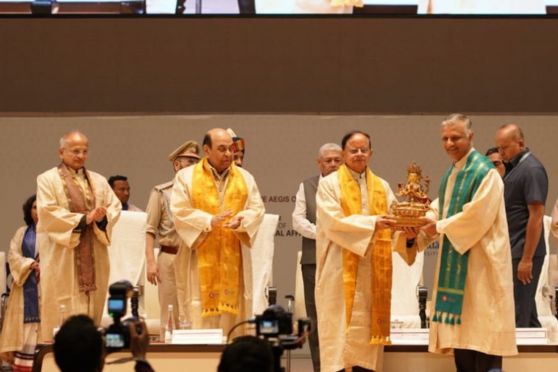
Nalanda University celebrated its Third Convocation Ceremony (Snatakotsava) on May 19, 2026, at the newly inaugurated 2000-seater Visvamitaralay Auditorium on its campus in Rajgir.
Dr. P.K. Mishra, Principal Secretary to the Prime Minister of India, attended the ceremony as the Chief Guest.
Nalanda University celebrated its Third Convocation Ceremony (Snatakotsava) on May 19, 2026, at the newly inaugurated 2000-seater Visvamitaralay Auditorium on its campus in Rajgir, marking another milestone in the revival of the historic centre of learning as a modern global university rooted in civilizational knowledge and international academic engagement.
The convocation ceremony witnessed the participation of students, dignitaries, academicians, diplomats, and scholars from across India and abroad, reinforcing Nalanda University’s growing stature as an international institution committed to responsible knowledge, dialogue, sustainability, and interdisciplinary learning.
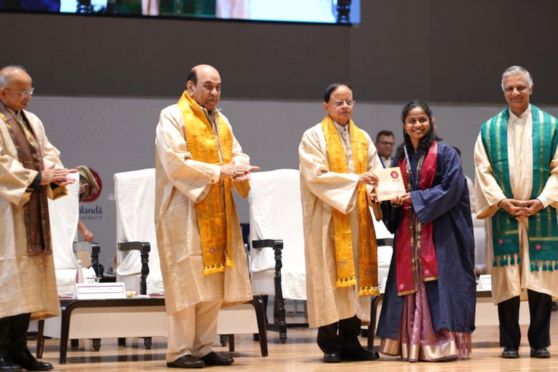
The convocation ceremony witnessed the participation of students, dignitaries, academicians, diplomats, and scholars from across India and abroad. Nalanda University
Dr. P.K. Mishra, Principal Secretary to the Prime Minister of India, attended the ceremony as the Chief Guest, while Lt. Gen. Syed Ata Hasnain (Retd.), Governor of Bihar, graced the occasion with his distinguished presence. Shri Rudrendra Tandon, Secretary (East), Ministry of External Affairs, Government of India, attended the event as the Guest of Honour. Also present were Ms. Archana Nair, Joint Secretary, Nalanda Division, Ministry of External Affairs, Vice Chancellors of various universities, academicians, diplomats, and other distinguished guests.
A total of 219 students from the 2024–26 graduating batch received degrees during the convocation. Reflecting the truly international character of the university, the graduating cohort represented 14 nationalities, including students from Vietnam, Bangladesh, Bhutan, Myanmar, and several other countries.
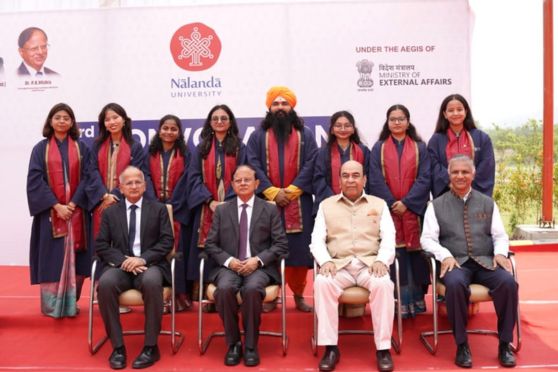
The ceremony also celebrated academic excellence, with eight students receiving Gold Medals for outstanding performance. Nalanda University
The ceremony also celebrated academic excellence, with eight students receiving Gold Medals for outstanding performance. Notably, seven of the eight medal recipients were female students, highlighting the remarkable academic achievements of women scholars at the university.
Following the convocation, the Kautilya Centre for Capacity Building was formally inaugurated on the university campus by Chief Guest Dr. P.K. Mishra, further strengthening Nalanda University’s focus on policy learning, leadership, and institutional capacity building.
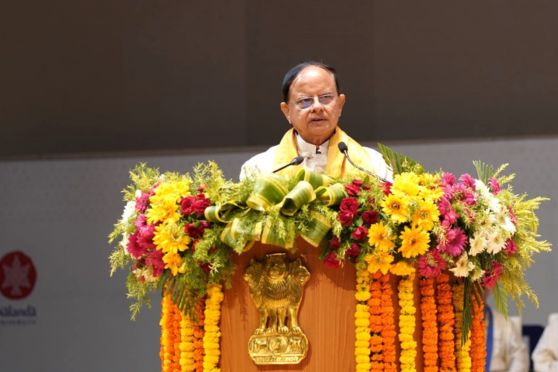
Addressing the gathering, Dr. P.K. Mishra, Principal Secretary to the Prime Minister of India, spoke extensively on the importance of “Responsible Knowledge in the 21st Century.” Nalanda University
Addressing the gathering, Dr. Mishra described Nalanda as “not merely a university, but a civilizational symbol,” and spoke extensively on the importance of “Responsible Knowledge in the 21st Century.” He emphasised that while the modern world possesses unprecedented technological advancement, the greater challenge lies in ensuring that knowledge remains deeply connected to ethics, wisdom, compassion, and human responsibility.
Reflecting on Nalanda’s historical relevance, he remarked that the story of Nalanda is “not merely a story about the past” but equally “a story about the future.” He added that the revival of Nalanda University reflects India’s enduring belief in openness, inquiry, pluralism, and dialogue as essential foundations for humanity’s collective future.
Speaking at the event, Bihar Governor Lt. Gen. Syed Ata Hasnain (Retd.) described Nalanda as “a civilizational ecosystem” that historically connected India with Asia through ideas, learning, and spiritual exploration rather than conquest. He noted that the revival of Nalanda represents “the recovery of a civilizational idea” and referred to the emerging “Nalanda Corridor” linking Nalanda, Bodh Gaya, Rajgir, Vaishali, and Vikramshila as a living geography of ethics, spirituality, and knowledge traditions.
The Governor further observed that institutions like Nalanda can become powerful platforms for dialogue, sustainable thinking, and ethical reflection in a world increasingly challenged by conflict, polarization, and environmental crises. He remarked that while ancient Nalanda symbolized humanity’s search for knowledge, the modern Nalanda must represent humanity’s search for wisdom.
Welcoming guests and graduates, Vice Chancellor Professor Sachin Chaturvedi reflected on the university’s journey of revival and transformation. He stated that Nalanda University has entered a new phase of consolidation and accelerated growth focused on stronger academic engagement, intellectual innovation, and global partnerships.
Professor Chaturvedi also announced the launch of new academic programmes in Science, Technology and Policy Studies, along with courses in Data Analytics and Artificial Intelligence from the upcoming academic session. Additionally, the university will introduce a new course titled “Nalanda Spirit” beginning August 2026.
Highlighting the institution’s broader intellectual vision, the Vice Chancellor stated that Nalanda is “not just a university, but a spirit.” He added that the university aims to emerge as a leading global centre for non-Western intellectual traditions, ecological thought, comparative civilizational studies, and Asian knowledge systems.
The Third Convocation concluded with a renewed commitment to building Nalanda University as a global hub of learning, sustainability, dialogue, ethical inquiry, and responsible knowledge for the 21st century.
Last updated on 20 May 2026