Also Read
Winter in Bengal has always announced itself with the annual return of migratory birds from distant countries and continents.
However, over the last few years, that familiar rhythm has been somewhat unsettled. Birders say this pattern is no longer confined to one season or one lake. It is about whether Bengal is steadily losing its ability to attract these birds at all.
Sujan Chatterjee, a conservationist, birder and founder member of the Birdwatcher’s Society, explains the problem. “The real issue is the way land is being used without any long-term ecological understanding,” he said in an interview with My Kolkata.
Apart from migratory species, south Kolkata’s Dhakuria lake is home to 43 resident bird species that depend on the region year-round.
Chatterjee cautions against treating such losses as isolated incidents. “The most basic question for any bird is where it will nest and where it will feed,” he said.
“Wetlands across Bengal are being reclaimed or fragmented to make way for urban settlements. Rajarhat is a classic example. Once you disturb that network, birds have nowhere to go.”
The Rajarhat wetlands near Kolkata is a rich birding spot, known for resident species like Red-vented Bulbuls, Indian Pied Starlings, Black Drongos and Tricolored Munias.
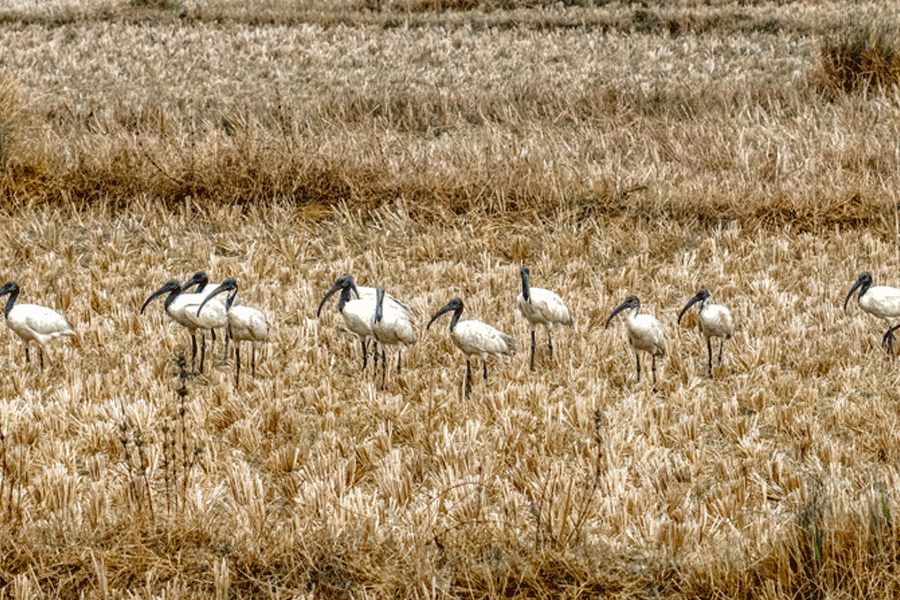
Waterbirds, including bar-headed geese, greylag geese, common teal, gadwall, and northern pintail rely on shallow wetlands linked to open fields.
Waders such as common snipe, redshank and greenshank depend on muddy edges and seasonal water levels. When wetlands or other waterbodies are concretised or stripped of their surrounding landscape, these species struggle to survive.
They support rich biodiversity and serve as crucial stopovers for migratory birds.
Yet many of Bengal’s waterbodies have steadily deteriorated in water quality and quantity. Santragachi Jheel in Howrah, located next to a busy railway station and just eight kilometres from central Kolkata, illustrates this.
Once a thriving habitat, it is now bombarded by pollution, encroachment and constant disturbance. “All these spots are being spoiled,” Chatterjee said.
However, the situation is not totally bleak or irreversible.
Shubhankar Patra, a veteran birdwatcher, told My Kolkata that the numbers of birds recorded so far remain encouraging, provided the water bodies are protected consistently throughout the year.
Calling the Santragachi lake a delight for birdwatchers, Patra acknowledged the pressures it faces as shops and other structures gradually come up around its edges. This expansion, he said, has led to waste being dumped into the lake, causing the water body to shrink over time.
To counter this, conservation enthusiasts and NGO workers have been clearing nearly 30 per cent of the kochuripana, or water hyacinth — a floating aquatic plant, and shaping it into small islands where birds can rest.
Patra stressed that such efforts need stronger support, particularly by ensuring that garbage, especially plastic waste, is not dumped into the lake and that the water body is protected from encroachments.
He also pointed out that the migration season is still underway, adding that there is time for more migratory birds to arrive at Santragachhi, with observers expecting the numbers to rise significantly in the coming weeks.
Birder Sujan Chatterjee also urged observers to widen the lens beyond state boundaries.
“Bengal is on the receiving end,” he explained. “We see the birds when they arrive here, but we rarely think about where they are coming from and what is happening there. The actual breeding grounds matter just as much.”
Some of the migratory birds visiting Bengal originate in the Arctic. “Climate change has deeply altered those northern ecosystems. The Arctic is getting depleted,” Chatterjee said.
“That is affecting breeding success even before birds begin their journey south.” Long-distance migrating birds have suffered population declines because melting sea ice has reduced food availability, while habitat loss and increased predators threaten ground-nesting birds.
“These Arctic birds are not long-living birds,” Chatterjee added, stressing that even small disruptions across global flyways can have lasting consequences.
In Bengal, the problem is visible in everyday land-use changes.
“At Santragachhi for instance, birds are seen in the mornings,” he explained. “At night, they fly out to forage in nearby paddy fields. But those fields are also getting urbanised. There is simply no place left for them to feed.”
As feeding grounds disappear, birds are forced to shift again.
Baruipur had emerged as a possible refuge, but that too is shrinking.
“Baruipur once had many guava orchards,” Chatterjee said. “Now they are barely there. Most of that land is taken up by housing estates and government projects.” Roads and embankments are breaking ecological continuity.
“Birds need a periphery. A wetland alone cannot sustain them,” he said.
Despite its small size, West Bengal has one of the longest bird lists in the country. Birds move across a vast network, from the Sundarbans to Nalban Bheri, Ballabhpur Sanctuary and Bakreswar.
Species arriving here include local residents, Himalayan migrants, and birds from Siberia, Europe and East China.
Tracking these movements relies on citizen science.
Platforms such as eBird, developed by Cornell University, along with Bird Count India and the Birdwatchers’ Society, allow birders to log sightings that feed into a global database used for research and conservation planning.
Chatterjee says such data is invaluable, but warns it must be matched with policy action, because without protecting wetlands, surrounding fields, and tree cover Bengal risks losing both winter visitors and its resident birds.