Until recently, Harvard was the most productive research university in the world, according to a global ranking that looks at academic publication. Now it has dropped to No. 3. The schools racing up the list are not Harvard’s American peers but Chinese universities that have been steadily climbing in rankings that emphasise the volume and quality of research they produce.
“There is a big shift coming, a bit of a new world order in global dominance of higher education and research,” said Phil Baty, chief global affairs officer for Times Higher Education, a British organisation unconnected to The New York Times that produces one of the better-known world rankings of universities.
Educators and experts say the shift is a problem not just for American universities, but also for the nation as a whole.
“There is a risk of the trend continuing and a potential decline,” Baty said. “I use the word ‘decline’ very carefully. It’s not as if US schools are getting demonstrably worse, it’s just the global competition. Other nations are making more rapid progress.”
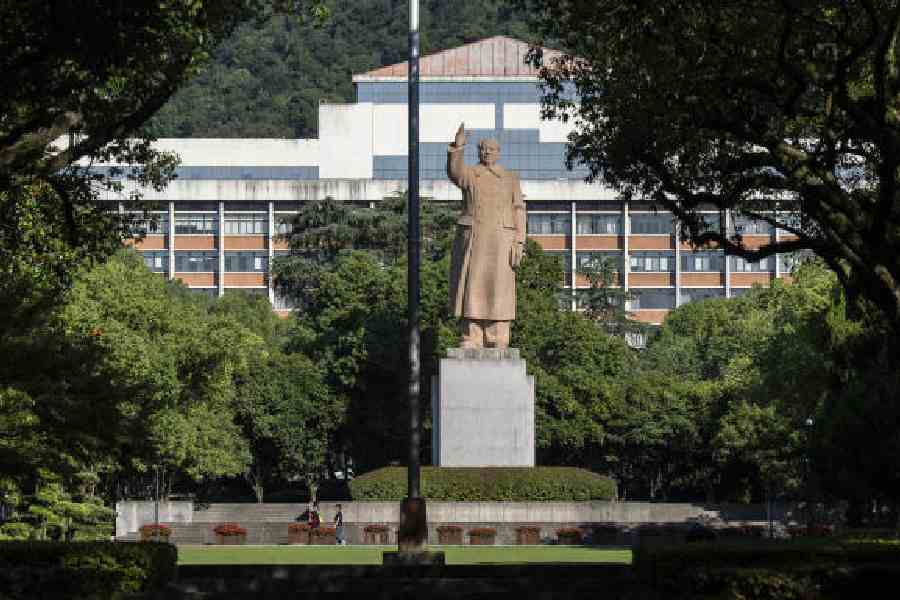
Look back to the early 2000s and a global university ranking based on scientific output, such as published journal articles, would be very different. Seven American schools would be among the top 10, led by Harvard University at No. 1. Only one Chinese school, Zhejiang University, would even make the top 25.
Today, Zhejiang is ranked first on that list, the Leiden Ranking, from the Centre for Science and Technology Studies at Leiden University in the Netherlands. Seven other Chinese schools are in the top 10.
Harvard produces significantly more research now than it did two decades ago, but it has nonetheless fallen to third. And it is the only US university still near the top of the list. Harvard is still first in the Leiden Ranking for highly-cited scientific papers.
The issue at top American universities is not falling production. Six prominent American schools that would have been in the top 10 in the first decade of the 2000s are producing more research than they did two decades ago, according to the Leiden tallies. But production by the Chinese schools has risen far more.
According to Mark Neijssel, director of services for the Centre for Science and Technology Studies, the Leiden Ranking takes into account papers and citations contained in the Web of Science, a database set of academic publications that is owned by Clarivate, a data and analytics company. Thousands of academic journals are represented in the databases, many of which are highly specialised, he said.
Global university rankings generally have not attracted much popular attention in the US. Even so, some experienced academics are seeing the growth in research production from China that the rankings reflect, and are warning that America is falling behind.
Rafael Reif, a former president of the Massachusetts Institute of Technology, US, said on a podcast last year that “the number and the quality of the papers coming from China are outstanding” and are “dwarfing what we’re doing in the US”.
The centre at Leiden has begun producing an alternative ranking that is based on a different academic database, called OpenAlex. Harvard is No. 1 in that ranking but 12 of the next 13 schools are Chinese.
President Xi Jinping, in a speech in 2024, praised his country’s advances in fields such as quantum technology and space science. He cited a breakthrough by researchers at Tianjin Institute of Industrial Biotechnology, who developed a method to synthesise starch from carbon dioxide in the lab, which could possibly lead to industries making food from the air.
Other ranking systems that are weighted toward scientific output reflect a similar shift toward Chinese institutions.
Harvard is No. 1 globally in the University Ranking by Academic Performance compiled by the Informatics Institute of Middle East Technical University in Ankara, Turkey. But Stanford University was the only other US school in the top 10, which includes four Chinese universities. Another ranking, the Nature Index, placed Harvard first, followed by 10 Chinese schools.
Harvard and other leading US universities face a fresh set of stressors from the Trump administration’s science grant cuts, as well as from travel bans and an anti-immigration crackdown that has swept up international students and academics.
The number of international students arriving in the US in August 2025 was 19 per cent lower than the year before, a trend that could further hurt the prestige and rankings of American schools if the world’s best minds choose to study and work elsewhere.
China has been pouring billions of dollars into its universities and aggressively working to make them attractive to foreign researchers. In the fall, China began offering a visa specifically for graduates of top universities in science and technology to travel to China to study or do business.
NYTNS
Last updated on 17 Feb 2026