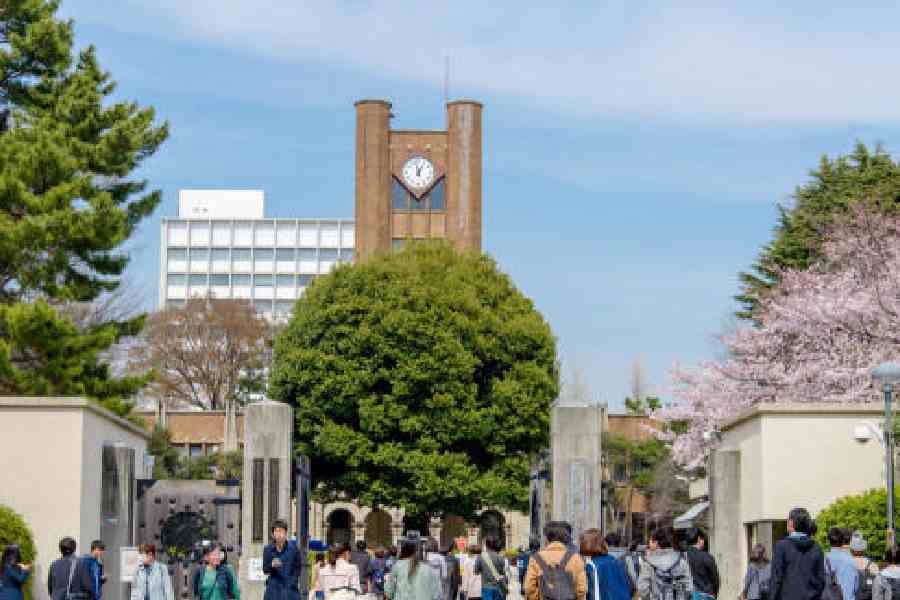
In Japan, systems work, and people do too. Titas Chatterjee, an exchange student at the Tokyo University of Foreign Studies (TUFS), recalls an experience that captures this. “I lost my student ID card, which is also an IC card outside the university,” he says. An IC card is a smart card used for trains, subways and buses. When Chatterjee reported it to the university office, they asked him to wait for two days. He says, “I was perturbed; losing an ID card is serious, and I couldn’t understand their relaxed attitude.”
The next morning, he received an email saying his card had been found from a place two train rides (about 20 kilometres) away. The experience was revealing; it showed a society where trust is practised daily and not just discussed.
Japan is steadily opening up to international students with a growing number of English-taught programmes. It is positioning itself as a serious higher education option across disciplines. “We’re seeing interest from Indian students in international relations, public policy and business, particularly finance, given Tokyo’s growing fintech ecosystem,” says Hargun Luthra, senior advisor (South Asia) for the University of Tokyo.
Says Anahata Harikumar, who studied BBA at Ritsumeikan Asia Pacific University (APU) in Tokyo, “Japan was the right fit. It’s close to home and also offers a unique environment and deep-rooted cultural experience. As part of a study abroad programme at APU, I went to Perth to better understand the ANZ region. These experiences shaped my approach to working across cultures.” ANZ refers to the Australia and New Zealand region.
She continues, “APU offered a 65 per cent tuition waiver and with support from Jasso, studying in Japan became more feasible.” Jasso stands for the Japanese Student Service Organisation that offers scholarships to international students. Anahata also received the Ando Momofuku Award, which recognises academic performance, leadership and commitment to society in the Asia-Pacific region. The award is a cash prize of 5,00,000 yen (around ₹2,95,000).
Japan’s admissions process differs from that of the US or the UK. Luthra explains, “There is no centralised platform. Students apply to each university individually and requirements vary. Typically, universities consider Class X and Class XII scores, letters of recommendation and a statement of purpose.” A few universities use shared platforms such as the Admissions Office to streamline applications but the system remains mostly university specific.
Academic merit is the main focus. “In the US, profiles may show many extracurriculars. In Japan, research, internships and academic performance matter more,” adds Luthra. Some universities also accept SAT scores. Though not always required, they can make an application strong.
Undergraduate programmes are of four years. According to the government-approved studyinjapan.go.jp, admission and tuition fees for the first year at national or public universities are between ₹4,85,000 and ₹5,40,000. And private universities charge between ₹7,70,000 and ₹22,49,000, depending on the course.
Exchange and short-term immersion programmes between India and Japan are growing — the Sakura Science Program, LOTUS Programme, MIRAI-Setu and MEXT’s Inter-University Exchange Project are some examples. Many are fully or partially funded, helping students experience Japan’s academic environment before committing to longer stays.
Chatterjee followed such a path. He learned Japanese in high school and during undergraduate studies in comparative literature at Jadavpur University. When students from TUFS visited for a Bengali programme, he served as a language volunteer. Later, he applied for an exchange programme with TUFS. “I interacted with students and professors from Europe, Turkey, Indonesia and Germany. This broadened my perspective.”
Japanese universities offer basic language training in the first months of an undergraduate programme. Yukiko Yuasa, visiting faculty at Calcutta’s Presidency University, has also taught Japanese in the US and Europe. She finds that Indian students have a strong ear for languages. “With proper guidance and practice, students here can pick up Japanese quite effectively,” she says. Though most students join English-taught programmes, learning Japanese is important, not only for daily life but for deeper cultural engagement as well.
But most important is the question of fit. Yuasa says, “Students who do well in Japan are those who are patient, observant and willing to adapt.” She adds, “It is a structured and disciplined environment. Those expecting a familiar or highly flexible system may find it challenging, especially in the beginning.”
Last updated on 28 Apr 2026