Summary
The National Council of Educational Research and Training (NCERT) has confirmed that revised textbooks for Classes 10 and 11 will not be introduced in the 2026 academic session.
Students in these classes will continue studying from the existing books.
The National Council of Educational Research and Training (NCERT) has confirmed that revised textbooks for Classes 10 and 11 will not be introduced in the 2026 academic session. Students in these classes will continue studying from the existing books, with the new curriculum and textbooks now scheduled for implementation from the 2027-28 academic year.
The decision is part of the broader curriculum transformation being undertaken under the National Education Policy (NEP) 2020 and the National Curriculum Framework for School Education (NCF-SE) 2023. NCERT is adopting a phased approach to introduce updated syllabi and textbooks across different grade levels to ensure a smooth and structured transition for students and educators.
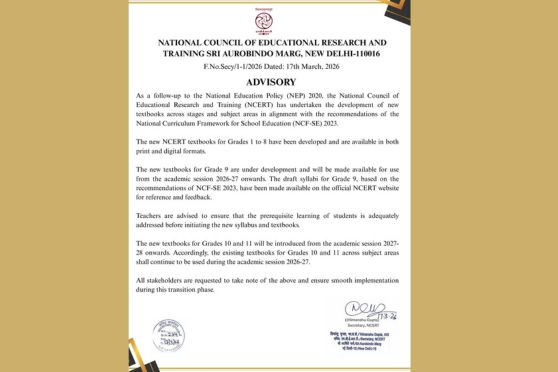
Official advisory on textbook rollout. NCERT X handle
As per the current rollout plan, textbooks for Classes 1 to 8 have already been developed and made available in both print and digital formats. Meanwhile, new textbooks for Class 9 are currently under preparation and are expected to be introduced in the 2026–27 academic session. To support this transition, NCERT has also released draft syllabi for Class 9 aligned with the NCF-SE 2023, inviting feedback from teachers, experts, and other stakeholders through its official platform.
In line with these reforms, NCERT has introduced a new English textbook for Class 9 titled Kaveri, which replaces the earlier books Beehive and Moments. The revised textbook reflects a shift in focus towards Indian authors and the integration of Indian Knowledge Systems, while also maintaining a global literary perspective.
Kaveri comprises 16 selected texts, equally divided between Indian and international writers. The Indian section features works by noted authors such as Subramania Bharati, Sudha Murty, Temsula Ao, Mitra Phukan, and Rabindranath Tagore. The book opens with a story from Sudha Murty’s 2004 collection, setting the tone for a diverse and culturally rooted reading experience.
The international section includes contributions from writers such as David Roth, Charles Swain, Bryanna T. Perkins, Robert Langley, Maya Anthony, and Irene Chua. It also features an anonymous poem and an interview-based narrative centred on Paralympic athlete Deepa Malik, adding contemporary and inspirational elements to the curriculum.
With the introduction of Kaveri, NCERT has streamlined the English curriculum by reducing the number of textbooks from two to one and cutting down the total number of chapters from 29 to 16. This move aims to simplify the learning process while ensuring a balanced representation of both Indian and global literature.
The latest update underscores NCERT’s ongoing efforts to align school education with the objectives of NEP 2020, focusing on conceptual clarity, cultural relevance, and reduced academic burden. Students of Classes 10 and 11, however, will have to wait until the 2027-28 academic session for the introduction of the revised textbooks under the new framework.
Last updated on 19 Mar 2026