Summary
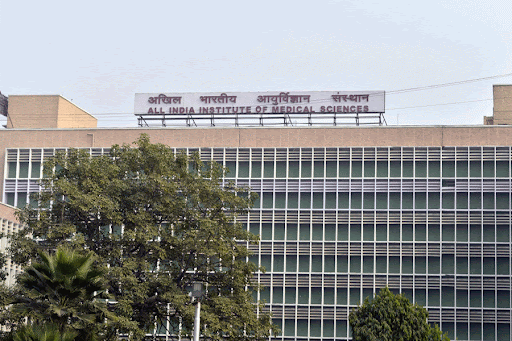
The All India Institute of Medical Sciences (AIIMS), New Delhi, has introduced a comprehensive set of social media guidelines for students, residents, faculty members, researchers and employees.
The new policy, approved by the Competent Authority and implemented with immediate effect through an office memorandum, seeks to regulate the use of social media platforms while addressing concerns related to institutional branding, patient privacy, academic integrity, and online conduct.
The All India Institute of Medical Sciences (AIIMS), New Delhi, has introduced a comprehensive set of social media guidelines for students, residents, faculty members, researchers and employees, establishing a formal framework for responsible digital engagement and the protection of the institute’s reputation. The new policy, approved by the Competent Authority and implemented with immediate effect through an office memorandum, seeks to regulate the use of social media platforms while addressing concerns related to institutional branding, patient privacy, academic integrity, and online conduct.
According to the memorandum issued by the Academic Section, the guidelines have been formulated to encourage responsible use of social media and reduce reputational as well as legal risks arising from unauthorised representation of the institute. AIIMS acknowledged the growing importance of social media as a tool for communication, outreach and public engagement but stressed that misuse of institutional identity or unauthorised representation could lead to serious consequences for both individuals and the institution.
The policy applies to a broad range of stakeholders associated with AIIMS New Delhi. These include students enrolled in undergraduate, postgraduate, doctoral and super-speciality programmes, recognised student bodies and associations, faculty members, researchers, administrative personnel, institutional departments and centres, as well as third-party collaborators or individuals who may be granted temporary access to institute-related communication platforms.
A major feature of the guidelines relates to the use of the AIIMS name, logo, emblem and official branding. The institute has made it clear that no student, employee, association or affiliated body may use the name “AIIMS, New Delhi” or any official branding elements in digital or print formats without obtaining prior written approval from the concerned department. Even when permission is granted, the use of institutional branding must strictly adhere to official standards prescribed by the institute.
The memorandum specifically identifies several forms of unauthorised use. These include displaying the institute’s branding on event posters, banners, social media profiles and digital handles on platforms such as Instagram, Facebook and X that may create the impression of official representation. AIIMS has also prohibited the use of its branding in promotional videos, reels, blogs or similar content created without authorisation. The institute noted that these requirements are aligned with provisions under the Indian Medical Council Regulations, 2002, as well as the Digital Personal Data Protection Act, 2023.
Members of the AIIMS community have been instructed not to disclose patient-related information, images or records through social media platforms. The institute has also prohibited the circulation of copyrighted material without appropriate permission or attribution. Further, users have been directed to refrain from sharing content that may be considered harassing, threatening, discriminatory or otherwise harmful. The policy additionally requires compliance with the UGC Regulations on Curbing the Menace of Ragging in Higher Educational Institutions, 2009, and prohibits the publication or dissemination of obscene, defamatory or hate-based content.
To uphold academic standards, AIIMS has included provisions addressing academic integrity in digital spaces. The guidelines prohibit plagiarism, academic misconduct and the sharing of confidential educational materials through social media channels. Students and employees have been specifically directed not to post or circulate examination papers, answer keys, evaluation materials or other sensitive academic documents that could compromise institutional processes.
The memorandum also introduces governance mechanisms for official and semi-official social media accounts operated by student organisations, departments or employees. Such accounts must be formally registered with the relevant department, and details of account administrators, including names, contact information and institutional email addresses, must be submitted. Departments have been instructed to designate a Media Coordinator who will function as the nodal authority for content review and approval. In addition, official accounts must clearly state whether content has been generated by students or departments and should avoid implying institutional endorsement unless such approval has been explicitly granted.
Read the official notice here.
Last updated on 26 Jun 2026