Summary
Yutika Das of M.P. Foundation Higher Secondary School is preparing for her Class XII board exams next year
Yutika Das of M.P. Foundation Higher Secondary School is preparing for her Class XII board exams next year. It involves studying for several hours at a stretch and sitting for a three-hour exam.
"At first, staying focused was difficult, as I kept getting distracted by scrolling my phone or, earlier in school, by gazing out of the window," she said, citing a problem faced by many. Yutika sought help from her mother and now consciously practises how to focus. According to experts, attention spans are increasingly getting shorter, sometimes turning into a disorder.
"Studying for long stretches leads to mistakes, so short breaks — like a walk — help me recharge and focus better," chipped in Aarushi Chakraborty, a Class VIII student of South City International School.
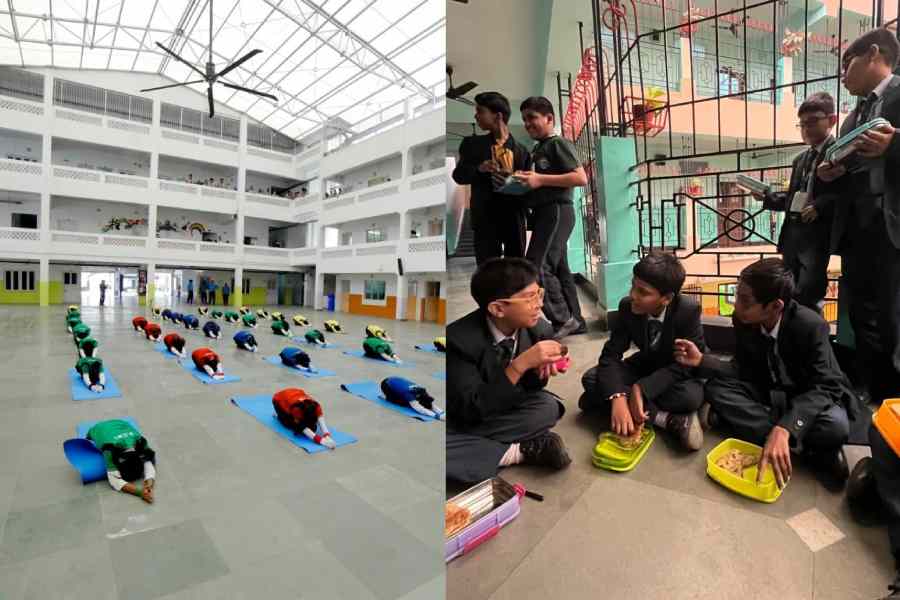
Schools have also realised the growing problem and are arranging their timetables accordingly. From making activity and yoga rooms more accessible to students to implementing two recesses and a transition zone between classes, the authorities have devised various ways to hold students' attention.
"Thanks to social media and the reel culture, students cannot concentrate for more than a few minutes," said Madhumita Sengupta, principal of B.D.M. International, a school with over 7,400 students.
According to her, around 150 of her students have been diagnosed with attention deficit hyperactivity disorder (ADHD), but many more are undiagnosed, lack patience or get bored easily.
"We have activity and book corners in the Pre-primary section, up to Class I, so that students can have some me-time after their lessons. We also have a yoga and meditation room where students and teachers can go when they're free to clear their minds. We integrate quizzes and activities with regular lessons, thus gamifying them," said Sengupta.
Anabia Irfan Wadood of Class V, Mahadevi Birla World Academy, said interactive, gamified lessons always kept her refreshed in school. "A full period of only the teacher speaking would be boring, and when my attention drifts — especially at home — I move around, like cycling in my compound, to refocus," she said.
The vice-principal of her school, Nupur Ghosh, said their students were also given two breaks, a long and a short one. "A child is free to take as many water breaks if the attention dips. Whenever I see children talking and fidgeting in class, I ask them to close their books, and we do some mind gym or yoga exercises together," she said.
A lot of time goes into making the timetables in schools.
"Since Covid, I have seen more children with shorter attention spans. We have added more co-curricular activities. We ensure the timetable offers relief to the brain in between heavy classes," said Sujoy Biswas, principal of Ram Mohan Mission High School.
M.C. Kejriwal Vidyapeeth (MCKV) also offers two breaks to refresh the students. "We follow a thoughtfully structured timetable with two well-spaced breaks that allow children to return to their classes with renewed focus," said headmaster Biswajit Majumdar. "Besides activity spaces, we have also incorporated brief transition periods between classes," he added.
Hrid Banerjee, a Class VI student of the school, added how he often stares at plants to get back to lessons. "Jotting things down or looking at greenery outside always helps," he said.
According to Rumjhumi Biswas, the educators at Swarnim International School often send children with attention issues on errands to help them refocus. "That always works. We also give them our students recesses, a fruit and a lunch break," she said.
"Lately, I am coming across people of all age groups with various attention issues. Most children cannot concentrate for over 20-25 minutes now. Overload of information and excessive screen time are adding to the problem. After long screen time, children find books boring. Hence the need for breaks," said Sanjay Garg, consultant psychiatrist.
Last updated on 25 Dec 2025