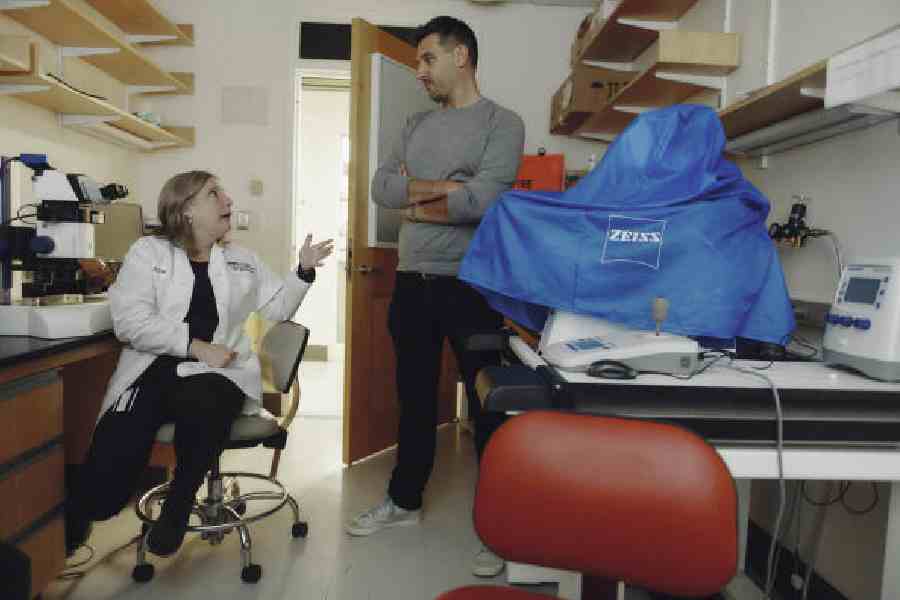
Will Mair, a Harvard University professor who studies ageing, was preparing to lead a panel discussion one afternoon last May when he picked up his phone to review the questions he planned to ask.
Peering at the screen, he saw a flurry of text messages, and then an email bearing staggering news: “You are receiving this email because one (or more) of your projects have been terminated per notice from the federal funding agency.” Weeks earlier, Harvard had refused to comply with the Trump administration’s demands for sweeping changes. Now the White House had retaliated, cutting off billions of dollars in research grants and contracts.
Why do Harvard researchers need federal funding? Couldn’t their work be paid for by private donors, and by corporations that could benefit from their findings? It was true that sometimes products emerged from decades of biomedical research and made billions of dollars. Weight loss drugs like Ozempic and Wegovy were recent examples. But the path to such discoveries was long, Mair explained to the audience, requiring years of costly, unplanned detours.
“No for-profit company could possibly withstand all the false leads required by that process,” he recalled telling them, “all the weird, random science that never panned out”.
For Mair, 47, a native of Britain and a professor of molecular metabolism at the T.H. Chan School of Public Health, chasing breakthroughs felt critical and urgent. A century of scientific progress had added decades to average life spans, yet human bodies were still ravaged by time. To keep his lab afloat, at a cost of $1,000 to $2,000 (about ₹1-2 lakh) per day, Mair would have to find new ways to pay for it.
Mair had been granted tenure in 2024, making his job secure no matter what happened. His employees were much more vulnerable. A day or two after they lost their funding, Mair stepped into his lab and asked the staff to gather in a nearby break room.
Mair had been advised to lay off employees. Instead, he told them, he would use the money he had negotiated as part of his tenure agreement to keep their team together for as long as he could.
In early September, a court ruled that the Trump administration had broken the law in freezing Harvard’s research funding. It felt like a victory, and afterward, some faculty members’ grants were restored. But Mair’s money was caught in a complicated tangle.
The funding freeze had caught him at the end of his five-year funding cycle. His previous five-year grant was almost gone, and was now terminated. He had applied for another round of government support, but the new money was still pending. So when Harvard stepped up and covered portions of some active grants to help keep research going, Mair was passed over.
Yet no one knew if or when new grants would be processed, within a funding system stricken by layoffs, restructuring and a six-week government shutdown. With his lab mired in uncertainty, he decided to take on a new role as a part-time consultant to a for-profit company. The venture, co-founded by Hollywood mogul Jeffrey Katzenberg, planned to expand its investments in ageing research, and Mair would help decide where the money went. The company would not help fund his lab. But it would give him new connections, in a realm where potential donors might one day be found.
Mair had made another decision in the midst of the disruption — to become an American citizen. In his two decades in the country, it had never seemed necessary. But now the Trump administration was going after international students and researchers. The self-assurance he had once felt passing through airports, crossing borders, as a Harvard professor with a green card, was gone.
As the year ended, negotiations between Harvard and the White House entered an eighth month. The Trump administration announced in December that it would appeal the court ruling that had blocked its freeze on Harvard’s research funding. Most of the funds the government had withheld had been restored. But Mair still had no idea if or when his grant might come.
To extend his pledge to cover salaries for his staff, he had enacted deeper cuts, slashing his lab’s budget for experiments by 80 per cent. Some employees had left. The lab felt like a ghost town.
In mid-January, Mair received a text from his grants manager. “NIH says we’ll have an NOA on Friday!” it said. The NOA, or notice of award, would mean that his top-ranked research proposal would finally be funded. He should have felt elated. Instead, he felt uneasy. “I’ll believe it when I see it,” said Mair.
NYTNS
Last updated on 07 Apr 2026