Summary
The Central Board of Secondary Education (CBSE) has introduced a new syllabus on Computational Thinking (CT) and Artificial Intelligence (AI) for students from Classes 3 to 8.
The curriculum has been developed with inputs from leading academic institutions and subject experts to equip students with essential future-ready skills.
The Central Board of Secondary Education (CBSE) has introduced a new syllabus on Computational Thinking (CT) and Artificial Intelligence (AI) for students from Classes 3 to 8, marking a significant step towards integrating emerging technologies into school education. The curriculum has been developed with inputs from leading academic institutions and subject experts to equip students with essential future-ready skills.
The syllabus has been prepared with contributions from faculty members of IIT Madras, Azim Premji University, and Dhirubhai Ambani International School, among others. Additionally, the Centre for Creative Learning at IIT Gandhinagar played a key role in designing the curriculum. The board also consulted mathematics and computer science teachers, along with school principals, to ensure the syllabus is practical and relevant.
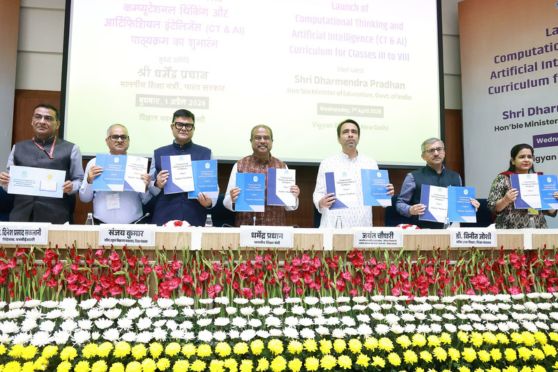
The new curriculum was officially unveiled during a press conference attended by key education leaders, including Union Education Minister Dharmendra Pradhan, National Council of Educational Research and Training Chairman Dinesh Prasad Saklani, and CBSE Chairman Rahul Singh.
According to officials, India joins a select group of countries such as China, South Korea, Finland, Estonia, and Singapore that have incorporated artificial intelligence into school-level education. The initiative aims to foster critical thinking, problem-solving abilities, and digital literacy among students at an early stage.
The syllabus has been approved by NCERT and is supported by three key documents: a detailed curriculum framework, a teachers’ handbook for Classes 3 to 8, and comprehensive teaching-learning materials. These resources are designed to help educators effectively deliver the new content in classrooms.
The Ministry of Education has also emphasised the need to make the curriculum accessible in multiple Indian languages. NCERT has been tasked with working in collaboration with State Councils of Educational Research and Training (SCERTs) to translate and adapt the content for regional contexts.
In line with global education standards, CBSE has also announced plans to develop competency-based assessments for skill subjects, aligning them with benchmarks such as the Programme for International Student Assessment (PISA). Additionally, the board is considering the introduction of semiconductor technology as a skill subject for students from Classes 8 to 12.
With this initiative, CBSE aims to strengthen foundational learning in technology and innovation, preparing students to navigate an increasingly digital and data-driven world.
Last updated on 02 Apr 2026