Debra Barksdale vividly remembers her first nursing school clinical rotation. “It was terrifying,” said Barksdale, who is the president of the American Academy of Nursing. “Your head is full of all this knowledge, but actually putting it in practice in front of a real live human being is very daunting.”
It’s been 40 years since then, and things have changed. Increasingly, students in training are not starting with human patients. They are working on lifelike manikins.
While mannequins are used to model clothing, manikins are models of the human body used to train medical professionals. Also known as high-fidelity medical simulators, they can cry, sweat, bleed, blink and breathe. Some of them can convulse and foam at the mouth.
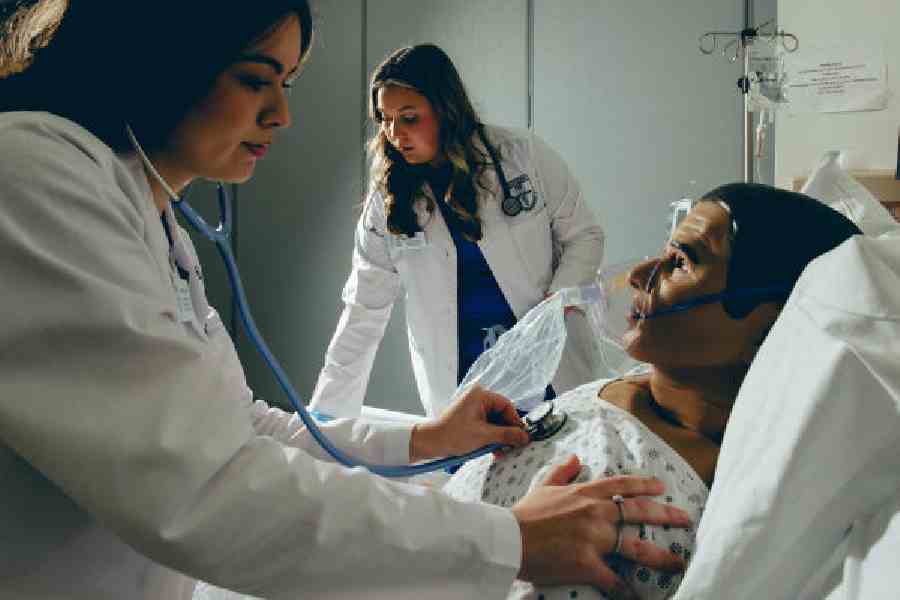
At a recent training at Seton Hall University’s clinical simulation centre in New Jersey, US, Juliana Vitolo, a nursing student, had an appointment with a “pregnant” manikin named MamaAnne. “How are you feeling?” Vitolo asked. MamaAnne blinked a few times and answered, “I’m having a little pain in my lower abdomen.”
The use of manikins has grown significantly in recent years; in professions such as nursing, they have become a training staple. Research has suggested that working with these manikins not only enhances knowledge and performance, but improves skills such as communication, confidence and empathy.
There are roughly 2,00,000 of these simulators in the US, said Inger Stenberg, head of public affairs at Laerdal — that manufactures such manikins — and they are used in hospitals like the Mayo Clinic as well as in trade schools. The US Army, Navy and Coast Guard use them too.
Trainees can feel a realistic pulse that can be programmed to race. They can draw “blood”, a red fluid that can “clot” when mixed with gelatin. And they can inject fluids into a manikin’s arms, which are covered with soft silicone. Some simulators even have pupils that contract when their eyes are examined with a flashlight.
Premature baby manikins have fine hair (from a goat) and geriatric models have wrinkled skin and cataracts. There are interchangeable “headskins”, silicone faces in different skin tones, to represent diverse patient populations.
Manikins have been used in healthcare training for decades, but today’s high-fidelity medical simulators allow students to rehearse complex, dynamic procedures. Kevin Ching, medical director of the simulation centre at NewYork-Presbyterian and Weill Cornell Medicine, US, says, “Students can rehearse everything from respiratory failure to shock, sepsis, cardiac arrhythmias,” he said.
The manikins at the simulation centre at the University of North Carolina Greensboro School of Nursing are so sophisticated, Barksdale said, that “if you’re walking around at night, and you stumble into one of our labs, you would think it’s full of people”.
“It can be kind of scary,” she added. For healthcare trainees, the prospect of medical errors is far scarier — and research suggests that simulation-based training with high-fidelity manikins improves performance in real-life clinical environments.
This training stresses the need for precision, which can enhance patient safety down the line, said Jennifer McCarthy, director of the clinical simulation programme at Seton Hall. When trainees administer medication to a manikin, the technology inside of it measures the exact volume delivered.
“If a team is expected to give 2 millilitres of a medication but only administers 1.8 millilitres, that discrepancy may not seem like a big deal,” she said. “But this is an error, and errors can have harmful consequences.” At Seton Hall, the manikins actually “talk” so healthcare workers can rehearse patient interactions like the one between MamaAnne and Vitolo.
A simulation operations specialist speaks from inside a control room, and their voice is modulated to mimic a male, female or child voice for the manikin. For professions like nursing, which involve frequent communication with patients, this feature is especially helpful, said Fiorella Carvo, a nursing student.
“We’re learning how to build rapport in an environment that can be intimidating,” said Brittany Hague, a speech-language pathology student who also trains with manikins. Some manikins can also be programmed to have medical conditions that change suddenly, Ching said. At Seton Hall, for instance, a baby manikin can be engineered to become lethargic, and students have to check vitals.
Hague said that the most valuable aspect of learning on a manikin was the self-assurance it gave her. “The more mistakes you make in a safe environment, the more you’re able to learn,” she said. “So that it doesn’t happen in the real world,” she added.
NYTNS
Last updated on 19 May 2026