 |
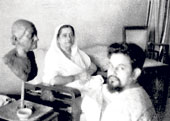
| Sarbari Roy Choudhury with Kesarbai Kerkar posing for her portrait |
Sarbari Roy Choudhury is a difficult artist to define, and R. Siva Kumar’s recently launched book, titled Sensibility Objectified, The Sculpture of Sarbari Roy Choudhury, goes a long way in improving our understanding of the sensibility of an artist that was enriched as much by Hindusthani classical music as by his mentor Pradosh Das Gupta and modernist masters like Alberto Giacometti and Henry Moore.
The book brought out jointly by Akar Prakar, Mapin Publishing and Lalit Kala Akademi has a wealth of excellent reproductions of the sculptor’s works as well as some invaluable photographs of the sculptor. We see him as a young man, and as he grows into maturity, so does the amazing diversity of his work.
The sensitive young man gradually develops into the sculptor who models the portraits of Ustad Ali Akbar Khan, of Kesarbai Kerkar at her home in Mumbai, and is seen in the company of the heads of Alauddin Khan and that of Bade Ghulam Ali, which he holds aloft like a mask.
Sarbari is also seen with his guru, with Ramkinkar and Giacometti, and in his own studio in Calcutta in the 1950s, and later in Santiniketan, where he continues to live with his family who also appear in these photographs.
What raises the value of this book, however, is the photographs of his sculptures, which, as Siva Kumar writes, may have been minuscule but created the impression of monumentality. The photographic images increase the scale and dimensions of his actual works.
They also accentuate his role as a modeller “in the best modernist tradition for whom sculpture is the magical act of turning clay into flesh.”
The author, who now teaches art history in Visva Bharati, was himself a student in Santiniketan, and his proximity to the sculptor makes his writing more insightful. He writes with feeling about the tactile quality of Sarbari’s sculpture — “…Sarbari fictionalises scale and thus space in his intimately sized works while keeping the surface real in relation to our sensory, primarily tactual, experience of objects.”
Unlike many art historians and artists he seldom uses gobbledygook and so reading the text is a pleasurable experience. His analyses of the portraits and the method of their creation stems from a great understanding of the artist’s method as well as Indian classical music that often inspired Sarbari. His prose in these sections is expressive of Sarbari’s technical rigour.