 |
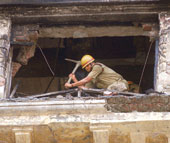
| A fireman demolishes a crumbling portion of Stephen Court on Friday afternoon. Picture by Amit Datta |
Calcutta’s legitimate tryst with illegal construction dates back to the year when Charlton Heston, the man who was to make the Red Sea part as Moses, was born.
No wonder the provision of regularising illegal constructions, born in the Calcutta Corporation Act of 1923, resuscitated in the 1980s and now caught in the glare of the Stephen Court inferno, has enjoyed such a smooth passage.
Till the 1970s, this provision was hardly invoked because of lack of violation on the one hand and the daunting task of having to approach a municipal magistrate for such regularisation on the other.
The first illegal multi-storeyed commercial structures came up in the mid-1970s — Nandram Market on Brabourne Road and Shree Shyam Market at 174 CR Avenue. Prior to that illegal constructions were limited to an additional room or floor for personal use.
The rules of the building game changed dramatically after the Left Front came to power. A revival of trade and commerce in the post-Naxal period saw the rise in demand for commercial space in the central business district.
But the scope for growth was stunted as the CMC Act did not allow adequate vertical growth. (This was amended in end-2009.) Rebuilding was also not feasible as FAR (floor-area ratio) had shrunk through successive changes to the Act in 1923, 1951 and 1980.
So, how could the central business district grow? Vertically and illegally, of course.
Enter, politicians, a section of corrupt civic officials and local police officers. A group of moneyed middlemen — or fiddlers on the roof — began scouting for old buildings. They would approach the landlord, lure him with cash and the promise of a facelift for access to the rooftop. The landlord would approach the CMC for repair work permission.
What would begin as repair would soon turn into construction of additional floors. The local councillor and cops would turn a blind eye. With good reason.
“Back in the 1980s, an addition of 1,000sq ft of commercial space above an existing building would cost Rs 1.5 lakh but yield not less than Rs 25 lakh. So, there was enough cash to cast around,” said a retired official in the building department.
It was time to remove the roadblocks to regularisation and get some of this money into the official coffers. Step one was to allow a house-owner to approach a hearing official rather than a municipal magistrate.
What Calcutta did yesterday, Bangalore strives to do today |
■ A scheme was mooted by the Karnataka government in September 2007 to regularise violations in land use and building bylaws through penalties. ■ Called Sakrama, it was meant to avoid the large-scale demolition of illegal buildings in the state’s urban areas. ■ It allowed a three-month window for regularising violations such as buildings constructed on sites formed illegally, and violations of building bylaws such as exceeding the floor-area ratio. ■ The scheme was opposed by citizens saying it was unfair to those who obeyed the law. ■ In December 2007, Karnataka High Court ordered a stay on the scheme, while hearing a petition challenging the scheme. ■ In December 2009, Karnataka’s ruling BJP cleared a revised Sakrama scheme and tried to enact it through an Ordinance. ■ In January 2010, Governor H.R. Bhardwaj declined to give his assent and returned the Ordinance with an observation that there should be a detailed discussion on the scheme in the legislature. |
The CMC Act 1980 took care of that, vesting the authority of regularising — or ordering demolition of — illegal construction.
One of the first big beneficiaries of this was Stephen Court. In 1984, with municipal affairs minister and CPM leader Prasanta Sur at the helm — the civic body at that time was superseded — the illegal additional floors atop 18A Park Street were “regularised”.
How did the regularisation match-fixing work? Fiddlers on the roof, or builders eyeing the rooftop of large buildings in the central business district, would work the system to get what they wanted — prime square feet to sell or lease out.
The building department would slap a showcause notice on an illegal construction, the cue for the local councillor to team up with key employees of the building department and strike a no-demolition deal.
The house-owner would be summoned before the hearing officer, a retired bureaucrat or member of the judiciary picked for his proximity to the powers that be. In most cases, the house-owner would not turn up for three hearings. An ex-parte penalty would be imposed and the illegal floors would be regularised. The builder would pay the penalty — Rs 300 to Rs 500 per square feet — in the name of the house-owner.
Regularisation became the most wanted tool of growth because this process — unlike with a new construction — did not require clearance from the police, the fire brigade, the CMDA or a chartered structural engineer. Once regularised, a property would enjoy all legitimate benefits — from bank loan to registered sale deed.
The total number of illegal buildings in Calcutta now stands at over 2.5 lakh, 1.3 lakh of them in the Theatre Road, Park Street, Camac Street, Sealdah and Burrabazar areas. Theatre Road, Park Street and Camac Street abound with regularised illegal buildings in order to attract the big brands of business.
Illegal buildings in Sealdah and Burrabazar, Jadavpur and Behala, Topsia and Tiljala, Kasba and Tollygunge, Kidderpore and New Alipore do not even bother to go in for regularisation.
Clearly, Calcutta quite likes being street illegal.