 |
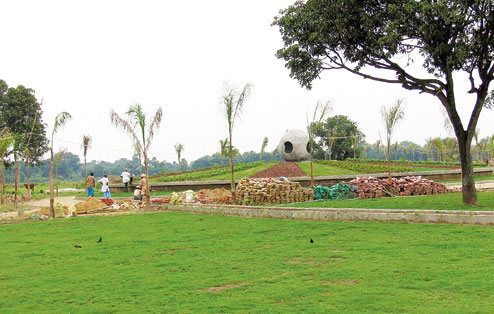
| The park beside the Motijheel lake that is being renovated for tourism. Picture by Debasish Das |
A palace embraced by an ox-bow lake and the site of much intrigue at the hour the British scored its first decisive victory in Bengal is getting a new lease of life.
The grounds of the 18th century Motijheel Palace, the residence of Ghaseti Begum, Siraj-ud-Daula’s aunt who conspired against him, are getting a facelift.
Chief minister Mamata Banerjee had launched the renovation project on December 17 last year and the grounds were opened to the public on August 8.
However, many feel the grounds were thrown open in haste as only 60 per cent of the work had been done in the seven-and-a-half months.
The park is in Murshidabad town and 12km from Behrampore, which is the district’s main town.
“The park should have been completed before it was officially inaugurated. It could have been a milestone for tourism in historically rich Murshidabad. Tourists coming from distant places are returning thoroughly frustrated,” regretted principal of Giaganj Sripat Singh College Mohammed Samsujjaman.
 |
But more is in the offing at Motijheel, so called because of the surrounding water-canal where pearls (moti) were cultivated.
The Motijheel grounds stretch like a vast, but forgotten tract of history. Only a part of the palace exists on the eastern side of the 40-acre grounds. The remnants of Ghaseti Begum’s residence are not being touched. A huge wall is being erected around the palace.
The area will be revamped with other features as well.
A 2.4km road is being constructed on the bank of the lake. There will be five cottages for the tourists amidst the greenery and tranquillity. Two children parks, orchards and a rose garden are also lined up.
At least 40 types of roses will be planted. Besides, there will be an open-air stage and a gallery for the audience and the grounds will be dotted with retro lampposts and musical fountains.
The chief minister had sanctioned Rs 11 crore for the project.
Ghaseti Begum was the eldest daughter of Alivardi Khan, the popular nawab of Bengal, Bihar and Odissa, who was succeeded by his grandson Siraj-ud-daula. Siraj’s mother, Amina Begum, was the youngest of Alivardi Khan’s three daughters. Alivardi Khan had no son.
Ghaseti Begum was married to her cousin Nawazish Muhammad Khan Shahmat Jang, the naib-nazim of Dhaka, who came over to Murshidabad to help Alivardi Khan with administration.
Nawazish had built the Motijheel palace within the ox-bow lake around 1743. He had built a huge gate on the western side of the palace and a mosque, a madarsa and a rest-house near the gate. Nawazish passed away soon after the untimely death of his adopted son.
After her husband’s death, Ghaseti Begum inherited his vast wealth as well as Motijheel palace.
After Alivardi Khan’s death in 1756, Ghaseti Begum tried to place the son of her second sister on the throne of Murshidabad. But she failed in her mission and was kept under house arrest at Motijheel palace by Siraj.
Later, she conspired with Mir Jafar and the British to overthrow Siraj.
This time, Siraj lost and was killed, but Ghaseti fared not much better. According to an account, she was killed by Mir Jafar’s men.
Official sources said the dilapidated portion of Ghaseti Begum’s palace was being kept intact.
Sources in the Murshidabad district administration said the horticultural department had already floated tenders to set up the orchards and the rose garden.
“But the officials of the department have virtually no role to play. The whole thing is being supervised by the district magistrate himself,” said a senior official.
The district magistrate said he was hopeful that Motijheel palace would be a pride of Bengal in near future.