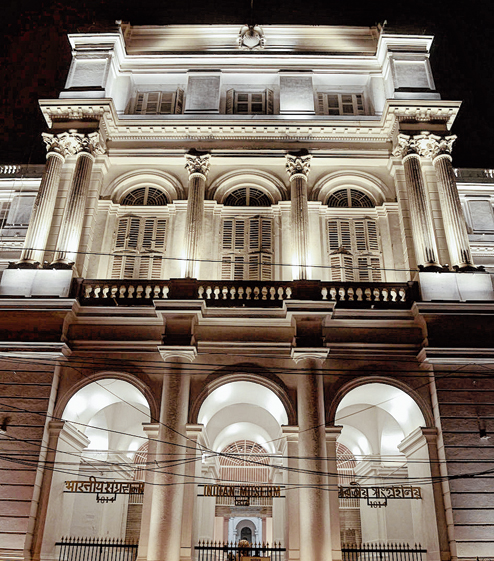

If you are planning to meet up with friends tomorrow after college or work, chances are slim that the Indian Museum will even cross your mind. But changes are afoot at the grand old Chowringhee landmark that might just change your mind. Soon.
"Museums will no longer work as simple repositories of the past. They have to reinvent themselves as open-ended cultural spaces. Indian Museum has to become a place where people want to be. It has to become a hang-out zone," said Jayanta Sengupta five days after formally taking charge as the director of Indian Museum on June 20.
He continues to be the curator and secretary of Victoria Memorial Hall and brings with him the experience of running a museum born out of the Raj's imperial knowledge system. As a teacher of history at Jadavpur University previously, he also has an idea of what young people want.
"I used to observe the Nandan premises. People sit, chat, have cha, have chop... that place has an energy. There are young people and middle-aged people and they like that zone. I wondered how to bring that buzz to Victoria Memorial. I wish to do the same for Indian Museum," he said.
Explaining the many "lives" of a museum, Sengupta said there were three basic things Indian Museum must focus on - day-to-day activities, a vision for the future and a digital roadmap.
"Daily activities include opening all the galleries every day, care and conservation of artefacts, documentation, data updating, fleshing out data when the information in the manual registers is not enough...."
Research and updating the database are very important, especially since the aim is to eventually have a completely searchable computerised database, an inventory of everything that the museum has.
"In cricket, like Dhoni says, 'Do the basics right', this is the core activity of a museum. It has to run smoothly for visitors to come and have a hassle-free educative experience," Sengupta pointed out. He wants to streamline the daily activities of the museum, and that includes everything from ensuring the courtyard drains rainwater to meeting the quorum for opening the galleries.

"Museum guidelines specify in whose presence a gallery might be opened - the curator, the gallery attendant and security personnel. There is a specific number for each gallery. Managing the quorum for every gallery every day is becoming very, very difficult, because while attendants and guards are retiring, we are unable to recruit because of a court stay order. We are somehow managing, either by tweaking provisions in the guidelines or using interns to meet the quorum."
Coming to the second "life" of a museum, he feels, "a museum should always have a vision of where it wants to go... how does it want to see itself 20 years or 50 years later".
Indian Museum, Sengupta reminds us, is the oldest museum outside of Europe. "While documentation may be inadequate, there is no doubt that we have the most interesting collection among all historical museums in India. Our collection is hugely important and historically significant, even more than the National Museum in Delhi," he said.
Sengupta feels that museums cannot afford to think that they will only collect objects from the past and people will go to see them. "This is a laidback approach which is being abandoned all over the world. A museum has to sell itself. It has to proactively reach out and pull people."
One primary way to reinvent the museum is to design it as a cultural space. "In the last four-five years so many coffee shops have opened in Calcutta. People go, have coffee, talk... Look at the courtyard we have, look at the building, and look at the location - right in the heart of the city! That advantage has to be maximised," said Sengupta.
While he was serving as the museum's interim head, just before taking over, the museum received a proposal from the NGO, PUBLIC, for a discussion on "What makes a city great?".
"We readily agreed to co-host it," said Sengupta. A few days before that, the museum co-hosted the launch of Amitav Ghosh's book, Flood of Fire, in its courtyard. Both author and audience were mesmerised by the grand setting.
Sengupta plans to hold lectures, panel discussions, film screenings, programmes for schools and many other such activities to re-energise the museum space. And he wants to "aggressively market it to the people", so that many more feel like participating in the life of the museum.
Another plan is to start a museum shop. "I want to bring out more publications, more catalogues, photographic prints, portfolios... all of this should be available at the museum shop. A store has been created but it hasn't opened shop," he said, adding that merchandise like coasters with prints of Mughal miniatures are sure to find takers. "Imagine a couple coming here for a date. While leaving they can pick out Indian Museum T-shirts as gifts for each other," he smiled.
The third idea is to make value additions for a better visitor experience. "Like Wi-fi. Wi-fi is so important, it's like roti-kapda- makaan aur Wi-fi now," he laughed.
No museum, he explains, has enough space to display its complete collection. Less than 10 per cent of Indian Museum's collection is on display. "Every museum has about 150-200 objects that are the highlights, they are on permanent display. The rest are displayed on rotation, usually every three years.
"But visitors can be offered a combination of physical and digital displays. If we keep computers and interactive kiosks in the galleries and screen documentaries etc, we can give the visitor a better idea of the museum's entire collection," he said.