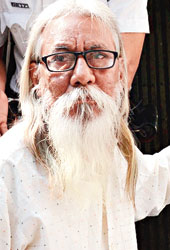
Calcutta, July 19: Gaur Chakraborty, the CPI (Maoist) spokesperson during the Lalgarh movement who was the first person to be accused under the Unlawful Activities (Prevention) Act (UAPA) in Bengal, was acquitted by a Calcutta court today.

"The investigation has failed to prove the charges against the petitioner. So this court is acquitting the petitioner of all the charges," said Kumkum Sinha, the second additional magistrate of the chief metropolitan magistrate's court in Calcutta.
According to police, Chakraborty, 73, who had allegedly identified himself as the rebel outfit's spokesperson during a show aired on a news channel on June 23, 2009, had been rounded up outside the channel's office.
The police had claimed Chakraborty had been picked up as soon as he stepped out of the television studio at Park Circus.
In today's verdict, judge Sinha said: "To substantiate their claim that Chakraborty had been involved in anti-national activities, the police had shown several reasons. But during the trial, the police failed to substantiate them."
"The investigation has failed to prove its claim that the petitioner was arrested from a TV channel office. None of the witnesses had deposed that they had seen the police arresting the petitioner," the verdict added.
The verdict mentioned that the TV channel anchor who the police said had taken the interview could not remember having done so. Police sources said cops had failed to submit before the court footage of the TV programme.
The judge pointed out that sub-inspector Debasish Dutta, who arrested Chakraborty, had himself filed the FIR and conducted the investigation. Under the law, a person who lodges the FIR cannot investigate the case.
The judge accepted the argument of Chakraborty's counsel, Subhasish Roy, and mentioned in her judgment that Dutta had claimed he had watched the TV programme while on duty. "How can a police officer watch TV during duty hours?" Roy had mentioned during the trial.
The judge said that according to a Supreme Court ruling, the police couldn't arrest a member of a banned organisation unless it had been proved that he was involved in anti-national activities.
"In this case, the police have failed to substantiate their claim that the petitioner was involved in anti-national activities," the magistrate said.
Judge Sinha added that according to the rule, an officer not below the rank of assistant commissioner of police can conduct a probe into cases under the UAPA. "But in this case, a sub-inspector conducted the investigation," the verdict mentioned.