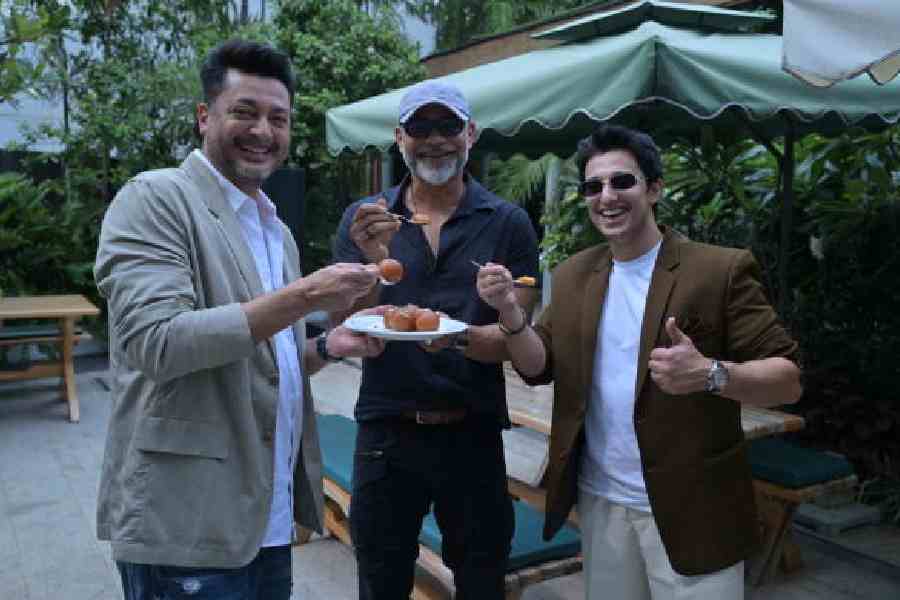
The release itself is a bigger event than the shoot these days,” says director Abhinay Deo as he settles into a sofa over lunch at a star hotel in Calcutta. The filmmaker is extolling the virtues of his favourite tequila, Tears of Llorona. “It has a bit more salt than most others, though not because of the tears in the legend behind the name,” he says with a grin.
The conversation soon turns to Brown, the neo-noir crime thriller that has brought him to the city. When t2 suggests uncorking a bottle to celebrate the show’s launch, Deo quickly objects. “I’d rather not have Tears of Llorona for Brown. Let it be a happier celebration,” he says, prompting cast members Jisshu U Sengupta and Aryann Bhowmik to burst into laughter.
You started with a dark comedy (Delhi Belly), moved to action thrillers and now a crime thriller. How long has Brown been in your head?
Abhinay Deo: In 2021, the Zee team came to me with the book and I started work on it. So it has been in my system for more than five years now.
Did you ask your actors to read the book?
Abhinay: I don’t recommend or discourage any process. I read the book once and shut it. Between a book and a screen adaptation, there is a lot of difference. Thinking constantly about the book is unfair to the screenwriting process.
Jisshu U Sengupta: For me, the script is the Bible because that’s what I’m going to shoot. It’s the director’s vision. If a story is adapted from a book or an older film, I generally avoid revisiting the source material. I didn’t watch Sanyasiraja before doing Ek Je Chhilo Raja. In fact, I only learnt on the second or third day of shooting Brown that it was adapted from a book.
Aryann Bhowmik: I was given a deck during the audition process and saw that it was based on a book. Out of curiosity, I read it. Later, I realised how different the adaptation was.
How much did you change from the original?
Abhinay: I retained the essence. The book’s author had done extensive research, especially about the city, and I relied on that because I’m not from Calcutta. But there were major changes. We added characters, altered relationships and even changed the way the crime unfolds. The characters are very differently imagined.
The protagonist in the book was Sohini Sen, a Bengali. Why make her an Anglo-Indian?
Abhinay: Calcutta has a unique mix of communities — Marwaris, Chinese, Anglo-Indians. I wanted to incorporate that texture. So the lead became Rita Brown, who speaks some Bengali but speaks English at home.
How did you approach casting, especially local actors?
Abhinay: I first focus on characteristics rather than faces. Once the script was locked, I started imagining who could embody those traits. I watched a lot of Bengali cinema and worked with a local casting director.
Which of Jisshu’s films did you see?
Abhinay: I already knew Jisshu. He’s a superstar. My concern was whether he’d say yes. I had seen his Byomkesh Bakshi and Ek Je Chhilo Raja. I loved them. Bengali cinema has managed to retain a certain purity. Marathi cinema, where I come from, has increasingly become a small brother of Hindi cinema.
You’ve retained quite a bit of Bengali in the dialogues.
Abhinay: When two Bengalis speak, they are bound to slip into Bangla. We wanted authenticity, but we also ensured that important information is conveyed in a language everyone can understand.
Without giving away spoilers, what is Brown about?
Abhinay: The trailer makes it clear that there is a murder under investigation. Jisshu plays a psychologist assisting the police, while Aryann plays a character with obvious shades of grey. There are several morally ambiguous characters. In older suspense films, the culprit often appeared only at the end. I always felt cheated by that. Here, the key person is right in front of you all along.
The opening close-up of Karisma Kapoor is startling. We’ve never seen her look so vulnerable.
Abhinay: Karisma’s potential is immense and she’s reinventing herself. This is the best performance of her career, in my opinion. We stripped away every possible advantage — no make-up, no hair-do. My instruction was that nobody would hand her a mirror on set. Actors often get distracted by perceived flaws. I wanted the audience to see every flaw in her appearance.
Jisshu: We’ve never seen Karisma Kapoor like this. For our generation, the Govinda-Karisma pairing was iconic. Seeing her in such a raw avatar was a shock.
Shaan also makes a cameo.
Abhinay: That was my creative head’s idea. Initially, I was unsure whether he could hold his own opposite Karisma. But he did. Because he was there, we also incorporated the Rabindrasangeet that he hums in the show.
You also cast Helen. How did that happen?
Abhinay: I didn’t want someone in their 50s made up to look 85. We first tried finding actual Anglo-Indian actors, but that didn’t work out. Then we thought of Helen ma’am. She comes from a mixed cultural background herself. Initially, she was reluctant. She said, “I’m 80. Where will you take me?” Then she agreed on one condition: no climbing stairs. Ironically, there were stairs, but she still did it.
Jisshu: I had a sequence with Helen ma’am and Soni Razdan. I’ve worked with many legends, but Helen was someone I had only known from the screen. She had a remarkable aura about her, yet she was incredibly sweet.
Abhinay: She was in Calcutta for only two days. We shot at Bow Barracks and a church location. What surprised me most was her sense of humour. She would often improvise an extra line and then ask me, “Sir, is it okay?” Imagine Helen calling me “sir”!
There is a sequence where a police officer dives into the river from a boat while chasing a suspect. Where was that shot?
Abhinay: In Titagarh, where the river is almost half a kilometre wide. We went for a technical recce a day before shooting. The weather suddenly changed. Dark clouds gathered and the boatmen became nervous. I’m an adventure junkie, so I jumped into the water for a swim. Within seconds, the river turned violent. There was a thunderstorm and torrential rain. I was being tossed around while trying to swim towards the rocks near the shore. At the same time, our larger boat was heading directly towards me. Everyone was shouting that I’d get crushed between the rocks and the boat. I decided to dive under the boat and emerge on the other side. Within 45 seconds of us reaching land, both boats sank.
Jisshu: It was a full-blown kalbaisakhi.
Abhinay: Exactly. Surya Sharma, who plays the inspector, had agreed to do the dive. But after witnessing the boats sink, he changed his mind. There was no way we could convince him to jump into the river the next day, so we eventually used a body double.
How important was Calcutta to the story?
Jisshu: I’m a Calcutta boy, born and brought up in Lake Terrace, and I’ve worked in almost every corner of the city. But what struck me about Brown is that if you remove Calcutta from it, the series ceases to exist.
There was a phase when every production seemed content with drone shots of Howrah Bridge, a boat ride on the Hooghly and a glimpse of Victoria Memorial and the Maidan. That’s not the whole city. Brown goes beyond the postcards. It captures the lanes of north Calcutta, the neighbourhood addas and the lived-in texture of the city. That’s the Calcutta I recognise, and that’s what makes the show special.