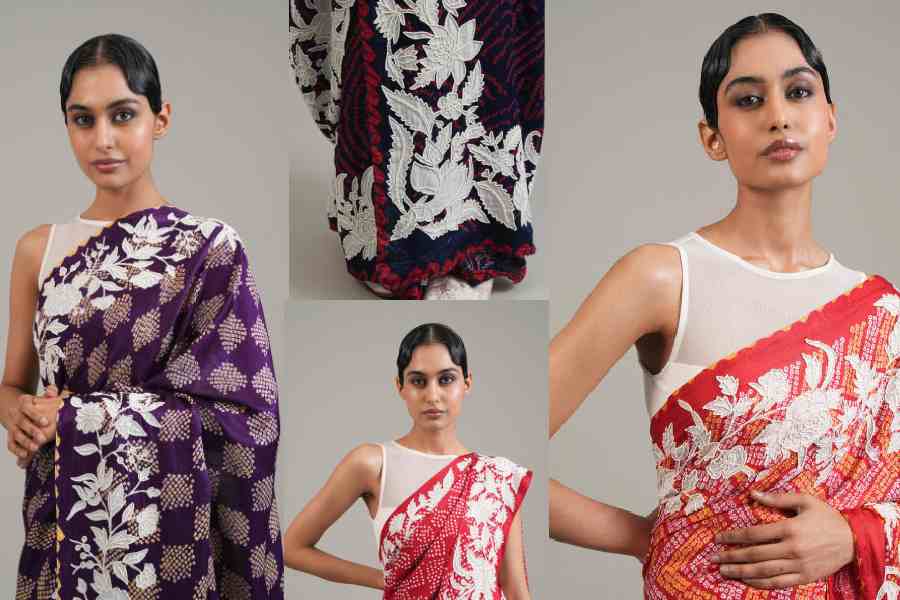
Delhi-based designer Ashdeen Z. Lilaowala, who has been stitching new tales with the age-old Parsi gara embroidery, giving it a contemporary twist and a new language for over a decade now, has fused the effervescent bandhni with the delicate art form. His aim has always been to use the same kind of vocabulary but refresh the colours, fabric, placement of motifs, change the proportions, merge two fabrics and refine the design. All to bring in a variety of new elements but keep the visual aesthetic the same.
In Tarana, his new collection of saris, Ashdeen used hand-dyed bandhni from Neelgar as the canvas and embellished it with beautiful handcrafted silk applique that has bead detailing. The colours are lively, like tulip pink, green and vermilion. The bandhni dots form various patterns on the saris — from zigzag and ombre to smart cubes. Simple and stunning.
“We’ve been working with bandhni quite a lot. This time we wanted to do something different with it. So, we thought that instead of doing full embroidery, if you see closely, it’s our applique work, and then we’ve done an outline of beads around the applique. So, it kind of came from this whole idea of how two cultures can merge. And there is a certain sense of harmony when two things come together, and it kind of really works well.
And that’s why we kind of went with the name Tarana. It signifies harmony. I’ve always enjoyed bandhni as a technique, its fineness, and how graphic it can be,” says Ashdeen.
The simple dot that lends itself to versatile designs. “The way you can use it to make it dance is lovely. It’s literally like a drawing, you know, in that sense. It’s a beautiful technique. It’s something inherent in Indian culture. When we travel with the bandhni collection, most people know what it is. It’s very identifiable as an Indian thing. Shibori and all are a little still, like Japanese or something. But I think everybody has seen this growing up and most women have some form of bandhni. It’s a form so ingrained in the Indian psyche that it is loved and admired,” adds Ashdeen.
Mixing it with Parsi gara is like advancing the language of Parsi gara. “Parsi gara, as I’ve always told you, is an amalgamation of many different aesthetics, which came together, like Chinese, European and Indian. So why not mix different techniques? I think that gives us a little more excitement and fun,” he says.
The saris can be worn for multiple occasions and dressed up or down. You could wear it for a Sangeet or cocktails. “Make it fun,” is Ashdeen’s mantra.
We agree!