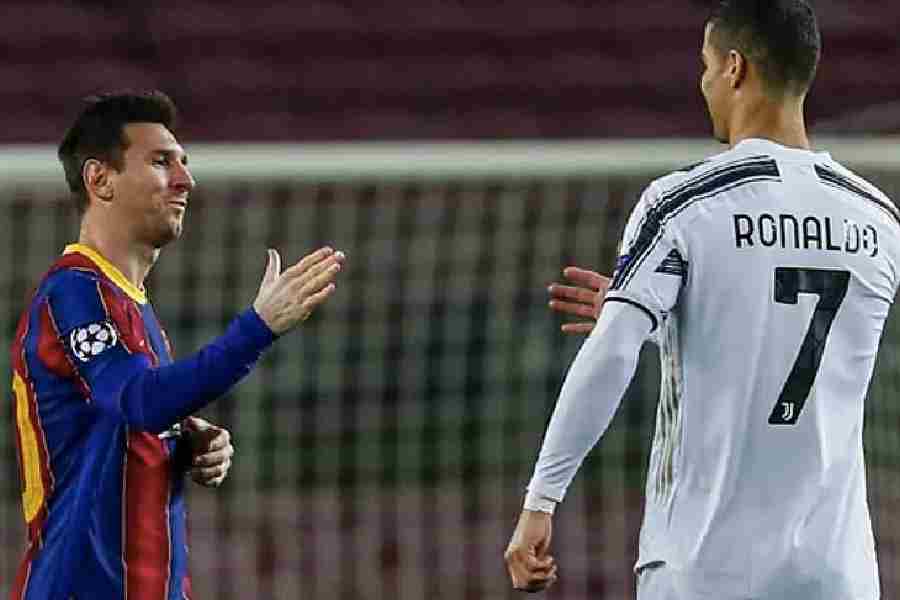
Legends are very much a part of one’s daily life, even if they cease to be in the public eye. And if they happen to be footballers, their accomplishments leave an indelible impression on the world of sports.
This edition of the Fifa World Cup prepares us to witness what could be one last shot from two household names and, of course, archetypes of greatness, whose rivalry had a generation divided, occupying a sizeable place in football folklore.
For Lionel Messi, 38, and Cristiano Ronaldo, 41, this World Cup appears to be their swansong, unless one of them — or maybe both — decides to spring yet another surprise and be back for 2030 as well.
Going into what will be their sixth World Cup appearance, both Messi and Ronaldo, despite being in the closing stages of their respective careers, must be hoping to make their last dance a truly memorable one. Messi, though, has already been crowned a World Cup winner, when he helped Argentina to their third Cup title in Qatar 2022.
For sure, a successful defence of the crown will double his delight as well as that of the rest of Argentina.
But for Ronaldo, this World Cup could be even bigger as he’s yet to have a feel of the coveted trophy in his hands. Portugal were Europe’s best when Ronaldo and his teammates won the 2016 Euro Championship, but the World Cup remains elusive. Will Ronaldo be able to produce a final spell of brilliance to help Portugal to their maiden Cup glory? Given his level of determination, he will believe so.
However, regardless of the revered duo and their team’s performance in this quadrennial showpiece, how they defined and tried to redefine modern-day football will leave a lasting impression on the minds of all.
Speaking of Messi first, beginning as a threatening winger, he became the “False Nine” during Pep Guardiola’s tenure as Barcelona manager before evolving into a deep-
lying playmaker and also doubling up as a menacing attacker when the situation demanded. Alongside his world-class dribbles that still sometimes appear almost as effective as those of Maradona, Messi’s precision in terms of his positional awareness and ball control could break open even the tightest of defences.
In the Cup that counts, it won’t be too surprising if he rolls back the clock and makes the fans relive those moments that made him “LM10”.
“Even if he is on the field facing difficulties, he brings us a great deal as he’s capable of creating and generating a lot,” Argentina coach Lionel Scaloni highlighted Messi’s role in the team.
Unlike Messi, Ronaldo has transitioned into more of an out-and-out striker, ultra-clinical in conversion, laying priority on aerial dominance and sudden explosive bursts alongside positioning himself correctly in the 18-yard circle. All of these combine to make Ronaldo deadly, although his record in Real Madrid colours isn’t great against a Barcelona team with Messi in it.
However, staying committed to physical conditioning has led to his incredible fitness, which continues to make him an asset for Portuguese football.
“What Messi and Ronaldo have demonstrated is the immense value of individual quality and decisive actions in key moments. Their legacy is not necessarily about changing the tactical landscape of football, but about proving how much influence world-class individual talent can have on the outcome of matches.
“Players like them are the ones who capture the imagination of fans and often make the decisive difference when it matters most,” Dutchman Eelco Schattorie, a former East Bengal coach, who’s at the helm of Oman’s Al Shabab at present, told The Telegraph.
Unless a major upset or two occur, this World Cup should have a fair share of Messi and Ronaldo as both Argentina and Portugal are placed in relatively easy groups. In Group J, Messi and Co. have Algeria, Austria and debutants Jordan.
Portugal’s only thorn in Group K is Colombia, with Congo DR and first-timers Uzbekistan being their other opponents.
Midfield Major
A good deal of attention will also be on another modern-day great, Luka Modric, one of the most complete midfielders who was hugely instrumental in Croatia’s runners-up finish in 2018. Be it creating moves for his team’s forwards or going deep almost in the back-line to foil the opposition’s attempts, the 40-year-old, going into his fifth World Cup, has been adept at his all-round game which will once again be key for Croatia in their tough group (L) comprising England, Ghana and Panama.
“Technically, Modric is outstanding with both feet and is capable of linking defence and attack seamlessly. He can create chances, provide assists, score goals and dictate the tempo of a game.
“Defensively, he is equally effective, capable of recovering possession, intercepting passes and helping protect the back-line. What makes Modric special is his balance,” Schattorie, a Uefa Pro coach, analysed.
The balance bit aside, Modric has also been an architect of the trivela pass, a technique where a player kicks the ball using the outside of his dominant foot. In Modric’s case, it’s the outside of his right foot.
Wrong side of 30
For Brazil’s all-time leading goal-scorer Neymar, 34, and Kevin De Bruyne, a vital cog of Belgium’s “golden generation” who will be 35 later this month, this World Cup could be their last as well.
Injuries have been a bane for Neymar throughout his career, and his country knows how badly he was missed in that nightmarish 7-1 loss to eventual champions Germany in the 2014 semi-final. This edition, too, a right calf-muscle injury makes Neymar uncertain for Brazil’s opener against Morocco on June 14 (IST).
However, if Neymar can recover in the coming days, his nimble feet and swift runs that can link the midfield with the forward line — a feature of his game — will be crucial for Brazil. A fit Neymar’s presence will take considerable pressure off Vinicius Jr., Luiz Henrique and Bruno Guimaraes, and also do well in enhancing their attacking play.
Talking about De Bruyne, his sprints from the right half and following them up with accurate deliveries and crosses that led to numerous set-ups for both Belgium and Manchester City strikers have been a standout characteristic of his play. In one way, De Bruyne, with his full sprint in churning out assists, has been able to redefine the speed in executing counterattacks in modern-day football.
When Belgium begin their campaign against Egypt in Seattle on June 16 (IST), it will also be a showdown between De Bruyne and Mohamed Salah, who too will be keen to prove his worth in what could be his last World Cup as well.
Salah, 33, will certainly be striving for his trademark inside diagonal runs from the right flank, which helped him score many a goal in his professional career and keep the opponents under pressure.