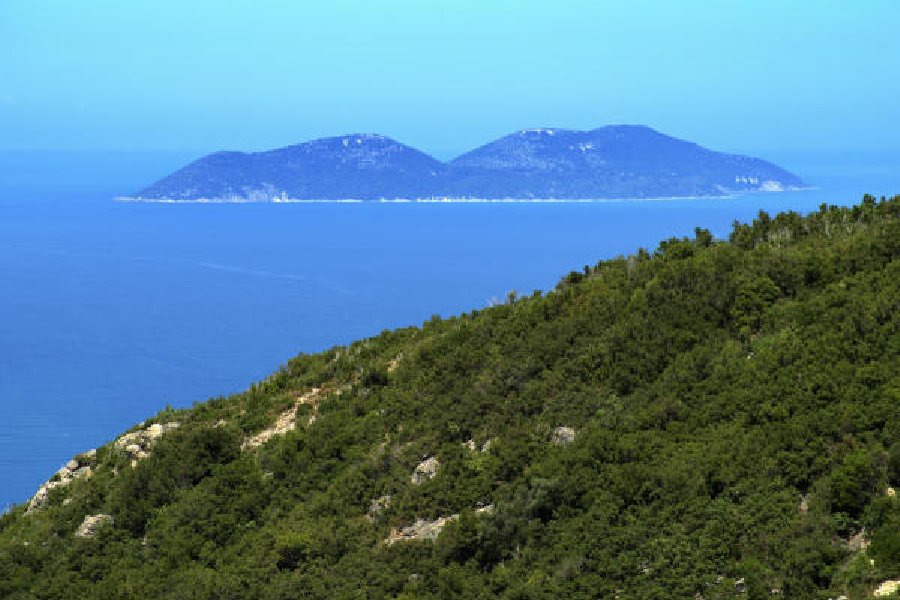
On Albania’s only island, there is no running water. A craggy former military outpost basking in the cross between the Ionian and the Adriatic seas, Sazan Island (picture) will become the site of Europe’s newest luxury destination built by Donald Trump’s son-in-law, Jared Kushner. This development worth 1.4 billion euros would transform the island into a high-end tourism complex, featuring hotels, villas and wellness facilities and further cement a relationship with the most powerful family in the Western world.
This form of celebrity diplomacy has long been part of the leadership style of the Albanian prime minister, Edi Rama. He has been personally courting Americans to boost his country’s profile. In one prominent example from last year, after dropping out of New York City’s mayoral race due to mounting federal corruption charges and unpopularity despite numerous appeals to Trump to drop the accusations, Eric Adams, the former NYC mayor, received an honorary citizenship to Albania in a characteristically odd ceremony and declared, bizarrely, “New York is the Albania of America.” Rama has also promoted Albania as a refuge for a wide range of eccentrics, from digital nomads to crypto enthusiasts to American MAGA retirees, who are eager to find a cheap and largely unregulated safe haven. Under Rama, Albania would like to capitalise on its status as a largely unregulated, undeveloped European state.
But in the past week, thousands of Albanians have taken to the streets to protest the development of Sazan Island by Kushner and his company, Affinity Partners. Protests have centred on the environmental damage that such development would cause to the island and its surrounding wetlands.
It is not only the potential environmental damage but also the lack of political transparency surrounding the project. Speaking to The Guardian, Aleksandër Trajçe, the executive director of the country’s leading conservation group, the Protection and Preservation of Natural Environment in Albania, said, “We’ve never seen anything like this in Albania’s protected regions.” “It’s not just unprecedented, there’s been a complete collapse of rule of law with no consideration of society, no environmental consideration, no contract permits, just bulldozers moving in.” Closed off for almost 50 years under the iron rule of a regime that banned travel, Albania’s rise as a destination for luxury developers, political operatives and wealthy foreigners did not happen overnight. Why has Albania, a country of fewer than three million people, become such a magnet for politically-connected investors, luxury developers and ambitious outsiders?
For decades, Albania was an anomaly. Under the communist dictatorship of Enver Hoxha, it was among the most isolated nations on Earth. Foreign visitors were rare. Private investment was non-existent. Much of the coastline was militarised or inaccessible. While neighbouring Mediterranean countries transformed themselves into tourism powerhouses, Albania remained largely untouched.
That isolation left a surprising legacy. By the time the country emerged from communism in the early 1990s, much of the development that had reshaped the rest of the Mediterranean was yet to occur in Albania. The beaches remained largely undeveloped. Property values remained low. Entire stretches of coastline looked less like Europe in the 21st century than Europe several decades earlier.
To many investors, that represented opportunity. In much of Western Europe, the era of grand coastal development projects is largely over. Environmental protections are stricter. Property rights are more established. Public opposition can derail projects for years. Albania, by contrast, offered something increasingly difficult to find: valuable land, relatively low costs, and a government eager to attract foreign capital.
Prime Minister Edi Rama has embraced that opportunity. Over more than a decade in power, he has sought to transform Albania’s image from one associated with poverty and isolation into one associated with growth, tourism and investment. Under his leadership, Tirana’s skyline has filled with new towers, international architects have been recruited for ambitious projects, and the country’s coastline has been promoted as Europe’s next great destination.
The strategy has worked, at least in part. Tourism has surged. Instagram feeds are flooded with images of wild Albanian beaches with untamed horses casually trotting along turquoise waters. International attention has followed. Publications that once paid little attention to Albania now routinely describe it as an undiscovered corner of the Mediterranean.
Yet the country’s success has produced a new debate: what kind of development does Albania want? On the one hand, Rama is courting a vision of Albania as a welcome home for those frustrated with pesky regulations. Albania’s greatest advantage is that it is an underdeveloped frontier. On the other, Albania has had long standing ambitions of joining the European Union, which is notoriously bureaucratic and regulated. The goal is not to remain a frontier but to outgrow one. Economic development is important, but not at the expense of environmental safeguards, public oversight, and rules that ensure development in public interest and without corruption.
The tension between those visions helps explain why Albania attracts such an eclectic cast of outsiders. Developers, consultants, investors and entrepreneurs are often drawn to places where transformation feels possible. Albania offers that feeling in abundance.
There is also a cultural dimension. Albania is a place where things still
feel negotiable. Bureaucracies can be frustrating, but they can also be flexible. Unlike the average Albanian citizen, well-connected foreigners can easily arrange meetings with high-level officials. Personal relationships often matter. Access to decision-makers can be surprisingly direct. To some investors, these qualities are appealing. To critics, they are symptoms of institutions that remain vulnerable to political influence.
The very characteristics attracting today’s investors are often the ones many Albanians hope to leave behind. The country’s aspiration to join the EU ultimately depends on strengthening institutions, increasing transparency, and enforcing regulations more consistently. Success, in other words, may require becoming less like the place that currently fascinates so many outsiders.
Albania is simultaneously marketing itself as Europe’s next great opportunity while attempting to build the kinds of institution that typically reduce the opportunities associated with frontiers. The battle over projects like Sazan Island is, therefore, about more than tourism or real estate. It is a debate about what comes after the frontier stage of development. Albania’s recent popularity has been fuelled in part by the perception that it remains a place of possibility where dramatic change can still occur. The question now is whether the country can preserve the benefits of that dynamism while building the rules and the institutions synonymous with a mature European democracy.
The answer will help determine not only the future of its coastline but also the future of Albania itself.
Carol Schaeffer is a journalist based in Berlin, Germany, and is a Senior Fellow at the Atlantic Council in Washington D.C.