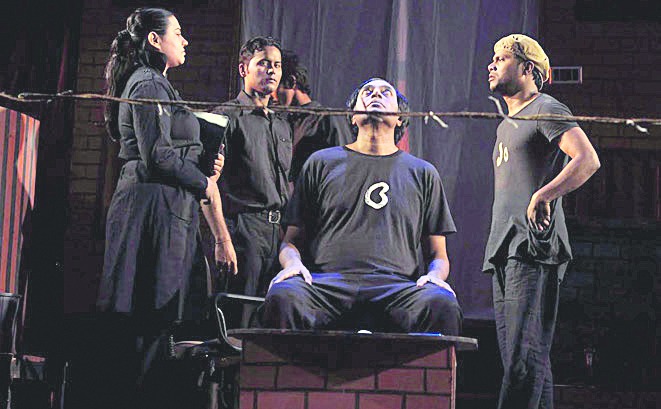

Dramatization of fiction raises several problems exemplified by two new Bengali productions. Both should garner popularity, but how closely do they manifest their mid-20th century sources?
Anya Theatre's Nati Kiranshashi, written by Ujjwal Chattopadhyay, comes from Bimal Kar's short story Pingalar Prem, about a professional heroine who toys with the starstruck affection of a talented youth cast opposite her (picture) in a village gig. In order to create a full-length drama, Chattopadhyay pads the 20-page original with promising secondary characters, but they remain undeveloped because the story itself concerns the fate of only two intertwined couples. Even among them, the final implication of an Oedipal situation renders a last-minute shock ingredient typical of melodramatic plots, hardly evocative of tragedy.
Bibhash Chakraborty, the director, makes a case for it as a tribute to the lost tradition of commercial theatre/Jatra, but the play is simply not complex enough to support such a claim. The performers do fine, though Senjuti Mukhopadhyay now must decline the parts of regal ladies seducing younger men: she has far more to offer. Shyamal Chakraborty shows variety as her partner, the owner of the company, while Pratik Dutta (her rural admirer) and Mishti Ghosh (his true love) impress.
Pratikriti's Kopai Nadir Banke occupies the other side of the spectrum. Alok Deb adapts and directs it from Tarashankar Bandyopadhyay's novel, Hansuli Banker Upakatha, one of his masterpieces. Deb had achieved previous success with Padma Nadir Majhi another riverine classic. But to compress 300 pages on stage means to sacrifice much of Tarashankar's epic sweep. In keeping the basic narrative thread, Deb has had to surrender substantial ambience and significant subplots. Also, one wonders why he changes everybody's names from the authorized ones.
He stresses the conflict between the age-old agrarian lifestyle of the Kahar community and modern progress symbolized by the British laying rail tracks. But both have positives and negatives. The Kahars believe in superstitions, but they also understand and respect elemental nature. Their rebel (Karali, called Kaluya here) becomes a foreman under the British, swayed by the lure of money, but there is nothing wrong in upward mobility, or the fact that trains brought development to the countryside. Besides, leaving aside Karali, Tarashankar presented other internal schisms among the Kahars. Deb projects utter hopelessness at the end, rather than Tarashankar's more detached historical inevitability. Among the actors, Sandip De (the headman), Saumitra Mitra (Kaluya) and Maya Ray (the matriarch) stand out, whereas the sahib sports an anachronistic red coat and clichéd red wig.