
It's fairly taken for granted now, a 100-plus years after the innovations were introduced. But collage-making and the concept of objets trouvés, ravenously co-opting into 20th-century art all kinds of images and things - everyday, outrageous, outré - would challenge accepted material and methods, and extend art language to inspire generations of practitioners. CIMA's current show, Studio Gem Revisited, on till May 6, emerges out of exactly this subversive modern tradition to look at life largely as fragmented, comical, restless, bleak. Which, like Humpty Dumpty, can never be integrated into the seamless, cogent whole of divine design ever again.
This follow-up to the Gem exposition allows a fuller articulation of the six participants. Veena Bhargava and Prasanta Sahu have set aside conventional material for junk: the former using timber and scrap metal; the latter, newspapers. Shreyasi Chatterjee foregrounds appliqué and embroidery. The gifted Sumitro Basak, no longer there, exploited acrylic and canvas or paper but his fine-tuned antennae picked out for intermixing visual scraps from the cacophonous trivia all around. Rashmi and Kingshuk Sarkar's colours are largely derived from Nature. This time they've expanded their palette by appropriating other kinds of earth products. Significantly, they are now committed to coming out of not only established practice but the cocooned atelier as well.
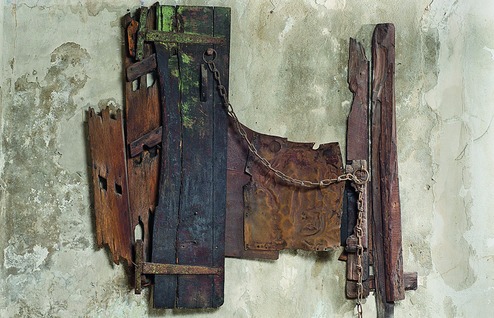
The senior-most participant, Bhargava, works with quiet intent somewhat away from the limelight but invariably engages the serious viewer with her sharp vocabulary. In the undated series presented here, she's shifted from the figurative to gaunt assemblages in wood and metal (picture) to set your imagination on fire. Weathered, rotting, pocked, veined with fine cracks, these aged planks fitted with rusted knockers and nails, chains and hinges, seem like flotsam from earlier lives, mute witnesses to tide and time, seething with tales: of Nature's fury and shipwrecks, of dungeons and drawbridges, of the inevitable disintegration of bygone ages.
From scrap wood and iron to thread and scraps of fabric. Chatterjee takes the thrifty home craft of recycled tailoring trims and stitches to the high table of art. What gives her works their piquant seduction is, firstly, her treatment of space: its quaint verticality as in Miniatures and its exhilarating vastness. The tactile patchwork of bits of cloth, the scatter of embroidered little motifs, the stretches of flat, painted colours, the brief interludes of canvas white unfold a theatre of unlinked, synchronic episodes, bewildering in their diversity, bewitching in their lively, amusing minutiae.
In choosing newspapers as the material of his installations instead of newsprint, Sahu leaves arch suggestions to mull over: how, in the Barthesian sense, the newspaper denotes an everyday object in every middle-class home but is, in fact, slyly layered with connoted messages. In the choice and display of news and photographs. What appears as facts becomes loaded with sub-texts. News itself is being treated as an object in flux, handled and manhandled daily, some item highlighted one day and buried the next. Hence, Sahu prises out lines for the viewer' conscience that his eyes may have missed. What's riveting is the way he turns newspapers into ropes to be hung from the wall - like Threads of News is, with its seven carelessly-looped tangles, one for each day of the week - or tightly woven into tapestries with horizontally-fluted surfaces. And in artfully blending colour printing with black-and-white he turns Ocean of News into a captivating naturescape.
Like R.K. Laxman's Common Man, there's usually a protagonist-observer in Basak's art: a fuddled young man in spectacles whose astonishment at the banal and the bizarre has an impish edge. Having turned himself inside out like a shirt, he's a mere shell, innards spilling polka dots as he gets wafted about helplessly. A Kafkaesque avatar in Bengal, he's often found dead. Like the multimedia professional, Rizwanur; or like the mythical Lakhindar. Life appears as something of an inexplicable circus in Basak's art, strewn in different canvases as fragments, as unambiguously hi-decibel as advertisements, as flat and garish in its stylized forms and colours as cartoons. In his last work, however, where washing flutters, uncollected, and colour is shed, his peppy levity is replaced with a stark desolation.
Deeply rooted in a partnership with Nature, Rashmi and Kingshuk use different weaves, including canvas, as the base for the smears, splatters and stains of iron rust, eucalyptus, myrobalan and even cow dung along with natural Japanese pigment. The energy and abandon of their gesture shows a rejection of human premeditation as their art becomes a humbling obeisance to the bounty of the earth.