 |
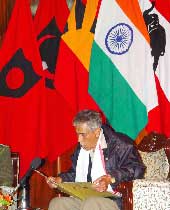
| ‘Buragohain has stated unequivocally and conclusively that he and the Ulfa have chosen the wrong path’ |
History has had some spectacular twists and turns in recent times. A person whose life symbolised rebellion against the established order and whose reported death was mourned with great regret and sadness, has resurfaced. The once perspicacious Bhimkanta Buragohain is now a revered, mellowed elder with a sublime message of peace. For a man who has given his best years in exchange for an arduous life in the jungle, for a cause he believed in, Buragohain’s message cannot be discounted as the sermon of a tired renegade. There must be some, nay a great deal of substance to what he has said and will be saying in the days to come. The people of Assam and indeed the people of India’s Northeast have arrived at a crux. What they do henceforth must be well considered.
Ever since Ulfa was baptised at the Sivasagar Rongghar in April 1979, things have never been the same. Militancy spread with ferocious speed and its model was replicated by the smaller ethnic groups of Assam, Meghalaya, Manipur, Tripura and Arunachal Pradesh. Nagaland was, of course, the indisputable leader. Development came to a standstill as investors bypassed the region for fear of not getting their returns. Of course, the prospect of extortion was as daunting as that of coming under a bullet. More than 20 years down the line, militancy has shown no visible results. All it has left is a trail of destruction and the death of innocent non-combatants. Militancy has dealt a body blow to the economy of the region, resulting in a spiralling unemployment roll.
A period of 20 years is a long enough time for any idea to gestate. If the idea has not borne fruit but only thistles and thorns, then it is time for the idea to be jettisoned and for a people or state or nation to move on. Assam, it appears, is ready to chart out a new course for itself. This was evident from the dismal response to the 48-hour bandh called by the Ulfa earlier this month. The Ulfa and National Socialist Council of Nagalim are two key players among the insurgent outfits of the region. If both are convinced that the only way out of their dilemma is a negotiated settlement based on dialogues which set no conditions, then other insurgencies in the region will have no leg to stand on.
The Bhutan operation has certainly pushed the Northeastern militants to take more realistic decisions for the future. The problem was beginning to get stuck with the same rhetoric and same theme — government asking the rebels to come overground and rebels stubbornly refusing to do so. The flushout has forced some daylight into an imbroglio that was shrouded in darkness, ambiguity and lack of transparency. One is only distressed by the appeal made by a certain human rights group in Assam to the President of India, asking that the Bhutan offensive be immediately halted. One suspects that such groups cannot but be mouthpieces of the Ulfa. While there is need for any army operation to be sensitive towards their treatment of non-combatants, particularly women and children, one cannot expect that gun-toting militants be treated with kid gloves. This would negate the very notion of justice and fair play.
Political solution
There is no denying that a political solution to the ongoing problem is a must, but the people of Assam and not just the Ulfa, must have a role and become stakeholders in the negotiations, along the lines of what has happened in Nagaland, where broad-based inter-tribal consultations in the form of the Naga Hoho preceded the talks with the Union government. Today, at least from all outward appearances, it is not just the NSCN leadership but the Naga people who are engaged in the dialogue. This must hold true of all insurgent groups. Unfortunately most of the outfits are so divorced from the genuine needs and aspirations of their people that they can no longer be considered to be representing their communities or ethnic groups.
The Hynniewtrep National Liberation Council and Achik National Volunteers Council in Meghalaya do not have a popular mandate. One wonders if the National Democratic Front of Boroland has the support of the entire Bodo population. If that were so, the recent Bodo settlement would not have received the kind of support it apparently has up to this point.
India’s Northeast has got so much bad publicity that it would have to work overtime to reverse the image largely created by the mainstream media. Recently, while on my way to Delhi at Borjhar airport, I met a doctor who had come from Delhi to attend a medical conference in Guwahati. She was so enthralled by the scenic beauty of Assam and Meghalaya where the doctors had been taken for a sightseeing tour that she, in fact, wanted to stay longer. She said, “I never expected this place to be so serene. What we read of the region is so different from reality.” I suppose there are many like her who expects to see gun-carrying militants teeming all over this place. In the course of my conversation with the medico, I also learnt that many of her colleagues had cancelled their trip at the last moment because of the anti-Bihari conflict, which received extensive media coverage. The cancellations were mainly of doctors from Bihar.
The Northeast has been somewhat estranged from the rest of India partly because the discourse has always focused on the rest versus the Northeast. Sometimes one fails to understand why the region struggles to feel accepted. Or why there is this feeling of being treated as the deformed stepchild of the nation. This feeling of self-pity has gone on for too long.
Insurgencies have developed along this theme with no visible outcome. Time has come to move on to better things. Today there are several civil society groups that are able to project the needs of the region better than say the collective forum of the Members of Parliament from the region. The MPs incidentally are too fragmented along party lines to be able to make a dent in national politics. Meaningful dialogues with the Union government are important. So is the strengthening of department for Development of Northeastern Region (Doner) which must have someone from the region to head it if it is to have any impact.
Economic link
It is an undisputed fact that the Northeast is poised to become a major transactional point once the golden quadrilateral project becomes a reality. Northeast India can become the crucial linkage in the synthesis emerging between the south Asian and southeast Asian economies. If insurgencies are allowed to remain on the boil, the region could become a deterrent to these long-term goals of neighbouring nations. If such be the case, the Northeast would get a short shrift and become a mere over-bridge through which the economic transactions of progressive nations would be carried out while those under the bridge remain even more deprived and slummy.
The likes of Paresh Barua and Arabinda Rajkhowa, who enjoy safe haven in a neighbouring country, must surely be intellectual enough to read the signs of the times. Is it their agenda to see Assam relegated to a position of total insignificance in world affairs? And along with Assam the entire region? Isak Swu and Thuingaleng Muivah, too, should reflect on these new and significant developments. So must the leaders of the smaller, less potent rebel groups in the region. This is a make-or- break situation for the Northeast. We must come out of the sulking mode, end the blame game and get on with life.
Buragohain has stated unequivocally and conclusively that he and the Ulfa have chosen the wrong path. In short, he has set up one building block for peace. Can there be a better opportunity to take the peace agenda forward?