 |
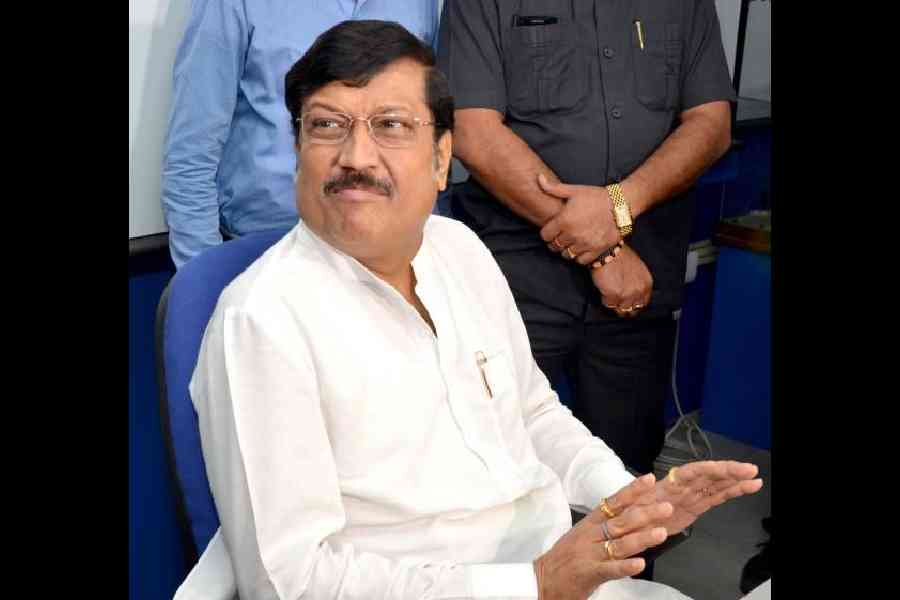
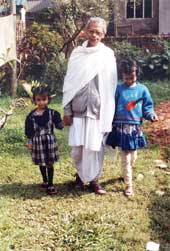
| Nalinidhar Bhattacharyya with his grandchildren. Picture by S.H. Patgiri |
The octogenarian poet is perfection personified in
whatever he does, says Monideepa Choudhuri
For Nalinidhar Bhattacharyya, there are no full stops, only newer nuances — of truth, beauty, equality, friendship and human compassion. Thus, even at the ripe old age of 82, the poet and literary critic continues to pen thoughts that come straight from the heart: of matters, which he says, are “imbibed into the depths of consciousness from everyday life”.
It was in the fitness of things, therefore, that this indefatigable writer was recently conferred the Sahitya Akademi award for his book Mahat Aitijya, a compilation of critical essays on literature.
Bhattacharyya, however, says “the pleasure would have been greater” had he received it for Noni Asene Ghorot, a collection of poems.
Winner of several laurels — the Soviet Land Nehru award in 1983 for Dui Purush (a translation of the Russian novel Fathers and Sons), the Bharatiya Bhasa Parishad award for Kobitar Kotha, the Asam Sahitya Sabha-instituted Chaganlal Jain award for Noni Asene Ghorot and the Mrinalini Devi award in 1999 — Bhattacharyya is one of the few modern Assamese poets to have excelled in literary criticism when it was still an evolving genre.
Bhattacharyya began his pursuit of literature way back in 1942, when he was a teenager.
He began writing for the literary journal Abahan, inspired by what he says were “the three constant inspiring forces” of his life — Ananda Chandra Barooah, who lived near his family home in Jorhat, Hem Barua, his teacher and the first Jnanpith winner from Assam, and Birendranath Bhattacharyya, his brother.
“They were, and still are, my muses — rousing my creativity and sparking a talent whose existence I initially doubted,” he says.
The poet with a “progressive perspective” began writing around the time when the Romantic Age was on the wane and a nebulous social consciousness was taking shape.
Sensitive to the milieu of the period, which was a period of upheaval, he felt persuaded to move away from the modern school of thought to pen his feelings about social sensibilities.
“The freedom movement had been a beacon of hope for many of us, a path that we thought would finally lead to the end of all kinds of disparities among Indians. After all, we witnessed colonial misrule and the horrifying dehumanising of people. I, especially, used to be moved by the plight of the tea garden labourers, whose pitiable lives I saw from up close. But when no light was visible at the end of the tunnel, there was turmoil in my mind. My pen then became a weapon of protest,” recalls the poet, regarded as one of the leading lights of the progressive literary movement in Assam.
Much of Bhattacharyya’s oeuvre reflects his understanding of the lives of ordinary people.
In fact, it is his skill in weaving a personal passion into socially relevant issues that has established his position as a poet of eminence.
“Poetry stems from mon jontrona, a turmoil in the mind. It can, I strongly believe, impel an individual to become a better human being since creativity itself has a soul and a dharma that inspires,” he says.
“I have also tried to develop and protect this dharma throughout my literary career.” Though a firm believer in Marxist philosophy, Bhattacharyya is no revolutionary.
He candidly admits that philosophies are largely idealistic and change towards a better world can come about only when man recognises the “compassionate” aspect of his soul. “No philosophy has yet been able to change society, not even the Gandhian, which is apparently flawless. Only strong human character can trigger a social revolution,” he says.
Born on December 4, 1921 at Melenghat village near Jorhat, Bhattacharyya passed out from Kakajan High School in 1940.
Two years later, after passing the intermediate examination from J.B. College, he joined Kakajan Government High School as a teacher, where he worked till 1960.
Bhattacharyya completed his graduation and post-graduation in Assamese literature as a private candidate. In 1963, after a brief stint as lecturer at Shillong’s St. Edmund’s College, he joined Arya Vidyapith College in Guwahati as a lecturer, from where he retired in 1983.
“Guwahati opened new literary vistas for me. I became part of a circle where discussions abounded on the many facets of life and literature. This honed my creativity and gave me a platform for expression of my feelings,” he says.
It was while he was teaching at Arya Vidyapith College that Bhattacharyya developed his analytical and critical skills.
Bhattacharyya has published several poetry collections, critical essays and translations (“prompted by my brother Biren”) of Russian works such as Dr Zhivago and Fathers and Sons.
His collection of verses include Ei Kuwolit, Cherasalir Malita, Aahot Sopun and Noni Asene Ghorot, while Mool Aru Phool, Bezbaruah Aru Adhunik Dharana, Kabita Aru Naipathya are acclaimed critical appraisals.
A poet and critic — where do the two meet?
Literature should be critical, he affirms, “even while when one pours out his thoughts and feelings in poetry”. Bhattacharyya is true to his works — simple, frank and free of frills.
His observations are analytical, sharp and genuine in their content. Having traversed through the turbulence of “realism”, while at the same time believing in an ideal disparity-free world, Bhattacharyya’s soul has yet not lost the innocence that had been nurtured in Assam’s rural ambience.