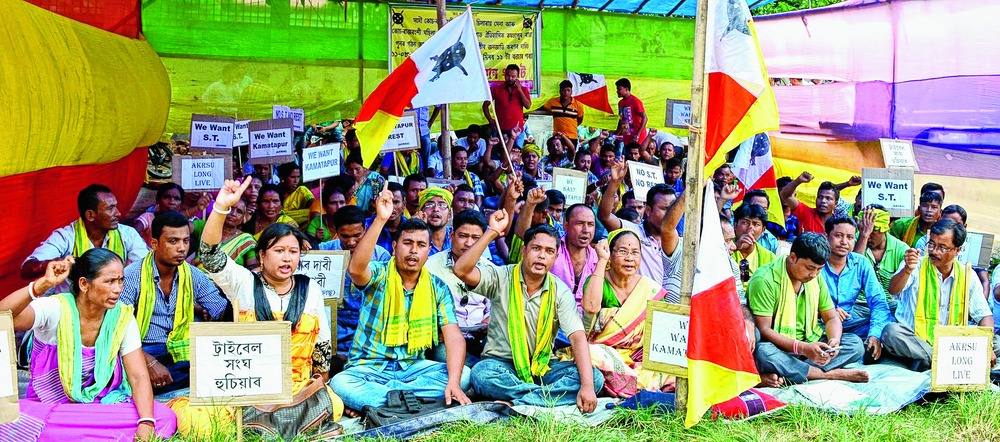

Bongaigaon, Aug. 23: Koch-Rajbongshi organisations today criticised the Coordination Committee of Tribal Organisations' decision to oppose the move to grant Scheduled Tribe (ST) status to six communities of the state.
The committee, in a convention held in Guwahati yesterday, decided to approach the Supreme Court and launch a movement to stop the Centre from granting ST status to Koch Rajbongshis, Tai Ahoms, Chutias, Morans, Muttocks and tea tribes. These six communities have been demanding ST status for decades.
The convention, attended by leaders of all existing ST communities, was led by leaders from the Bodo community.
"The Koch-Rajbongshi community treats the Bodos as its brother and has never opposed their due rights. But some groups of the community have been opposing ST status for six communities, including Koch-Rajbongshis. This is unfortunate," said Bimal Kumar Barman, the president of Koch-Rajbongshi Jatiya Mahasabha.
"The latest decision of the tribal groups has hurt our sentiments. Given their aggression against our constitutional safeguard, we are compelled to accept their bellicosity and challenge. We will now reshape our agitation in support of our demand for Kamatapur and ST status," Barman said.
The Pradip Ray faction of the All Koch-Rajbongshi Students' Union (AKRSU) has called a 24-hour strike in the state on August 29 in protest against the committee's stand.
"The provisions of the Sixth Schedule of the Constitution, which are applicable for hill tribes, were changed to create a territorial council for the Bodos, a plains tribe. Then what is wrong if the government changes the modalities to grant ST status to the six communities?" Ray questioned.
Hitting out at the section of Bodo leaders opposed to ST status for the six communities, he said since it is illegal to include non-tribal dominated villages in the Bodoland Territorial Areas District, his group would now intensify the movement for exclusion of these villages from the BTAD.
The Hiteswar Barman faction of AKRSU said other tribal groups had no right to oppose their demand for ST status.
"Tribal groups have no right to oppose our ST demand. We have sought constitutional safeguards for our community from the government. It is our right and we are ready to face every challenge for it," said Troilokyo Ray, general secretary of the group.
The Centre is expected to make the modalities for granting ST status to the six communities public by September 22.
The Koch-Rajbongshi is the largest indigenous community of the state with a population of around 80 lakh. The community was accorded ST status in 1996 through an ordinance issued by then President Shankar Dayal Sarma. But the ordinance was later withdrawn.
The demand for ST status by the community was first raised by some intellectuals under the leadership of late Ambika Charan Choudhury of undivided Goalpara district in 1968.