 |
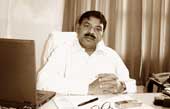
| Banking on health care: Sayeed Ahmed Ansari, director, ARAM-Apollo Hospital, at his office in Ranchi. Picture by Prashant Mitra |
The father, the late Hazi Abdur Razzaque Ansari, a former Congress minister in erstwhile Bihar, dreamt of building a small hospital with 20 to 25 beds. The eldest son, Sayeed Ahmed Ansari, a banker, decided to give a grander shape to his father?s dream, who died shortly after initiating the work for the hospital. ?We decided to fulfil his last dream,? says Sayeed. Meaning, leaving the cushy bank job in Calcutta and settling down in Ranchi. That decision today stands in the shape of ARAM-Apollo Hospital, Irba ? where ARAM stands for Abdur Razzaque Ansari Memorial ? which started on April 7, 1996, with a sarva dharma puja and prayer, a fitting tribute for late Ansari, who hated firka parasti communalism.
To fulfil his father?s dream, Sayeed left the bank?s job of 24 years and took up the assignment of director (projects). He attended courses and workshops on hospital management from organisations like Kaiser Permanente, a health care provider in San Fransisco. He visited nine countries to attend international workshops on hospital administration.
Sayeed talks to Arun Kumar Thakur about the aspects of running a super-speciality hospital, which has emerged as a centre of excellence in this part of the country.
lHow did you come to choose Apollo Hospitals group for fulfilling your father?s dream project for weavers?
My father was a patient of Dr Pratap Reddy. We had gone to Apollo, Chennai, for my father?s treatment with a letter of introduction from Dr P.D. Sinha. When we met Dr Reddy, my father was very impressed. That was when he thought of a 20-25-bed hospital. In 1987 he said we should meet him to discuss the details of our hospital.
lWhat was the next step?
Then my father organised a board meeting and got Rs 22 lakh sanctioned for the hospital. He also met the then governor and requested him to lay the foundation stone on August 14. But on March 13, 1992, my father developed heart problems and was admitted in HEC hospital, where he died. We decided to fulfil his last ambition.
lBut it is a big hospital. How did the number of beds increase?
Dr P.D. Sinha and I went to Chennai and met Dr Reddy with a proposal for a 50-bed hospital. He suggested 70 beds, for financial viability. It was agreed that Rs 17 lakh would be paid for consultancy and management and Rs 25,000 per month for running the hospital. We wanted it to run as the Apollo in Chennai is run, hence we left everything in their hands. Rs 3.43 crore was the project outlay in 1993. We got M/s C.P. Kukreja Associates from Delhi as consultants because they had done other Apollo projects.
lHow did you arrange the finance for such a huge project?
We received a Rs 1.5-crore non-refundable grant from the Centre and the rest we arranged through loans from the weavers? co-operative and banks.
lWhat were the initial days of the hospital like?
In 1996 we started with 55 beds and treated only 3,628 patients. In 10 years the number of bed has gone up to 142, and now we are treating on an average 28,419 patients. There was a time when per day collection was as meagre as Rs 2,500 a day in 1996. Now it is around Rs 8 lakh per day.
lThat?s good progress. What did it lead to?
Yes, every year we see growth. It has been so impressive that we decided to install a cath lab and a cardiothorasic unit in April 2000. After a slow and steady growth today we are doing around 24 to 30 cardiac surgeries and 35 angioplasty a month. That is why we have installed, on April 7 this year, another cath lab. This is supposed to be the world?s best cath lab, and our unit was the fourth to be installed in the world. Thus, equipment-wise, this is the best in eastern part of the country.
lWhat super speciality facilities does your hospital offer?
Besides the two cath labs, we also have all super-speciality facilities, nephrology, plastic surgery, neurology and neurosciences, gastroentrology, and critical care management. We have also started knee and joint replacement in laminar flow operation theatre.
lAnd the future plans?
We are all set to begin kidney transplant operations, we are only waiting for the state government?s decision on kidney transplant.
lWhat kind of problems and pressures do you face in running such a huge hospital?
Occasionally there are political interferences. When it is for a good cause it is all right. But sometimes they insist on waivers of even material costs, which puts the hospital in a dilemma because the hospital has already paid for the materials used on the patient concerned. In many cases we waive off room rent, investigation charges and doctors? fees, but material cost cannot be waived. We have provided free treatment worth Rs 70 lakh or so in the last financial year, that is that amount could not be recovered. We hope this does not become a permanent feature.
lAny other problem?
Power is a big problem. Everyday, for six to eight hours, we have to use gen sets as all life-saving gadgets work for 24 hours and we cannot afford to go without power. Two gen sets work together to take the load, thus a huge amount is spent on diesel for running those gen sets. This amount could easily have been used for expansion purposes.
lFinally, the secret behind the success of the hospital?
Our growth has been consistent because there is cohesiveness among medical fraternity, and our aim is to make a difference. We arrange for regular training to our people and each and every person is made to feel valued. We have also introduced post-discharge communication system and I have talked to more than 3,800 patients so far.
This gives us valuable feedback and helps us in improving our services.