A friend recently dug up an old autograph book that used to be all the rage in junior school, and pointed out that I’d mentioned wanting to be a vet when I was all grown up. Evidently, I hadn’t realised at age eight that that meant having to study science, not to mention maths. It was obviously an ambition I hastily abandoned. But it hadn’t yet occurred to me that I might be a writer, even though Belinda’s Dressing Table had been pencilled into some lined sheets of paper and I’d already started plotting the activities of Wag the Spaniel.

the t2 girl. (Rashbehari Das)
I don’t remember a time when I wasn’t writing something or the other, some in half-seriousness, others in complete jest. By the time I was in college, I knew I’d like to have an anthology of shorts published but I hadn’t the foggiest how to go about it. There is no manual that tells young writers how to get their work published and often the right way is simply the wrong way.

I found myself in a publishing house of some renown after I was done with a Master’s in English. Like many English graduates, I’d concluded that if one loved to read, one belonged in the editorial department of a publishing house. My limited experience of the industry schooled me for the hard battle it is to be a writer these days.
Yes, my mother and her friends are bouncing-off-the-walls excited about my foray into the world of published authors. It’s because they’ve grown up believing that to be published one must possess oodles of talent and that once published, it is only a matter of time before one achieves Austenesque fame.
In reality, writers these days are a dime a dozen and most sink without a trace. Publishers are battling to achieve the perfect balance between literary and mass-market, which is easier said than done. Personally, my heart lies in short stories, but I’m told no one else seems to care for it.

The Saturday Club. (B. Halder)
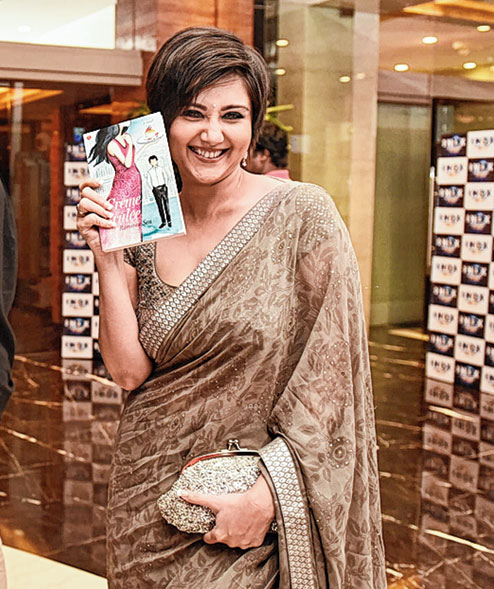
Before Creme Brulee looked anything like a novel, it was a little bit of satire dashed off without much thought, that a senior journalist friend printed on his blog. His literary agent swooped on it and in no time at all the premise of it turned into a novel.

Here’s a nibble from the blog: ‘The Honourable Atindra Mukherjee is adjusting his crested tie in the mirror when his butler interrupts him with a discreet cough.
“A phone call for you, sir. Mrs. Chatterjee wants to know if you’re free for lunch.”
As it turns out, the Hon. A. Mukherjee is not free. He has promised a young woman lunch at the club. Salmon (for him) and steak (for her). He informs Mrs. Chatterjee that he will meet her for tea (Earl Grey, accompanied by delicious little teacakes) in the Verandah at 4 o’clock. There, with their silver tea-cups, they can frown disapprovingly at the leggy young girls milling around the young men in tennis gear — What is the world coming to these days? It is raining and the Hon. Mukherjee frowns, for he knows that this means that the raucous garden lunchers will pour into the dining room (without dinner jackets, the horror!) and destroy the peace of his Sunday salmon. The guard raises his cap as the car rolls in through the large iron gates. The Hon. A. Mukherjee hopes that the young woman will not be late. He dislikes tardiness.
In another second he realises that she is not indeed late. She is standing on the steps in yellow polka-dotted wellingtons. The Hon. Mukherjee blanches. He orders the car to be turned around and calls his manservant to let him know that he is to inform Mrs. Chatterjee that he is free for lunch after all. At a different club, however. A club that does not allow yellow polka-dotted wellingtons to adorn its portico.’
In reality, the Calcutta I had lampooned in the blogpost and have continued to take a dig at in my novel is a Calcutta very dear to me, a Calcutta I had missed very much while living in dusty Noida. My protagonist — Aabir — is young but far older than his years, distinctly uncool, has a million idiosyncrasies, but he’s adorable. Far more likeable than his older predecessor who appeared in the blog and left a young girl, hopeful of lunch, stranded on the portico, because he disapproved of her footwear.
In his defence, as the owner of said wellingtons, I have been threatened by friends far younger and apparently cooler than the Hon. A. Mukherjee, that I leave them behind in the rain or go without lunch.
You see, Calcutta is where stuffy becomes cool, which explains why dining-room dress codes are grumblingly adhered to. Besides, Calcutta likes the good life. If Creme Brulee seems old-fashioned, it’s because time hasn’t moved at the frenetic pace in Calcutta as it has in the other cities. The city likes its afternoon nap and evening cuppa, its lazy mornings and not-so-late nights. Ambition and efficiency may not be our forte, and as exasperating as that can be, the abundance of good eating is what serves as compensation.

I’ve taken a moment to introspect on whether this is just my insatiable need for good food talking, but I’ve made a pointed note of the fact that where there is dessert, there is joy. While this might be universal, a Calcuttan is likely to walk that extra mile for a rosogolla (gurer, obviously), or if you’ve suddenly developed a taste for French dessert, a portion of creme brulee.