
New Delhi, Sept. 22: The government has picked three economists from the academic world for the new monetary policy committee (MPC), who along with the RBI nominees will set the benchmark interest rates to contain retail inflation within the targeted 4 per cent, paving the way for a major shift in the way the central bank decides its policy.
While a senior finance ministry official said the government would maintain an arm's length from the panel, the new mechanism will mark a significant departure from the current system of the RBI governor having powers to take a final call on the rates, irrespective of the advice from the existing technical advisory committee.
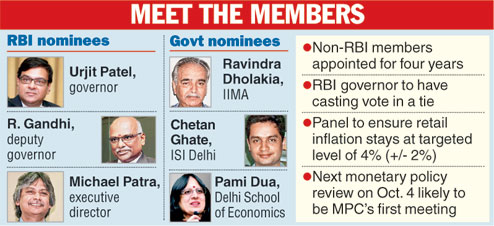
RBI governor Urjit Patel will head the six-member MPC and also have a casting vote in case of a tie in the new system.
The non-RBI members named today are Chetan Ghate, a professor at the Indian Statistical Institute, Delhi; Pami Dua, a director at the Delhi School of Economics; and Ravindra Dholakia, a professor at the Indian Institute of Management in Ahmedabad.
Besides Patel, RBI deputy governor R. Gandhi, who is in charge of the monetary policy, and executive director Michael Patra are the other RBI nominees.
The three experts have been appointed for a period of four years "or until further orders, whichever is earlier", a government notice said.
The statement did not specify whether the panel would set rates on October 4, the next scheduled RBI policy review, and the first to be held under Patel.
Analysts, however, expected the upcoming review to be the MPC's maiden meeting. "Choosing the monetary policy committee members ahead of the October policy means the rate decision will be taken collectively which will ensure transparency and independence in policymaking," said Soumya Kanti Ghosh, chief economist at the State Bank of India.
The MPC has been set up by amending the Reserve Bank of India Act, 1934, through the Finance Act 2016.
The committee will be responsible for containing retail inflation at the targeted level of 4 per cent (plus/minus 2 per cent). In fact, it has set itself a target of 5 per cent by next March as part of a "glide path" to achieving the median mark.
The shift to targeting inflation and collective decision making was pushed through by previous governor Raghuram Rajan and his then-deputy Patel in one of the biggest changes at the RBI.
Some details are yet to be revealed, including whether the panel would weigh in on other central bank decisions such as managing the exchange rate or liquidity in the financial system.
The three members appointed by the government are career academics.
Ghate is probably the most familiar to the RBI as he sits on a five-member technical advisory committee that provides advice on interest rates ahead of each policy review.
Dholakia has worked with Modi when the Prime Minister was the chief minister of Gujarat, being part of committees covering financial matters.